
UNITED STATES
SECURITIES AND EXCHANGE COMMISSION
Washington, D.C. 20549
FORM 10-K
(Mark One)
| ANNUAL REPORT PURSUANT TO SECTION 13 OR 15(d) OF THE SECURITIES EXCHANGE ACT OF 1934 | |||||
For the fiscal year ended December 28 , 2025
OR
TRANSITION REPORT PURSUANT TO SECTION 13 OR 15(d) OF THE SECURITIES EXCHANGE ACT OF 1934 | |||||
Commission file number 001-040866

(Exact name of registrant as specified in its charter)
| (State or other jurisdiction of incorporation or organization) | (I.R.S. Employer Identification No.) | |||||||
| (Address of Principal Executive Offices) (Zip Code) | ||||||||
(941 ) 907-9800
Registrant’s telephone number, including area code
Securities registered pursuant to Section 12(b) of the Act:
| Title of each class | Trading Symbol(s) | Name of each exchange on which registered | ||||||
(Nasdaq Global Select Market) | ||||||||
Securities registered pursuant to Section 12(g) of the Act: None
Indicate by check mark if the registrant is a well-known seasoned issuer, as defined in Rule 405 of the Securities Act. Yes ☒ No ☐
Indicate by check mark if the registrant is not required to file reports pursuant to Section 13 or Section 15(d) of the Act. Yes ☐ No ☒
Indicate by check mark whether the registrant: (1) has filed all reports required to be filed by Section 13 or 15(d) of the Securities Exchange Act of 1934 during the preceding 12 months (or for such shorter period that the registrant was required to file such reports); and (2) has been subject to such filing requirements for the past 90 days. Yes ☒ No ☐
Indicate by check mark whether the registrant has submitted electronically every Interactive Data File required to be submitted pursuant to Rule 405 of Regulation S-T (§232.405 of this chapter) during the preceding 12 months (or for such shorter period that the registrant was required to submit such files). Yes ☒ No ☐
Indicate by check mark whether the registrant is a large accelerated filer, an accelerated filer, a non-accelerated filer, a smaller reporting company or an emerging growth company. See the definitions of “large accelerated filer,” “accelerated filer”, “smaller reporting company” and “emerging growth company” in Rule 12b-2 of the Exchange Act.
| ☒ | Accelerated filer | ☐ | Non-accelerated filer | ☐ | Smaller reporting company | Emerging growth company | |||||||||||||||||||||||
If an emerging growth company, indicate by check mark if the registrant has elected not to use the extended transition period for complying with any new or revised financial accounting standards provided pursuant to Section 13(a) of the Exchange Act. ☐
Indicate by check mark whether the registrant has filed a report on and attestation to its management’s assessment of the effectiveness of its internal control over financial reporting under Section 404(b) of the Sarbanes-Oxley Act (15 U.S.C. 7262(b)) by the registered public accounting firm that prepared or issued its audit report ☒
If securities are registered pursuant to Section 12(b) of the Act, indicate by check mark whether the financial statements of the registrant included in the filing reflect the correction of an error to previously issued financial statements. ☐
Indicate by check mark whether any of those error corrections are restatements that required a recovery analysis of incentive-based compensation received by any of the registrant’s executive officers during the relevant recovery period pursuant to §240.10D-1(b). ☐
Indicate by check mark whether the registrant is a shell company (as defined in Rule 12b-2 of the Act). Yes ☐ No ☒
The aggregate market value of common stock held by non-affiliates (based on the closing price on the last business day of the registrant’s most recently completed second fiscal quarter as reported on the Nasdaq Stock Market) was approximately $733.4 million.
As of February 20, 2026, 61,138,143 shares of common stock of the registrant were outstanding.
DOCUMENTS INCORPORATED BY REFERENCE
TABLE OF CONTENTS
| Page | |||||||||||
2
CAUTIONARY NOTE REGARDING FORWARD-LOOKING STATEMENTS
This Annual Report on Form 10-K (the “Annual Report on Form 10-K”) contains forward-looking statements within the meaning of the Private Securities Litigation Reform Act of 1995, which are subject to known and unknown risks, uncertainties and other important factors that may cause actual results to be materially different from the statements made herein. All statements other than statements of historical fact are forward-looking statements. Forward-looking statements can be identified by words such as “aim,” “anticipate,” “believe,” “estimate,” “expect,” “forecast,” “future,” “intend,” “outlook,” “potential,” “project,” “projection,” “plan,” “seek,” “may,” “could,” “would,” “will,” “should,” “can,” “can have,” “likely,” the negatives thereof and other similar expressions. Examples of forward-looking statements include, but are not limited to, statements we make regarding the outlook for our future business and financial performance and statements discussing our current expectations and projections relating to our financial position, results of operations, plans, objectives, future performance and business, such as those contained in the section titled “Management’s Discussion and Analysis of Financial Condition and Results of Operations.” Forward-looking statements are based on our current expectations and assumptions regarding our business, the economy and other future conditions. Because forward-looking statements relate to the future, by their nature, they are subject to inherent uncertainties, risks and changes in circumstances that are difficult to predict. As a result, our actual results may differ materially from those contemplated by the forward-looking statements. Important factors that could cause actual results to differ materially from those in the forward-looking statements include:
•our vulnerability to changes in consumer preferences and economic conditions such as inflation and recession;
•our inability to successfully open new restaurants or establish new markets;
•our inability to effectively manage our growth;
•potential negative impacts on sales at our and our franchisees’ restaurants as a result of our opening new restaurants in existing markets;
•a decline in visitors to any of the retail centers, lifestyle centers, or entertainment centers where our restaurants are located;
•lower than expected same-restaurant sales growth;
•unsuccessful marketing programs and limited time new offerings;
•changes in the cost of food;
•unprofitability or closure of new restaurants or lower than previously experienced performance in existing restaurants;
•our inability to compete effectively for customers;
•our vulnerability to food safety and food-borne illness concerns;
•unsuccessful financial performance of our franchisees, our limited control over our franchisees’ operations, our inability to maintain good relationships with our franchisees and conflicts of interest with our franchisees;
•the geographic concentration of our system-wide restaurant base in the southeast portion of the United States;
•damage to our reputation and negative publicity;
•our inability or failure to recognize, respond to and effectively manage the accelerated impact of social media and artificial intelligence;
•our limited number of suppliers and distributors for several of our frequently used ingredients and shortages or disruptions in the supply or delivery of such ingredients;
•information technology system failures or breaches of our network security;
•our failure to comply with federal and state laws and regulations relating to privacy, data protection, advertising and consumer protection, or the expansion of current or the enactment of new laws or regulations relating to privacy, data protection, advertising and consumer protection;
•our potential liability with our gift cards under the property laws of some states;
•our failure to enforce and maintain our trademarks and protect our other intellectual property;
•litigation with respect to intellectual property assets;
•our dependence on our executive officers and certain other key employees;
•our inability to identify, hire, train and retain qualified individuals for our workforce;
•our failure to obtain or to properly verify the employment eligibility of our employees;
•our failure to maintain our corporate culture as we grow;
•unionization activities among our employees;
•employment and labor law proceedings;
•labor shortages or increased labor costs or health care costs;
•risks associated with leasing property subject to long-term and non-cancelable leases;
•risks related to our sale of alcoholic beverages;
•costly and complex compliance with federal, state and local laws, including trade and tax policies;
•changes in accounting principles applicable to us;
•our vulnerability to natural disasters, unusual weather conditions, pandemic outbreaks, political events, war and terrorism;
3
•our inability to secure additional capital to support business growth; our level of indebtedness;
•failure to comply with covenants under our credit facility; and
•uncertainty regarding the Russia and Ukraine war, war and unrest in the Middle East and the related impact on macroeconomic conditions, including inflation, as a result of such conflicts or other related events.
See Item 1A. “Risk Factors” for a further description of these and other factors. For the reasons described above, we caution you against relying on any forward-looking statements, which should also be read in conjunction with the other cautionary statements that are included elsewhere in this Annual Report on Form 10-K and in our other filings with the Securities and Exchange Commission (the “SEC”). Any forward-looking statement made by us in this Annual Report on Form 10-K speaks only as of the date hereof and is expressly qualified in its entirety by these cautionary statements. Factors or events that could cause our actual results to differ may emerge from time to time, and it is not possible for us to predict all of them. We undertake no obligation to publicly update or revise any forward-looking statement, whether as a result of new information, future developments or otherwise, except as may be required by law.
4
PART I
Item 1. Business
First Watch Restaurant Group, Inc. is a Delaware holding company. Unless the context otherwise requires, “we,” “us,” “our,” “First Watch,” the “Company,” “Management” and other similar references refer to First Watch Restaurant Group, Inc. and, unless otherwise stated, all of its subsidiaries.
Overview
Since opening our doors in 1983, we have been a pioneer in Daytime Dining, serving made-to-order breakfast, brunch and lunch using the freshest of ingredients. We have built our brand on our commitment to operational excellence, our culinary mission centered around a fresh, continuously evolving menu, and our “You First” culture. Our focus on one daytime shift enables us to optimize restaurant operations while generating an average unit volume of $2.3 million per restaurant in 2025 in only 7.5 hours per day. This daytime focus also provides us with a competitive advantage, allowing us to attract and retain employees who are passionate about hospitality and drawn to our “No Night Shifts Ever” approach, among other attractive benefits.
As of December 28, 2025, we had a total of 633 restaurants across 32 states, 560 of which were company-owned and 73 of which were franchise-owned.
We “Follow the Sun”
Every morning, thousands of our employees arrive at the crack of dawn to slice and juice fresh fruits and vegetables, bake muffins, brew our fresh coffee and whip up our French Toast batter from scratch. Every menu item is made-to-order and prepared with care. We do not use microwave ovens, heat lamps or deep fryers in our kitchens. At First Watch, we are driven by a pursuit of freshness as is highlighted by our culinary and sourcing philosophy to “Follow the Sun.” With this philosophy, our menu, which is inspired by the seasons, changes four to five times per year. Our rotating seasonal menu is commonly cited by our customers as a core element of the First Watch experience and has included favorites such as the Parmesan and Prosciutto Toast, Chimichurri Steak and Eggs Hash, and the Brooklyn Breakfast Sandwich.
These seasonal items are offered alongside our award-winning chef-driven menu that includes elevated executions of classic favorites for breakfast, brunch and lunch, such as our protein-packed Breakfast Quinoa Bowl, Chickichanga and Avocado Toast. Our menu also features fresh juices, that we juice each morning, including Morning Meditation and Kale Tonic.
Our Culture: You First
For over four decades, we have cultivated an organizational culture built on our foundational concept of “You First,” which puts serving others above all else. As a company, we put our employees first and empower them to do whatever it takes to put our customers first. As evidenced by our vision to “Create Amazing Opportunities for Our People,” we also work hard to provide our employees with opportunities for advancement and meaningful relationships, and we prioritize personal and professional growth so that our people can thrive. We believe our approach and operating model have enabled us to retain and attract the best and brightest employees in the industry and are key factors in our ability to meet our growing demand across the country. As a result, we are proud of the many people-focused awards and accolades we have received over the past few decades. For four consecutive years, First Watch has been named a Top 100 Most Loved Workplace® by the Best Practice Institute, and in 2025, was named the #1 Most Loved Workplace for the second year in a row, as featured in The Wall Street Journal. Also, in 2025, First Watch was named one of Yelp’s Most Loved Brands nationwide.
5
We also extend our You First culture by giving back to important organizations and causes that are meaningful to our people and our communities. In addition to various local philanthropic efforts in the communities we serve, First Watch focuses its giving through key efforts designed to create positive impact both externally and within our organization:
•Project Sunrise: Through this initiative, we source our coffee beans from women-owned farms in Colombia, and we pay an annual quality incentive bonus to farmers to further support their high-quality production. This program in turn empowers these women leaders to reinvest in their communities.
•Pediatric Cancer Research: We donate a portion of the proceeds from each sale of a First Watch kid’s meal to the V Foundation in order to support and advance pediatric cancer research. As of December 28, 2025, we have donated approximately $2.0 million toward this important effort.
•The You First Fund: Established in 2020, the You First Fund provides grants to eligible team members experiencing personal hardship related to qualifying disasters. The fund is intended to support employees and their immediate families during their times of most significant need and is funded through a portion of the proceeds from each kid’s meal sale, along with contributions from the Company, our employees and others. Since its inception, this fund has provided our employees with over $1.1 million in hardship grants.
Growth Strategies
New Restaurant Openings
We believe First Watch has the potential for more than 2,200 restaurants in the continental United States. In 2021, First Watch was recognized by FSR Magazine as the fastest-growing full-service restaurant company in the United States based on unit growth. In 2025, we continued to realize that potential by opening 64 new company-owned and franchise-owned restaurants, which we collectively refer to as “system-wide” restaurants, across 23 states. Our growth strategy contemplates increasing the annual number of new system-wide restaurant openings.
In selecting new locations, we evaluate specific market characteristics, demographics, traffic patterns, co-tenants and growth potential. Our development approach has proven that First Watch has tremendous portability across markets, with new restaurants boasting a consistent and strong average unit volume across all geographies. First Watch’s top 10% of restaurants in terms of sales, span 13 states and 24 designated market areas. The average annual sales volumes of our new restaurants outpace the system average, and we expect to sustain the performance through quality real estate selection and the introduction of features and operational practices designed to efficiently serve more demand.
Acquisitions of Franchise-Owned Restaurants
Our long-term growth strategy includes the acquisition of First Watch restaurants operated by certain of our franchisees. To that end, during 2025, we acquired 19 operating restaurants along with development and territory rights in two separate transactions. We believe the Company’s operation of the restaurants acquired from our franchisees as well as development in the reacquired territory, provides substantial opportunity to realize new Company value. At December 28, 2025, we had 9 franchisees operating 73 restaurants with 17 total new restaurant development obligations. At December 28, 2025, 12 franchise-owned restaurants are subject to our option to purchase.
Drive Restaurant Traffic and Build Sales
Our return on invested capital reflects our disciplined focus on building sales and traffic through the core elements of the First Watch experience - serving high-quality food, delivering memorable service, and providing an inviting atmosphere.
•Delivering an Excellent On-Premise Dining Experience. Excellence in restaurant-level execution, recognized by customers and reinforced by the many accolades we have received, increases the visit frequency of our customers, promotes trial by new consumers and ultimately encourages loyalty. Our single menu, throughout the day, streamlines our supply chain and restaurant operations, simplifies our employee training and provides for a consistent and superior customer dining experience.
•Technology and Increased Accessibility. We believe that technology can continue to elevate the First Watch experience for both our employees and customers. To date we have implemented technologies that have enhanced accessibility by adding the functionality for direct ordering of takeout as well as third-party delivery
6
integrations. In 2025 and 2024, our total off-premises sales accounted for 19.0% and 17.5%, respectively, of our total restaurant sales.
In-restaurant dining sales continue to strengthen, indicating continued customer demand for experiences and connection. Along with many other operational initiatives, processes and procedures, we continue to see opportunity to use technology to elevate the customer experience and simplify tasks for our teams. In February 2024, we completed the roll-out of pay-at-the-table technology at all company-owned restaurants. Through a QR code on our receipts, customers can seamlessly pay using Apple Pay, Google Pay or a credit or debit card, reducing bottlenecks at host stands, particularly during peak weekend hours. In 2025 we relaunched our customer facing technology platforms including a new ordering system, a new waitlist experience as well as a redeveloped app that we believe provides enhanced tools and experiences to remove bottlenecks and deliver a better experience. Amongst a variety of other benefits, customers can choose to auto check-in from the waitlist as they approach the restaurant, utilize new nutrition and allergen filters, and store personalized offers in a dynamic mobile wallet. We view these innovations as critical to maintaining relevancy across generations and ensuring that First Watch evolves with societal trends.
•Continued Menu Innovation. We constantly evolve our on-trend menu which highlights quality and freshness and is operationally efficient. When it comes to sourcing our produce, we are guided by a core philosophy: “Follow the Sun.” We believe our highly anticipated seasonal menus drive customer frequency, as we welcome each season with exceptional ingredients harvested when they are most flavorful and fresh. In addition, successful platform introductions such as our Fresh Juice program, our Shareables, our alcohol program and our premium iced coffees add incremental sales opportunities and capitalize on growing trends. Our longstanding practice of rotating our menu four to five times annually, serves as an ongoing source of innovation and learning as we continue to learn what items are embraced by our customers and teams, allowing us the ability to use past items to refresh and improve our core menu. We continue to seek ways to enhance our seasonal menu and in early 2026, we relaunched both a new seasonal and core menu rooted in feedback from both our employees and our customers.
•Increasing Our Brand Awareness. For over 40 years, our brand awareness has grown primarily through word-of-mouth as our service, menu and environment created loyal fans. While we believe that organic growth of brand awareness contributes to our local feel, we also recognize the potential of strategically marketing in appropriate channels to accelerate our brand awareness. We continue to build expertise in, and deploy tested strategies for, utilizing targeted digital channels to reach certain attractive customer segments and build top-of-mind awareness. These channels include paid social media, connected TV, paid search, programmatic digital and digital out-of-home to name a few. In 2025, we began to increase investment in these digital channels as we have tested and learned the appropriate spending levels and media mix to drive traffic and achieve a return on the investment. In addition, by using our first party data, we have been able to identify higher frequency customers and target similar customers with digital media vehicles. These demand generation strategies have aided in “balancing out” our customer base in recent years by growing penetration with Millennial and Gen Z segments.
•Customer Technology & Customer Data: We accelerated the implementation of customer data acquisition systems in order to better inform us of the habits and behaviors of our customers. With the large increase in remote digital orders, we also sought to digitize in-restaurant orders for the purpose of creating an omnichannel view of the First Watch customer. By integrating remote waitlist, remote orders, tokenized credit card transactions and WiFi into one system, we now have the ability to better understand trial and frequency. Since we implemented these systems, we have gathered information for millions of customer profiles, approximately 7.6 million of whom have opted for direct communication from First Watch. The advances in these foundational systems have allowed us to learn more about our customers and the behaviors that ultimately drive lifetime customer value. We see this as a long-term opportunity to drive increased visit frequency as we have the ability to build new customer technology features that elevate the customer experience.
7
Operations
Restaurant Staff
As of December 28, 2025, we had more than 17,500 restaurant employees. None of our employees are part of a collective bargaining agreement and based upon independent surveys and our internal evaluations, we believe our “You First” organizational culture continues to foster overall favorable relations with our employees.
Each restaurant operates with a staff of approximately 30 team members led by general manager(s).
During a restaurant’s 7:00 a.m. to 2:30 p.m. shift, our staff focus on gracious service, food preparation, order accuracy and “instagrammable” plating. General managers interview each applicant and identify motivated employees who are friendly, service oriented, eager to prepare high-quality food and a fit for our “You First” culture. We employ a narrow span of supervisory control, which we believe contributes to the consistency of our restaurants’ performance across our system.
Training
Our training programs share our legacy and culture of operating excellence. We have a training facility at our corporate headquarters named the F.A.R.M. (“First Watch Academy of Restaurant Management”), to which we invite managers-in-training for a week-long immersive brand experience where we teach everything from our history and cultural pillars to leadership and management tools. In addition, newly hired managers-in-training also complete a comprehensive 10-week C.A.F.E. (“Culture and Food Experience”) training program in the restaurants, alongside experienced managers. Training for all in-restaurant management positions, as well as multi-unit leadership, was also enhanced to clearly define and delineate roles in order to drive both results and engagement. New hourly employees participate in at least three days of initial onboarding training and shadowing. Our general managers and directors of operations conduct in-restaurant training for our staff who also train online through our Virtual Learning Academy. In 2025, we also introduced our new training platform, consisting of short employee tutorials in a fun, video-based format to enhance front-of-house and back-of-house knowledge on topics such as our menu, food preparation, teamwork, food safety, Company values and inventory, among other topics.
Purchasing and Distribution
Our Supply Chain department manages and negotiates directly with qualified, national suppliers and distributors with the dual goals of securing the supply of high quality, fresh products and controlling cost. Our selected vendors undergo assessments from our Quality Assurance department to ensure that products purchased conform to our specifications and quality standards. Additionally, our Quality Assurance department conducts on-site visits and requires third-party supplier audits or Global Food Safety Initiative certification for all food distributors and manufacturing facilities to help ensure good manufacturing practices, food safety, pest control, sanitation, training, regulatory compliance and food defense systems are in place. To help ensure freshness, most of our restaurants accept produce and broadline distribution deliveries at least three times per week.
Quality and Food Safety
First Watch emphasizes high food quality and a commitment to food safety in each restaurant through the careful training and supervision of personnel and by following rigorous quality and cleanliness standards. Food preparation and cleaning procedures are defined, monitored and maintained by our Quality Assurance department. We contract with third-party inspectors to regularly monitor restaurant performance through unannounced non-biased food safety assessments with program standards that meet or exceed those of local health departments. These inspections are intended to achieve active managerial control in our restaurants in an effort to reduce risk factors and maintain a strong food safety culture.
Restaurant management incentive plans provide strong motivation to meet and exceed standards. In addition, as part of our overall food quality assurance, we send product samples to accredited third-party laboratories to verify key quality attributes. We also maintain a formal process for reviewing vendors’ food safety practices to ensure they meet or exceed industry standards, as described above.
8
Management Information Systems
All our restaurants use digital management information systems, which we believe are scalable to support our future growth plans. These systems are designed to enable functionality, improve operating efficiencies, provide us with timely access to financial and marketing data and reduce restaurant and corporate administrative time and expense. In addition, our in-restaurant systems are used to process customer orders, credit card payments, employee time-keeping and scheduling.
Marketing and Advertising
We use a variety of marketing channels, including affiliate partnerships, social media interactions, digital marketing, direct mailers, public relations initiatives and local community sponsorships, email communications, promotions and partnerships. We continue to focus on increasing our engagement with social media platforms in order to generate brand awareness and also to gather information we can then apply to future marketing efforts.
Franchise Program
As of December 28, 2025, we had 9 franchisees that operated 73 restaurants and our existing franchisees had 17 total new restaurant development obligations. Typically, our franchise agreements provide an initial term of 10 years with additional renewal terms that total 10 years subject to various conditions that include upgrades to the restaurant facility and brand image. All franchise agreements grant licenses to use our trademarks, trade secrets and proprietary methods, recipes and procedures. The initial franchise fee for each restaurant is $35,000 to $40,000. Franchisees are required to pay 4.0% of franchised restaurant sales in royalties and contribute 1.0% to 3.0% of franchised restaurant sales to a system fund, which is used for advertising, marketing and public relations programs and materials on a system-wide basis.
Human Capital
“You First” Culture Elevates Employee and Customer Satisfaction
First Watch has a simple mission statement based on its “You First” culture—“Making days brighter at every opportunity.” We have been people-focused from our inception as we have always believed our employees are our greatest asset. We believe that putting our employees first, in turn, leads them to put customers first and we are confident that our people-centric culture plays a significant role in retaining our employees. This culture was also a key factor in the Company’s achievement of being named a Top 100 Most Loved Workplace® for four consecutive years by the Best Practice Institute, and in 2025, being named the #1 Most Love Workplace for the second year in a row, as featured in The Wall Street Journal. This designation was based on an assessment of First Watch’s people practices along with an independent survey of approximately 1,000 of our employees.
Listening to Our Employees
We believe in fostering an environment where all employees feel valued and heard, and we furnish employees with various communication channels to provide regular feedback, including surveys, meetings, and, most importantly, direct communication with Company leadership. In 2025, CEO and President, Chris Tomasso, Chief People Officer, Laura Sorensen and Chief Operations Officer, Dan Jones, hosted twenty-three separate 90-minute calls with hourly employees across the country for their fifth annual W.H.Y. Tour – their “We Hear You” listening tour. The purpose of these in-depth sessions is to learn more about the issues most meaningful to our hourly workforce. As a result of these tours, we have been able to take swift action on the issues that surfaced, resulting in positive changes for both employees and customers. New menu changes, employee benefits, training, operational practices, and system enhancements to improve service and operations, have been introduced as a direct result of feedback from each annual tour, reinforcing our culture of listening to our employees and taking action on the issues that matter the most to them.
Taking Care of Our Employees
At First Watch, our people are our purpose, which is why we continue to invest in benefits and programs. We operate on a “No Nights Ever” model and work to get our restaurant employees “out the door by four”– which allows our teams to enjoy evenings with their family and friends, and an improved quality of life. This one-shift model provides our employees with a work-life balance that does not exist for many employees in the restaurant industry. In addition to this flexibility, we
9
support our employees with healthcare benefits, a 401(k) plan, tuition reimbursement, family leave and other assistance, including but not limited to:
•Discounted and Company-subsidized backup childcare and eldercare available for all employees, at all levels
•“You First” Emergency Assistance Fund
•Free telemedicine for all employees regardless of insurance plan enrollment
•Complimentary access to the Calm App (for meditation, relaxation and sleep) for all employees and five of their loved ones
•24/7 access to confidential counseling and concierge services through the Company’s Employee Assistance Program for all employees and their family members, as well as free personal and professional coaching
•No-cost high school diploma program
•Discounts on thousands of items from sporting tickets and computers to cars and daycare
•Pet insurance
Including Our Employees
At First Watch, we are committed to making days brighter by creating a culture where our teams and our customers feel valued and celebrated for who they are and the differences they bring to the table. With our mission of “Making days brighter at every opportunity”, we endeavor to provide all employees with the opportunity to contribute at the highest level to ensure everyone can belong, thrive, and “Follow the Sun” to reach their fullest potential. We believe the composition of our teams reflects the diversity of our restaurant communities across the country, allowing us to better anticipate market trends and address the needs of our customers. And while our work is ongoing, we are dedicated to continuing to build upon our “You First” commitment and unlock possibilities for each team member and the communities we serve. We work with an outside consultant to complete an annual assessment of our culture and talent to better understand our current landscape, benchmark progress, and drive performance.
For five consecutive years, we have leveraged our #beabetterhuman initiative to take our people-focused approach to a new level. The #beabetterhuman initiative is comprised of monthly interactive in-person and online training workshops fostering personal and professional development. The #beabetterhuman campaign was designed to educate and develop our workforce, raise awareness of key issues impacting our employees, and influence positive change. We continue to build upon the success of the program with expanded development offerings to both our Home Office employees and restaurant management teams. Our #beabetterhuman campaign also inspired the opportunity for Home Office employees to give back to the community through our executive-sponsored and employee-led Kale Krew, which coordinates multiple volunteer opportunities annually.
Developing Our Employees
Professional development and growth are a way of life at First Watch. A majority of our general managers at corporate-owned restaurants are promoted from within. The average tenures for our directors of operations, regional vice presidents and field operations vice presidents are approximately 8 years, 12 years and 13 years, respectively.
First Watch takes a holistic approach to career advancement and development, with a focus on building skills, leadership capabilities, and long-term growth opportunities across all levels of the organization. We are constantly iterating and promoting career advancement opportunities for our people. Specific programs include:
•Our certified Black Hat and Black Apron program encourages leadership development for back-of-house and front-of-house employees through financial and growth incentives.
•A certified training general manager and restaurant program provides additional financial and growth opportunities for aspiring leaders, enabling us to promote more employees from within our restaurants and ensure we are delivering a best-in-class training experience to all new hires.
•Regional “Come Grow With Us” events provide hourly employees who are interested in leadership the chance to learn about growth and development and get on the fast track to management.
•Established in 2018, our First Watch Academy of Restaurant Management (F.A.R.M) immerses new restaurant managers in our You First culture and leverages Company subject matter experts to educate these leaders on a variety of essential topics, including leadership behaviors.
While we prioritize personal and professional growth because we believe it is simply the right thing to do and it is part of our culture, it also makes our aggressive growth plans possible. With over 100 new restaurants in our real estate
10
development pipeline, we need a robust GM-ready talent bench. Our ongoing career growth opportunities, along with our culture and hours, are key components to our employee value proposition, which fuels our ability to both attract and retain great talent.
Retaining Our Employees
Our focus on employee engagement and support contributes to our award-winning culture and employee retention. Our turnover measures well below the industry average and has improved sequentially over the last two years for both managers and hourly team members, enabling us to better provide consistent and memorable dining experiences for our customers.
Experienced, Passionate Leadership Team and Deep Bench of Talent
Our team is led by passionate executives who have an extensive mix of experience in our brand and with other leading national restaurant concepts and consumer-facing businesses. We have a deep bench of talent throughout the organization. Our executives and key employees average more than 15 years of industry experience and our directors of operations have an average tenure at First Watch of approximately 8 years. In addition, our restaurant staff includes hundreds of fully-trained, tested, high-performing managers throughout our system who are poised to step into the general manager role as we execute our growth strategy and open new restaurants.
Government Regulation
We are subject to extensive federal, state and local government laws and regulations, including those relating to, among others, public health and safety, zoning and fire codes, alcoholic beverage control and franchising.
In addition, we are also subject to the Fair Labor Standards Act, the Immigration Reform and Control Act of 1986, the Americans with Disabilities Act and various federal and state laws governing such matters as minimum wages, exempt versus non-exempt status, overtime, unemployment tax rates, workers’ compensation rates, citizenship requirements and other working conditions. New laws, regulations or interpretations could impact our business or our cost of compliance.
For a discussion of the various risks we face from regulation and compliance matters, see Item 1A.“Risk Factors.”
Intellectual Property
We have registered “First Watch the Daytime Cafe,” “You First,” “Yeah, It’s Fresh!” and certain other names used by our restaurants as trademarks or service marks with the United States Patent and Trademark Office (“USPTO”). In addition, the First Watch logo, website name and address and social media accounts are our intellectual property. Our policy is to pursue and maintain registration of our service marks and trademarks and to oppose vigorously any infringement or dilution of our service marks or trademarks. We maintain certain recipes for our menu items, as well as certain standards, specifications and operating procedures, as trade secrets or confidential information.
Competition
The restaurant industry is highly competitive and fragmented, with restaurants competing directly and indirectly with regard to dining experience, food quality, service, price and location. We also compete with grocery store chains and meal subscription services. In addition, there is active competition for management personnel, real estate sites, supplies and restaurant employees. Competition is also influenced strongly by marketing and brand reputation.
As consumers increasingly seek higher quality breakfast, brunch and lunch experiences, we believe we are well-positioned to compete with a wide range of national, regional and local establishments that operate during our hours of operation. More directly, we do not believe there is a comparable offering within our segment that operates at the scale of First Watch. We view our primary competition as a network of independent restaurants that also serve breakfast and lunch in neighborhoods across the United States.
11
Seasonality
Our quarterly results of operations are subject to fluctuations due to the timing of holidays, weather conditions and the number of new restaurant openings.
See Item 1A.“Risk Factors” for a discussion of risks related to periodic fluctuations.
Corporate Information
First Watch Restaurant Group, Inc. was incorporated in Delaware on August 10, 2017, under the name AI Fresh Super Holdco, Inc. We changed our name on December 20, 2019 to First Watch Restaurant Group, Inc. Our principal executive offices are located at 8725 Pendery Place, Suite 201, Bradenton, FL 34201 and our telephone number is (941) 907-9800. Our corporate website address is www.firstwatch.com. We completed our initial public offering (“IPO”) in October 2021 and our common stock is listed on the Nasdaq Global Select Market (“Nasdaq”) under the symbol “FWRG.”
Additional Information
Our consumer website is located at www.firstwatch.com, and our investor relations website is located at https://investors.firstwatch.com. We make available, free of charge, through our internet website, our Annual Report on Form 10-K, Quarterly Reports on Form 10-Q, Current Reports on Form 8-K, Proxy Statements and amendments to those reports filed or furnished pursuant to Section 13(a) or 15(d) of the Securities Exchange Act of 1934, as amended (the “Exchange Act”), as soon as reasonably practicable after electronically filing such material with the SEC. Our reports and other materials filed with the SEC are also available at www.sec.gov. The references to these website addresses are included as textual references only, and the information contained on or accessible through these websites is not incorporated by reference into, and should not be considered part of, this Annual Report on Form 10-K or any of our other SEC filings.
We announce material information to the public about us, our products and services, and other matters through a variety of means, including filings with the SEC, press releases, public conference calls, webcasts and our investor relations website (https://investors.firstwatch.com) in order to achieve broad, non-exclusionary distribution of information to the public and for complying with our disclosure obligations under Regulation FD.
The information disclosed by the foregoing channels could be deemed to be material information. As such, we encourage investors, the media, and others to follow the channels listed above and to review the information disclosed through such channels. Any updates to the list of disclosure channels through which we will announce information will be posted on the investor relations page on our website.
Item 1A. Risk Factors
You should carefully consider the risks described below in addition to the other information set forth in this Annual Report on Form 10-K, including the sections titled “Management’s Discussion and Analysis of Financial Condition and Results of Operations,” “Quantitative and Qualitative Disclosures About Market Risk” and our consolidated financial statements and related notes. If any of the risks and uncertainties described in the cautionary factors below actually occur or continue to occur, our business, financial condition, results of operations and cash flow and the trading price of our common stock could be materially and adversely affected. The considerations and risks that follow are organized within relevant headings but may be relevant to other headings as well. Moreover, the risks below are not the only risks we face and additional risks not currently known to us or that we presently deem immaterial may emerge or become material at any time and may adversely impact our business, reputation, financial condition, results of operations or cash flow or the trading price of our common stock.
Risk Factors Summary
Our business is subject to numerous risks and uncertainties, including those outside of our control, that could cause our actual results to be harmed. These risks include the following:
Risks Related to Our Business and Industry
•our vulnerability to changes in economic conditions, consumer preferences and other factors, many of which are largely outside of our control
12
•our inability to open new restaurants in new and existing markets or to operate them as profitably as we have experienced in the past
•our inability to effectively manage our growth
•opening new restaurants in existing markets may adversely impact sales at our and our franchisees’ existing restaurants
•the number of visitors to retail, lifestyle or entertainment centers where our restaurants are located may decline
•lower than expected same-restaurant sales growth or same-restaurant traffic growth
•unsuccessful marketing programs or limited-time menu offerings
•shortages or disruptions in the supply or delivery of frequently used food items or increases in the cost of our frequently used food items
•unsuccessful new restaurant openings
•our inability to compete successfully with other breakfast and lunch restaurants
•our vulnerability to food safety and food-borne illness concerns
•issues with our existing franchisees, including their financial performance, our lack of control over their operations and conflicting business interests
•our reliance on a small number of suppliers for a substantial amount of our food and coffee
•geographic concentration
•damage to our reputation and negative publicity, even if unwarranted
•our inability to effectively manage the accelerated impact of social media and artificial intelligence
Risks Related to Information Technology and Intellectual Property
•our failure to adequately protect our network security
•compliance with, and expansion of, federal and state laws and regulations relating to privacy, data protection, advertising and consumer protection
•potential state property law liability with our gift cards
•our failure to enforce and maintain our trademarks and other intellectual property
•adverse litigation outcomes with respect to our intellectual property rights
Risks Related to Employees and the Workforce
•our inability to identify qualified individuals for our workforce
•our failure to maintain our corporate culture
•potential unionization activities
•risks associated with our sustainability activities
Legal and Regulatory Risks
•compliance with federal and local environmental, labor, employment, food safety, franchise, zoning and other applicable laws and regulations
•the distraction and expense of litigation
•labor shortages and increased labor and healthcare costs
•risks associated with leasing properties subject to long-term and non-cancelable leases
•the impact of changes to future tax laws, unanticipated tax liabilities and realization of our deferred tax assets
•risks related to our sale of alcoholic beverages
Risks Related to Accounting and Financial Reporting Matters
•impairment in the carrying value of our goodwill or indefinite-lived intangible assets
•risks associated with changes to accounting estimates
•our inability to effectively manage our internal control over financial reporting
•changes in accounting principles or estimates
13
Risks Related to Our Indebtedness
•our level of indebtedness
•our duty to comply with covenants under our Credit Agreement
•volatility in credit and capital markets
Risks Related to Our Company and Organizational Structure
•our reliance on our operating subsidiaries
•risks associated with the anti-takeover provisions of Delaware law, our amended and restated certificate of incorporation (as amended to date, “our amended and restated certificate of incorporation”) and bylaws
•risks associated with exclusive forum jurisdiction in the Court of Chancery in the State of Delaware
Risks Related to Ownership of Our Common Stock
•the market price of our common stock could be reduced by future offerings of debt or equity securities
•our expectation not to pay any dividends on our common stock in the foreseeable future
•possible significant fluctuations in our quarterly results of operations that could fall below the expectations of securities analysts and investors
•dilutive impact from grants under our equity incentive plans
General Risk Factors
•the loss of our executive officers or other key employees
•lack of access to additional capital to support business growth
Risks Related to Our Business and Industry
We are vulnerable to changes in economic conditions and consumer preferences that could have a material adverse effect on our business, financial condition and results of operations.
Food service businesses depend on consumer discretionary spending and are often affected by changes in consumer tastes, national, regional and local economic conditions and demographic trends. Factors such as traffic patterns, weather, fuel prices, local demographics and the type, number and locations of competing restaurants have adversely affected, and may continue to adversely affect the performance of individual locations. In addition, economic downturns, geopolitical tensions, inflation or increased food or energy costs have harmed and could continue to harm the restaurant industry in general and our restaurants in particular. Adverse changes in any of these factors could reduce consumer traffic or impose practical limits on pricing that could have a material adverse effect on our business, financial condition and results of operations. It is possible that consumers may no longer regard our menu offerings favorably, that we will no longer be able to develop new menu items that appeal to consumer preferences or that there will be a drop in consumer demands for restaurant dining during breakfast and lunch dayparts. Restaurant traffic and our resulting sales depend in part on our ability to anticipate, identify and respond to changing consumer preferences and economic conditions. For example, the widespread popularity of certain weight loss drugs, which suppress a person’s appetite, may impact sales or traffic in our restaurants. In addition, the restaurant industry is subject to scrutiny due to the perception that restaurant company practices have contributed to poor nutrition, high caloric intake, obesity or other health concerns of their customers. If we are unable to adapt to changes in consumer preferences and trends, we may lose customers, which could have a material adverse effect on our business, financial condition and results of operations.
Additionally, government regulation may impact our business as a result of changes in attitudes regarding diet and health or new information regarding the adverse health effects of consuming certain menu offerings. These changes have resulted in, and may continue to result in, laws and regulations requiring us to disclose the nutritional content of our food offerings and laws and regulations affecting permissible ingredients and menu items. A number of counties, cities and states have enacted menu labeling laws requiring multi-unit restaurant operators to disclose to consumers certain nutritional information, or have enacted legislation restricting the use of certain types of ingredients in restaurants. An unfavorable report on, or reaction to, our menu ingredients, the size of our portions or the nutritional content of our menu items could adversely influence the demand for our menu offerings.
Compliance with current and future laws and regulations regarding the ingredients and nutritional content of our menu items may be costly and time-consuming. If we fail to comply with existing or future laws and regulations, we may be
14
subject to governmental or judicial fines or sanctions. The risks and costs associated with nutritional disclosures on our menus could also impact our operations, particularly given differences among applicable legal requirements and practices within the restaurant industry with respect to testing and disclosure, ordinary variations in food preparation among our own restaurants and the need to rely on the accuracy and completeness of nutritional information obtained from third-party suppliers. We may not be able to effectively respond to changes in consumer health perceptions, comply with further nutrient content disclosure requirements or adapt our menu offerings to trends in eating habits, which could have a material adverse effect on our business, financial condition and results of operations.
An important aspect of our growth strategy involves opening new restaurants in existing and new markets. We may be unsuccessful in opening new restaurants or establishing new markets and our new restaurants may not perform as well as anticipated which could have a material adverse effect on our business, financial condition and results of operations.
A key part of our growth strategy includes opening new restaurants in existing and new markets and operating those restaurants on a profitable basis. We must identify target markets where we can enter or expand. We may not be able to open our planned new restaurants within budget or on a timely basis, and our new restaurants may not perform as well as anticipated. Our and our franchisees’ ability to successfully open new restaurants is affected by a number of factors, many of which are beyond our control, including our and our franchisees’ ability to:
•identify a sufficient number of available and suitable restaurant sites;
•compete for restaurant sites;
•reach acceptable agreements regarding the lease or purchase of restaurant sites;
•obtain or have available the financing required to develop and operate new restaurants, including construction and opening costs, which includes access to leases and equipment leases at favorable interest and capitalization rates;
•respond to unforeseen engineering or environmental problems with our selected restaurant sites;
•mitigate the impact of inclement weather, natural disasters and other calamities on the development of restaurant sites;
•hire, train and retain the skilled management and other employees necessary to meet staffing needs of new restaurants;
•obtain, in a timely manner and for an acceptable cost, required licenses, permits and regulatory approvals and respond effectively to any changes in local, state or federal law and regulations that adversely affect our and our franchisees’ costs or ability to open new restaurants; and
•respond to construction and equipment cost increases for new restaurants.
If we are unable to open new restaurants, or if planned restaurant openings are significantly delayed, it could have a material adverse effect on our business, financial condition and results of operations.
In addition, our system-wide restaurants are geographically concentrated in the southeast portion of the United States and we have encountered, and may continue to encounter, new challenges as we enter new markets. The challenges of entering new markets include: difficulties in hiring experienced personnel; increased labor costs; unfamiliarity with local real estate markets and demographics; consumer unfamiliarity with our brand; and different competitive and economic conditions, consumer tastes and discretionary spending patterns that are more difficult to predict or satisfy than in our existing markets. Consumer recognition of our brand has been important in the success of company-owned and franchise-owned restaurants in our existing markets, and we may find that our concept has limited appeal in new markets. Restaurants we open in new markets may take longer to reach expected sales and profit levels on a consistent basis and may have higher construction, occupancy and operating costs than existing restaurants. Any failure on our part to recognize or respond to these challenges may adversely affect the success of any new restaurants and could have a material adverse effect on our business, financial condition and results of operations.
Our failure to manage our growth effectively could harm our business and results of operations.
Our growth plan includes opening new restaurants. Our existing restaurant management systems, financial and management controls and information systems may be inadequate to support our planned expansion. Managing our growth effectively will require us to continue our enhancement of these systems, procedures and controls and to recruit, hire, train and retain managers and team members. We may not respond quickly enough to the changing demands that our expansion will impose on our management, restaurant teams and existing infrastructure, which could have a material adverse effect on our business, financial condition and results of operations.
15
Opening new restaurants in existing markets may adversely impact sales at our and our franchisees’ existing restaurants.
The consumer target area of our company-owned restaurants and our franchise-owned restaurants varies by location, depending on a number of factors, including population density, other local retail and business attractions, area demographics and geography. As a result, if we open new restaurants in or near markets in which we or our franchisees already have restaurants, it could have a material adverse effect on the results of operations and same-restaurant sales growth for our restaurants in such markets due to the close proximity with our other restaurants and market saturation. Our existing restaurants could also make it more difficult to build our and our franchisees’ consumer base for a new restaurant in the same market. Sales transfer between our restaurants may become significant in the future as we continue to open new restaurants and could affect our sales growth, which could, in turn, have a material adverse effect on our business, financial condition and results of operations.
A decline in visitors to any of the retail centers, lifestyle centers, or entertainment centers where our restaurants are located could adversely affect our restaurant sales.
Our restaurants are primarily located in high-activity trade areas that often contain retail centers, lifestyle centers, and entertainment centers. We depend on high visitor rates in these trade areas to attract customers to our restaurants. Factors that may result in declining visitor rates at these locations include economic or political conditions, anchor tenants closing in retail centers in which we operate, changes in consumer preferences or shopping patterns, changes in discretionary consumer spending, increasing petroleum prices, mobility restrictions and fear of contracting infectious diseases. A decline in traffic at these locations for a sustained period could have a material adverse effect on our business, financial condition and results of operations.
Our same-restaurant sales growth and same-restaurant traffic growth may be lower than we expect in future periods.
Same-restaurant sales growth will continue to be a critical factor affecting our ability to generate profits because the profit margin on same-restaurant sales growth is generally higher than the profit margin on new restaurant sales. Our ability to increase same-restaurant sales growth depends in part on our ability to successfully implement our marketing and operations initiatives to build sales. It is possible such initiatives will not be successful, that we will not achieve our target same-restaurant sales growth or that the change in same-restaurant sales growth could be negative, which may adversely impact our ability to achieve profitability. This could have a material adverse effect on our business, financial condition and results of operations.
Same-restaurant traffic growth is a significant factor affecting our ability to increase same-restaurant sales growth. This measure also provides an important indicator as to the development of our brand and the effectiveness of our marketing strategy. Our ability to increase same-restaurant traffic depends in part on our ability to successfully implement our marketing initiatives to drive traffic to our restaurants. It is possible such initiatives will not be successful, that we will not achieve our target same-restaurant traffic growth or that the change in same-restaurant traffic growth could be negative, which may adversely impact our ability to achieve profitability. This could have a material adverse effect on our business, financial condition and results of operations.
Our marketing programs and our limited-time menu offerings may not be successful and could fail to meet expectations, and our new menu items, advertising campaigns and restaurant designs and remodels may not generate increased sales or profits.
We incur costs and expend other resources in our marketing efforts on new and seasonal menu items, advertising campaigns and restaurant designs and remodels to raise brand awareness and attract and retain customers. In addition, as the number of our restaurants increases, and as we expand into new markets, we expect to increase our investment in advertising and consider additional promotional activities. Accordingly, in the future, we will incur greater marketing expenditures, resulting in greater financial risk. Additionally, our limited time menu offerings, which are a key part of our promotional activities from time to time, may not perform as anticipated, which could have an adverse impact on our results of operations for the related period. If these initiatives are not successful, we could incur expenses without the benefit of higher revenues, which could have a material adverse effect on our business, financial condition and results of operations.
16
Changes in the cost of food could have a material adverse effect on our business, financial condition and results of operations.
Our profitability depends in part on our ability to anticipate and react to changes in food and beverage costs, including, among other things, our costs for pork, coffee, eggs, avocados, potatoes, bread, cheese and fresh produce items. We are susceptible to increases in the cost of food due to factors beyond our control, such as freight and delivery charges, general economic conditions, seasonal economic fluctuations, weather conditions, global demand, food safety concerns, infectious diseases, fluctuations in the U.S. dollar, tariffs and import taxes, product recalls and government regulations. In 2025, for example, we experienced significant increases in the cost of eggs, primarily due to an outbreak of avian influenza, as well as coffee, primarily due to the impact of climate and weather conditions. Dependence on frequent deliveries of fresh produce and other food products subjects our business to the risk that shortages or interruptions in supply could adversely affect the availability, quality or cost of ingredients or require us to incur additional costs to obtain adequate supplies. Further, increases in fuel prices could result in increased distribution costs.
Changes in the price or availability of certain food products could affect our profitability and reputation. While some commodities we purchase are subject to contract pricing, as our contracts expire, we may not be able to successfully re-negotiate terms that protect us from price inflation in the future. International commodities we purchase are also subject to supply shortages or interruptions, including as a result of changes in foreign and domestic trade and tax policies.
In the event of cost increases with respect to one or more of our raw ingredients, we may choose to temporarily suspend or permanently discontinue serving menu items rather than pay the increased cost for the ingredients. Any such changes to our available menu could adversely impact our restaurant traffic, business and same-restaurant sales growth. While future cost increases can be partially offset by increasing menu prices, such price increases may adversely affect our customers’ visit frequencies and purchasing patterns. Competitive conditions may limit our menu pricing flexibility and if we or our franchisees implement menu price increases to protect our margins, restaurant traffic could be materially adversely affected, at both company-owned and franchise-owned restaurants.
New restaurants may not be profitable or may close, and the performance of our restaurants that we have experienced in the past may not be indicative of future results.
Some of our restaurants open with an initial start-up period of higher or lower than normal sales volumes. Our restaurant level operating profit margins are generally lower through the first 12 months of operation. In new markets, the length of time before average sales for new restaurants stabilize is less predictable as a result of our limited knowledge of these markets and consumers’ limited awareness of our brand. In addition, our average unit volume and same-restaurant sales growth may not increase at the rates our existing restaurants have achieved over the past several years. Our ability to operate new restaurants profitably and increase our average unit volume and same-restaurant sales growth will depend on many factors, some of which are beyond our control, including:
•consumer awareness and understanding of our brand;
•general economic conditions, which can affect restaurant traffic, local labor costs and prices we pay for the food products and other supplies we use;
•consumption patterns and food preferences that may differ from region to region;
•changes in consumer preferences and discretionary spending;
•difficulties obtaining or maintaining adequate relationships with distributors or suppliers in new markets;
•increases in prices for commodities;
•inefficiency in our labor costs as the staff gains experience;
•competition, either from our competitors in the restaurant industry or our own restaurants;
•temporary and permanent site characteristics of new restaurants;
•changes in government regulation; and
•other unanticipated increases in costs, any of which could give rise to delays or cost overruns.
Although we target specified operating and financial metrics, new restaurants may not meet these targets or may take longer than anticipated to do so. If our new restaurants do not perform as planned or close, or if we are unable to achieve our expected restaurant sales, it could have a material adverse effect on our business, financial condition and results of operations.
17
We face significant competition for customers, and our inability to compete effectively may affect our traffic, our sales and our operating profit margins, which could have a material adverse effect on our business, financial condition and results of operations.
The restaurant industry is intensely competitive with many companies that compete directly and indirectly with us with respect to food quality, brand recognition, service, price and value, convenience, design and location. We compete in the restaurant industry with national, regional and locally-owned and/or operated limited-service restaurants and full-service restaurants. We compete with fast casual restaurants, quick service restaurants and casual dining restaurants. Some of our competitors have significantly greater financial, marketing, personnel and other resources than we do, and many of our competitors are well-established in markets in which we have existing restaurants or intend to locate new restaurants. In addition, many of our competitors have greater name recognition nationally or in some of the local markets in which we have or plan to have restaurants. We also compete with a number of non-traditional market participants, such as convenience stores, grocery stores, coffee shops, and meal kit delivery services. Competition from food delivery services companies has also increased in recent years. Any inability to successfully compete with the restaurants in our existing or new markets will place downward pressure on our customer traffic and could have a material adverse effect on our business, financial condition and results of operations.
Our continued success also depends in part on the popularity of our menu and the experience we offer customers at our restaurants. Consumer tastes, nutritional and dietary trends, traffic patterns and the type, number, and location of competing restaurants often affect the restaurant business, and our competitors may react more efficiently and effectively to changes in those conditions. In addition, some of our competitors in the past have implemented promotional programs that provide price discounts on certain menu offerings, and they may continue to do so in the future. If we are unable to continue to compete effectively, our traffic, restaurant sales and restaurant operating profit margins could decline, which could have a material adverse effect on our business, financial condition and results of operations.
Food safety and food-borne illness concerns may have an adverse effect on our business by decreasing sales and increasing costs.
Food safety and quality concerns may adversely impact our business and profitability, our internal operational controls and standards may not always be met and our employees may not always act professionally, responsibly and in our and our customers’ best interests. Any possible instances of food-borne illness could reduce our restaurant sales.
Food safety is a top priority, and we dedicate substantial resources to help ensure that our customers enjoy safe, quality food products. However, food-borne illnesses and other food safety issues have occurred in the food industry in the past, and could occur in the future. Incidents or reports of food-borne or water-borne illness or other food safety issues, food contamination or tampering, employee hygiene and cleanliness failures or improper employee conduct, customers entering our restaurants while ill and contaminating food ingredients or surfaces at our restaurants could lead to product liability or other claims. Such incidents or reports could adversely affect our brand and reputation and could have a material adverse effect on our business, financial condition and results of operations. Similar incidents or reports occurring at competitors in our industry unrelated to us could likewise create negative publicity, which could adversely impact consumer behavior towards us.
Our food safety controls, procedures and training may not be fully effective in preventing all food safety and public health issues at our restaurants, including any occurrences of pathogens, bacteria, parasites or other toxins infecting our food supply. These potential public health issues, in addition to food tampering, could adversely affect food prices and availability of certain food products, generate negative publicity, and lead to closure of restaurants resulting in a decline in our sales or profitability. In addition, there is no guarantee that our restaurant locations will maintain the high levels of internal controls and training we require at our restaurants. Furthermore, our reliance on third-party food processors, suppliers and transporters outside of our control makes it difficult to monitor food safety compliance and may increase the risk that food-borne illness would affect multiple locations rather than single restaurants. We cannot assure that all food items will be properly maintained during transport throughout the supply chain or that our employees will identify all products that may be spoiled and should not be used in our restaurants. The risk of food-borne illness may also increase whenever our menu items are served outside of our control, such as by third-party food delivery services companies, customer take out or at catered events. We do not have direct control over our third-party suppliers, transporters or delivery services, and may not have visibility into their practices. New illnesses resistant to our current precautions may develop in the future, or diseases with long incubation periods could arise, that could give rise to claims or allegations on a retroactive basis. One or more instances of food-borne illness in one of our company-owned or franchised restaurants could adversely affect sales at all our restaurants if highly publicized, such as on national media outlets or through social media, especially
18
due to the geographic concentration of many of our restaurants. This risk exists even if it were later determined that the illness was wrongly attributed to one of our restaurants.
Potential food safety incidents, whether at our restaurants or involving our business partners, could lead to wide public exposure and negative publicity, which could materially harm our business. A number of other restaurant chains have experienced incidents related to food-borne illnesses that have had material adverse impacts on their operations, and we could experience a similar impact upon the occurrence of a similar incident at one of our restaurants.
Finally, although we have followed industry standard food safety protocols in the past and have endeavored to continually enhance our food safety procedures to ensure that our food is as safe as it can possibly be, we may still be at a higher risk for food-borne illness occurrences than some competitors due to our greater use of fresh, unprocessed produce and meats, our reliance on employees cooking with traditional methods rather than automation, and our avoidance of frozen ingredients.
The financial performance of our franchisees can have a material adverse effect on our business, financial condition and results of operations.
As 12% of our system-wide restaurants were franchised as of December 28, 2025, our results of operations are dependent in part upon the operational and financial success of our franchisees. While we are responsible for ensuring the success of our system-wide restaurants and for taking a long-term view with respect to system-wide improvements, our franchisees have individual business strategies and objectives, which may conflict with our interests. Our franchisees may not be able to secure adequate financing to open or continue operating their restaurants. If they incur too much debt or if economic or sales trends deteriorate such that they are unable to repay existing debt, our franchisees could experience financial distress or even bankruptcy. If a significant number of franchisees become financially distressed or close their restaurants, it could result in reduced franchise revenues, which could have a material adverse effect on our business, financial condition and results of operations.
We have limited control with respect to the operations of our franchisees, which could have a material adverse effect on our business, financial condition and results of operations.
Franchisees are independent business operators and are not our employees, and we do not exercise control over the day-to-day operations of the franchised restaurants. We provide training and support to franchisees and set and monitor operational standards and guidelines. However, because we do not have day-to-day control over the franchisees, our franchisees may operate restaurants, including hiring and training managers and other restaurant personnel, in a manner that is not consistent with our standards, guidelines and requirements. If franchisees do not operate to our expectations, our image and reputation, and the image and reputation of other franchisees, may suffer, which could have a material adverse effect on our business, financial condition and results of operations.
If we are unable to maintain good relationships with our franchisees due to conflicts of interest or otherwise, revenues could decrease and we may be unable to expand our presence in certain markets.
Our franchisees pay us fees pursuant to our franchise agreements. The viability of our franchise business depends on our ability to maintain good relationships with our franchisees. If we are unable to maintain good relationships with our franchisees, we may be unable to renew franchise agreements, which would result in a decrease in our franchise revenues and our presence in certain markets, which could have a material adverse effect on our business, financial condition and results of operations.
Franchisees, as independent business operators, may from time to time disagree with us on our strategies regarding the business or our interpretation of our respective rights and obligations under the franchise agreement and the terms and conditions of the franchisee/franchisor relationship. In addition, franchise agreements require us and our franchisees to comply with operational and performance conditions that are subject to interpretation and could result in disagreements. As a result, at any given time, we may be in disputes with one or more of our franchisees. Such disputes may result in legal action against us. To the extent we have such disputes, the attention, time and financial resources of our management and our franchisees will be diverted from our restaurants, which could, even if we prevail, have a material adverse effect on our business, financial condition and results of operations.
19
We have a limited number of suppliers and distributors for several of our frequently used ingredients. If our suppliers or distributors are unable to fulfill their obligations under our arrangements with them, we could encounter supply shortages and incur higher costs.
We contract with one distributor, which we refer to as our “broad line” distributor, to provide virtually all of our food distribution services in the United States. If our broad-line distributor does not adequately perform its obligations or is unable to scale with our business, or our distribution is disrupted for any reason, there could be an adverse effect on our business, financial condition and results of operations. For example, in January 2024, unionized drivers at our broad-line distributor went on strike at a number of distribution centers, which adversely effected our operations and supply chain for several weeks resulting in the incurrence of higher costs and delays in food deliveries.
As of December 28, 2025, we procured substantially all of our pork from two suppliers, substantially all of our eggs from one supplier and all of our coffee from one supplier. We purchase these ingredients pursuant to purchase orders at prevailing market or negotiated contract prices and are not limited by minimum purchase requirements. The cancellation of our supply arrangements with any one of these suppliers or the disruption, delay or inability of these suppliers to deliver these major products to our restaurants or distribution centers due to problems in production or distribution, inclement weather, unanticipated demand, trade restrictions (such as increased tariffs or quotas, embargoes or customs restrictions) or other conditions may materially and adversely affect our results of operations while we establish alternative supplier and distribution channels. Accordingly, although we believe that alternative supply and distribution sources are available, we may not be able to identify or negotiate with such sources on terms that are commercially reasonable to us. If our existing suppliers or distributors are unable to fulfill their obligations under their contracts or we are unable to identify alternative sources, we could encounter supply shortages and incur higher costs, each of which could have a material adverse effect on our business, financial condition and results of operations.
In addition, if our suppliers or distributors fail to comply with food safety or other laws and regulations, or face allegations of non-compliance, their operations may be disrupted. If our suppliers’ employees are unable to work or our suppliers’ operations are disrupted due to a pandemic or other infectious diseases, we and our franchisees could face shortages of food items or other supplies, and our and our franchisees’ operations and sales could be materially adversely impacted by such supply interruptions. If that were to occur, we may not be able to find replacement suppliers on commercially reasonable terms or a timely basis, if at all.
More generally, we are subject to additional risks related to increases in energy and transportation costs. Energy prices are in turn subject to significant volatility caused by, among other things, market fluctuations, supply and demand, currency fluctuations, production and transportation disruptions, geopolitical developments, and other world events, as well as climate change related conditions discussed above. For instance, the Russia-Ukraine war has adversely impacted, and continues to adversely impact, among other things, our raw material, energy and transportation costs, and those of certain of our suppliers, as well as global and local macroeconomic conditions, and could cause further supply chain disruptions.
Our system-wide restaurant base is geographically concentrated in the southeast portion of the United States, and we could be adversely affected by conditions specific to that region.
Our restaurants in the southeast portion of the United States represented approximately 41% of our system-wide restaurants as of December 28, 2025, with our restaurants in Florida representing approximately 22%. Adverse changes in demographic, unemployment, economic, regulatory or weather conditions in the southeast portion of the United States have had, and may continue to have, material adverse effects on our business, financial condition and results of operations. As a result of this concentration, we have been, and in the future may be, disproportionately affected by conditions in this geographic area compared to other chain restaurants with a more national footprint.
Damage to our reputation and negative publicity could have a material adverse effect on our business, financial condition and results of operations.
Our reputation and the quality of our brand are critical to our business and success in existing markets, and will be critical to our success as we enter into new markets. Any incident that erodes consumer loyalty to our brand could significantly reduce its value and damage our business. We may be adversely affected by negative publicity relating to food quality, the safety, sanitation and welfare of our restaurant facilities, customer complaints or litigation alleging illness or injury, health inspection scores, integrity of our or our suppliers’ food processing and other policies, practices and procedures, employee relationships and welfare or other matters at one or more of our restaurants. Any publicity relating to health concerns, perceived or specific outbreaks of infectious diseases attributed to one or more of our restaurants, or non-compliance with government restrictions imposed by federal, state and local governments could result in a significant decrease in customer
20
traffic in all of our restaurants and could have a material adverse effect on our business, financial condition and results of operations. Furthermore, similar negative publicity or occurrences with respect to other restaurants or other restaurant chains could also decrease our customer traffic and have a similar material adverse effect on our business. In addition, incidents of restaurant commentary have increased dramatically with the proliferation of social media platforms. Negative publicity may adversely affect us, regardless of whether the allegations are valid or whether we are held responsible. In addition, the negative impact of adverse publicity may extend far beyond the restaurant involved, especially due to the high geographic concentration of many of our restaurants, and affect some or all our other restaurants, including our franchise-owned restaurants. The risk of negative publicity is particularly great with respect to our franchise-owned restaurants because we are limited in the manner in which we can regulate them, especially on a real-time basis and negative publicity from our franchised restaurants may also significantly impact company-owned restaurants. A similar risk exists with respect to food service businesses unrelated to us, if customers mistakenly associate such unrelated businesses with our operations. Employee claims against us based on, among other things, wage and hour violations, discrimination, harassment or wrongful termination may also create not only legal and financial liability but negative publicity that could adversely affect us and divert our financial and management resources that would otherwise be used to benefit the future performance of our operations. These types of employee claims could also be asserted against us, on a co-employer theory, by employees of our franchisees. A significant increase in the number of these claims or an increase in the number of successful claims could have a material adverse effect on our business, financial condition and results of operations.
Our inability or failure to recognize, respond to and effectively manage the accelerated impact of social media or artificial intelligence could have a material adverse effect on our business, financial condition and results of operations.
Our marketing efforts rely heavily on the use of social media. In recent years, there has been a marked increase in the use of social media platforms, including weblogs (blogs), mini-blogs, chat platforms, social media websites, and other forms of internet-based communications, which allow individuals access to a broad audience of consumers and other interested persons. Many of our competitors are expanding their use of social media, and new social media platforms are rapidly being developed, potentially making more traditional social media platforms obsolete. As a result, we must continuously innovate and develop our marketing strategies in order to maintain broad appeal with customers and brand relevance, particularly given the rise in digital orders by customers at home due to the increased work-from-home customer base. We also continue to invest in other digital marketing initiatives that allow us to reach our customers across multiple digital channels and build their awareness of, engagement with, and loyalty to our brand. These initiatives may not be successful, resulting in expenses incurred without the benefit of higher sales or increased brand recognition. Additionally, negative commentary regarding our restaurants, our food or our service may be posted on our social media platforms and may be adverse to our reputation or business. This harm may be immediate, without affording us an opportunity for redress or correction. In addition, the rapid evolution and increased adoption of artificial intelligence technologies may affect our customers’ expectations, requirements or tastes in ways we cannot adequately anticipate or adapt to, adversely affect our business financial condition and results of operations, and may require us to develop artificial intelligence-specific systems. We and many of our vendors have started to incorporate artificial intelligence tools in our business operations in an effort to improve workflows and outcomes. If these tools are not successful, we could incur expenses without the benefit of improved efficiency.
Risks Related to Information Technology and Intellectual Property
Information technology system failures or breaches of our network security could interrupt our operations and have a material adverse effect on our business, financial condition and results of operations.
We and our franchisees rely heavily on computer systems and network infrastructure across our operations, including point-of-sale processing at the restaurants and for management of our supply chain, accounting, payment of obligations, collection of cash, credit and debit card transactions and other processes and procedures. Our ability to efficiently and effectively manage our business depends significantly on the reliability and capacity of these systems. Our operations and those of our franchisees depend upon the ability to protect computer equipment and systems against damage from physical theft, fire, power loss, telecommunications failure or other catastrophic events, as well as from internal and external security breaches, viruses and other disruptive problems. Any actual or perceived breach in the security of our information technology systems or those of our franchisees and third-party service providers could lead to damage or failure of our computer systems or network infrastructure, causing an interruption in our operations, or could lead to a significant theft, loss, disclosure, modification or misappropriation of, or access to, guests’, employees’, third parties’ or other proprietary data or other breach of our information technology systems, any of which could have a material adverse effect on our business or subject us or our franchisees to litigation or to actions by regulatory authorities. Furthermore, at various times we have allowed certain of our team members in our corporate headquarters to work from home. Remote working, particularly for an extended period of time, could increase certain risks to our business, including an increased risk of
21
cybersecurity events, vulnerability of our systems and improper dissemination of confidential or personal information, if our physical and cybersecurity measures or our corporate policies are not effective. The costs to us to protect against any of the foregoing cybersecurity vulnerabilities or to address a cyber-incident could be significant and have a material adverse impact on our business, financial condition and results of operations.
Security incidents or breaches have from time to time occurred and may in the future occur involving our systems, the systems of the parties with whom we communicate or collaborate (including franchisees) or the systems of third-party providers. Certain of these technology systems contain personal, financial and other information of our customers, employees, franchisees and their employees, suppliers and other third parties, as well as financial, proprietary and other confidential information related to our business. The techniques and sophistication used to conduct cyber-attacks and breaches of information technology systems, as well as the sources and targets of these attacks, may take many forms (including phishing, social engineering, denial or degradation of service attacks, malware or ransomware), change frequently and are often not recognized until such attacks are launched or have been in place for a period of time. In addition, our employees, franchisees, contractors, or third parties with whom we do business or to whom we outsource business operations may attempt to circumvent our security measures in order to misappropriate regulated, protected, or personally identifiable information, and may purposefully or inadvertently cause a breach involving or compromising such information. Third parties may have the technology or know-how to breach the security of the information collected, stored, or transmitted by us or our franchisees, and our respective security measures, as well as those of our technology vendors, may not effectively prohibit others from obtaining improper access to this information. Advances in computer and software capabilities and encryption technology, new tools, and other developments may increase the risk of such a breach or compromise. The rapid evolution and increased adoption of artificial intelligence technologies may intensify our cybersecurity risks. Despite response procedures and measures in place in the event of an incident, a security breach could result in disruptions, shutdowns, or the theft or unauthorized disclosure of such information. The actual or alleged occurrence of any of these incidents could result in mitigation costs, reputational damage, adverse publicity, loss of consumer confidence, reduced sales and profits, complications in executing our growth initiatives and regulatory and legal risk, including criminal penalties or civil liabilities.
As data security-related threats continue to evolve, we may be required to expend significant additional resources to continue to modify or enhance our protective measures or to investigate and remediate any information security vulnerabilities. We could be forced to expend significant financial and operational resources in responding to a security breach, including investigating and remediating any information security vulnerabilities, defending against and resolving legal and regulatory claims and complying with notification obligations, all of which could divert resources and the attention of our management and key personnel away from our business operations and adversely affect our business, financial condition and results of operations. In addition, our remediation efforts may not be successful and we could be unable to implement, maintain and upgrade adequate safeguards.
We are continuing to expand, upgrade and develop our information technology capabilities. If we are unable to successfully upgrade or expand our technological capabilities, we may not be able to take advantage of market opportunities, manage our costs and transactional data effectively, satisfy customer requirements, execute our business plan or respond to competitive pressures.
Failure to comply with federal and state laws and regulations relating to privacy, data protection, advertising and consumer protection, or the expansion of current or the enactment of new laws or regulations relating to privacy, data protection, advertising and consumer protection, could have a material adverse effect on our business, financial condition and results of operations.
Our business requires the collection, transmission and retention of large volumes of customer and employee data, including credit and debit card numbers and other personally identifiable information, in various information technology systems that we and our franchisees maintain, and in those maintained by our third parties with whom we contract to provide services. The integrity and protection of that customer and employee data is critical to us. Further, our customers and employees have a high expectation that we and our service providers will adequately protect their personal information.
Further, the standards for systems currently used for transmission and approval of electronic payment transactions, and the technology utilized in electronic payments themselves, all of which can put electronic payment data at risk, are determined and controlled by the payment card industry, not by us. For example, we are subject to industry requirements such as the Payment Card Industry Data Security Standard (“PCI-DSS”), as well as certain other industry standards. Any failure to comply with these rules and/or requirements could significantly harm our brand, reputation, business and results of operations, and in the case of PCI-DSS, could result in monetary penalties and/or the exclusion from applicable card
22
brands. We also rely on independent service providers for payment processing, including payments made using credit and debit cards. If these independent service providers become unwilling or unable to provide these services to us or if the cost of using these providers increases, our business could be harmed.
We rely on a variety of marketing and advertising techniques, including email communications, affiliate partnerships, social media interactions, digital marketing, direct mailers, public relations initiatives and local community sponsorships, promotions and partnerships, and we are subject to various laws and regulations that govern such marketing and advertising practices. A variety of federal and state laws and regulations govern the collection, use, retention, sharing and security of consumer data, particularly in the context of digital marketing, which we rely upon to attract new customers. We are, and may increasingly become, subject to other various laws, directives, industry standards and regulations, as well as contractual obligations, relating to data privacy and security in the jurisdictions in which we operate. The information, security and privacy requirements imposed by governmental regulation are increasingly demanding and are subject to potentially differing interpretations. Laws and expectations relating to privacy continue to evolve, and we continue to adapt to changing needs. For example, the definition of “personal information” or “personal data” under newer privacy laws is much broader than the definition of “personally identifiable information” that appears in older privacy laws, and many jurisdictions have or will soon enact new privacy laws. Specifically, certain states in which we operate or may operate in the future have enacted or may soon enact comprehensive privacy laws that may be more stringent or broader in scope, or offer greater individual rights, with respect to personal information than current federal, international or other state laws, and such laws may differ from each other, all of which may complicate compliance efforts. The California Consumer Privacy Act (“CCPA”), for example, requires, among other things, covered companies to provide new disclosures to California consumers and allows such consumers new abilities to opt-out of certain sales of personal data. The CCPA also provides for civil penalties for violations as well as a private right of action for data breaches that may increase data breach litigation. Further, the California Privacy Rights Act, which became fully effective in January 2023, significantly modifies the CCPA. Colorado, Connecticut, Delaware, Indiana, Iowa, Kentucky, Maryland, Minnesota, Montana, Nebraska, New Hampshire, New Jersey, Oregon, Rhode Island, Tennessee, Texas, Utah and Virginia have enacted similar data privacy legislation. Several other states and countries are considering expanding or passing privacy laws in the near term. These laws and regulations have required and will require us to incur additional costs and expenses in our effort to comply. Our failure to adhere to or successfully implement appropriate processes to adhere to the requirements of evolving laws and regulations in this area could expose us and our franchisees to financial penalties and legal liability. Our and our franchisees’ systems may not be able to satisfy these changing requirements and customer and employee expectations, or may require significant additional investments or time in order to do so.
Any failure, or perceived failure, by us to comply with our posted privacy policies or with any federal or state privacy or consumer protection-related laws, regulations, industry self-regulatory principles, industry standards or codes of conduct, regulatory guidance, orders to which we may be subject or other legal obligations relating to privacy or consumer protection could adversely affect our reputation, brand and business, and may result in claims, proceedings or actions against us by governmental entities, customers, suppliers or others or other liabilities or may require us to change our operations and/or cease using certain data sets. We may also be contractually required to indemnify and hold harmless third parties from the costs or consequences of non-compliance with any laws, regulations or other legal obligations relating to privacy or consumer protection or any inadvertent or unauthorized use or disclosure of data that we store or handle as part of operating our business.
Federal and state governmental authorities continue to evaluate the privacy implications inherent in the use of third-party “cookies” and other methods of online tracking for behavioral advertising and other purposes. The U.S. government has enacted, has considered or is considering legislation or regulations that could significantly restrict the ability of companies and individuals to engage in these activities, such as by regulating the level of consumer notice and consent required before a company can employ cookies or other electronic tracking tools or the use of data gathered with such tools. Additionally, some providers of consumer devices and web browsers have implemented, or announced plans to implement, means to make it easier for Internet users to prevent the placement of cookies or to block other tracking technologies, which could, if widely adopted, result in the use of third-party cookies and other methods of online tracking becoming significantly less effective. Many applications and other devices allow consumers to avoid receiving advertisements by paying for subscriptions or other downloads. The regulation of the use of these cookies and other current online tracking and advertising practices or a loss in our ability to make effective use of services that employ such technologies could increase our costs of operations and limit our ability to acquire new customers on cost-effective terms and, consequently, have a material adverse effect on our business, financial condition and results of operations.
23
We face potential liability with our gift cards under the property laws of some states.
Our gift cards, which may be used to purchase food and beverages in our restaurants, may be considered stored value cards by certain states in accordance with their abandoned and unclaimed property laws. These laws could require a company to remit to the state cash in an amount equal to all or a designated portion of the unredeemed balance on the gift cards based on certain card attributes and the length of time that the cards are inactive.
We believe we are not currently required to remit any amounts relating to future unredeemed gift cards to states as our subsidiary that is the issuer of our gift cards was re-domiciled in Florida on December 9, 2022, a jurisdiction which exempts gift cards from the abandoned and unclaimed property laws. If this exemption was no longer available to us, our financial condition and results of operations could be adversely affected. We recognize income from unredeemed cards when we determine that the likelihood of the cards being redeemed is remote and that recognition is appropriate based on governing state statutes.
The analysis of the potential application of the abandoned and unclaimed property laws to our gift cards is complex, involving an analysis of constitutional, statutory provisions and factual issues. In the event that one or more states change their existing abandoned and unclaimed property laws or successfully challenge our position on the application of its abandoned and unclaimed property laws to our gift cards, or if the estimates that we use in projecting the likelihood of the cards being redeemed prove to be inaccurate, our liabilities with respect to unredeemed gift cards may be materially higher than the amounts shown in our consolidated financial statements. If we are required to materially increase the estimated liability recorded in our consolidated financial statements with respect to unredeemed gift cards, our financial condition and results of operations could be adversely affected.
The failure to enforce and maintain our trademarks and protect our other intellectual property could have a material adverse effect on our business, including our ability to establish and maintain brand awareness.
We have registered First Watch® and certain other names, logos and slogans used by our restaurants as trademarks or service marks with the USPTO. The First Watch® trademark is also registered in Canada. In addition, the First Watch logo, website domain name and Facebook and Instagram accounts are our intellectual property. The success of our business strategy depends on our continued ability to use our existing trademarks and service marks in order to increase brand awareness and develop our branded products. If our efforts to protect our intellectual property are not adequate, or if any third party misappropriates or infringes on our intellectual property, whether in print, on the Internet or through other media, the value of our brands may be adversely affected, which could have a material adverse effect on our business, including the failure of our brands and branded products to achieve and maintain market acceptance.
We or our suppliers maintain the seasonings and additives for our menu items, as well as certain standards, specifications and operating procedures, as trade secrets or confidential information. We may not be able to prevent the unauthorized disclosure or use of our trade secrets or confidential information, despite the existence of confidentiality agreements and other measures. If any of our trade secrets or other confidential information were to be disclosed to or independently developed by a competitor, it could have a material adverse effect on our business, financial condition and results of operations.
Litigation with respect to intellectual property assets, if decided against us, may result in competing uses or require adoption of new, non-infringing intellectual property, which may in turn adversely affect sales and revenues.
Third parties may, from time to time, assert infringement or misappropriation claims against us, or assert claims that our rights in our trademarks, service marks, trade names and other intellectual property assets are invalid or unenforceable. Any such claims could have a material adverse effect on us or our franchisees if such claims were to be decided against us. If our rights in our intellectual property were invalidated or deemed unenforceable, we may not be able to prevent third parties from using such intellectual property or similar intellectual property to compete with us, which, in turn, could lead to a decline in our brand and the goodwill associated therewith and our results of operations. If our intellectual property became subject to third-party infringement, misappropriation or other claims, and such claims were decided against us, we may be forced to pay damages, be required to develop or adopt non-infringing intellectual property or be obligated to acquire a license to the intellectual property that is the subject of the asserted claim. There could be significant expenses associated with the defense of any infringement, misappropriation, or other third-party claims. We may also from time to time be required to institute litigation to enforce our trademarks, service marks and other intellectual property. Any such litigation could result in substantial costs and diversion of management’s attention and resources and could have a material
24
adverse effect on our business, financial condition and results of operations regardless of whether we are able to successfully enforce our rights.
Risks Related to Employees and the Workforce
Our inability to identify qualified individuals for our workforce could slow our growth and adversely impact our ability to operate our restaurants.
Our success depends in part upon our ability to attract, motivate and retain a sufficient number of qualified managers and employees to meet the needs of our existing restaurants and to staff new restaurants. In recent years, the restaurant industry has experienced aggressive competition for talent, wage inflation and pressure to improve benefits and workplace conditions to remain competitive. A sufficient number of qualified individuals to fill these positions may be in short supply in some communities. Competition in these communities for qualified staff could require us to pay higher wages and provide greater benefits. We place a heavy emphasis on the qualification and training of our personnel and spend a significant amount of time and money on training our employees. Any inability to recruit and retain qualified individuals may result in higher turnover and increased labor costs, and could compromise the quality of our service and have a material adverse effect on our business, financial condition and results of operations. Any such inability could also delay the planned openings of new restaurants and could adversely impact our existing restaurants, which could have a material adverse effect on our business, financial condition and results of operations.
Failure to maintain our corporate culture as we grow could have a material adverse effect on our business, financial condition and results of operations.
We believe that a critical component to our success has been our corporate culture. We have invested substantial time and resources in building our team. As we continue to grow, we may find it difficult to maintain the innovation, teamwork, passion and focus on execution that we believe are important elements of our corporate culture. Any failure to preserve our culture could adversely impact our operations, including our ability to retain and recruit personnel and to effectively focus on and pursue our corporate objectives. If we cannot maintain our corporate culture as we grow, it could have a material adverse effect on our business, financial condition and results of operations.
Unionization activities may disrupt our operations and increase our costs.
Although none of our employees are currently covered under collective bargaining agreements, our employees may elect to be represented by labor unions in the future. If a significant number of our employees were to become unionized and collective bargaining agreement terms were significantly different from our current compensation arrangements, it could have a material adverse effect on our business, financial condition and results of operations. In addition, a labor dispute involving some or all our employees may harm our reputation, disrupt our operations and reduce our revenues, and resolution of disputes could increase our costs. Further, if we enter into a new market with unionized construction companies, or the construction companies in our current markets become unionized, construction and build-out costs for new restaurants in such markets could materially increase.
Our sustainability activities, including environmental, social and governance matters, could result in reputational risks, increased costs and other risks.
Certain customers, investors, lenders, regulators and other industry stakeholders have placed increasing importance on corporate sustainability practices, which could cause us to incur additional costs and changes to our operations. If our sustainability practices or disclosures do not meet stakeholders’ evolving expectations and standards, our customer and employee retention, our access to certain types of capital, and our brand and reputation may be adversely impacted, which could affect our business operations and financial condition. We could also incur additional costs and require additional resources to monitor, report and comply with various sustainability practices, laws and regulations, which could increase our operating costs and affect our results of operations and financial condition. In addition, from time to time, we may communicate certain initiatives regarding climate change, animal welfare and other corporate sustainability matters. We could fail or be perceived to fail to achieve such initiatives, which may adversely affect our reputation. The future adoption of new technology or processes to achieve such initiatives could also result in the impairment of existing assets. At the same time, stockholders and regulators have increasingly expressed opposing views and expectations with respect to ESG initiatives, including the enactment of “Anti-ESG” legislation or policies.
25
Legal and Regulatory Risks
Matters relating to employment and labor law could have a material adverse effect on our business, financial condition and results of operations.
Various federal and state labor laws govern our relationships with our employees. Our operations are subject to the U.S. Occupational Safety and Health Act, which governs worker health and safety, the U.S. Fair Labor Standards Act, which governs such matters as minimum wages and overtime, and a variety of similar federal, state and local laws that govern these and other employment law matters. These laws include employee classifications as exempt or non-exempt, minimum wage requirements, employment eligibility verification requirements, workers’ compensation rates, overtime, family leave, working conditions, safety standards, immigration status, unemployment tax rates, state and local payroll taxes, and federal and state laws which prohibit discrimination, citizenship requirements and other wage and benefit requirements for employees classified as non-exempt. Significant additional government regulations and new laws, including mandated increases in minimum wages, changes in exempt and non-exempt status, or mandated benefits such as health insurance, could have a material adverse effect on our business, financial condition and results of operations.
Restaurant companies have been the target of class action lawsuits and other proceedings alleging violations of workplace and employment laws. Proceedings of this nature are costly, divert management attention and, if successful, could result in our payment of substantial damages or settlement costs.
Our business is subject to the risk of litigation by employees or others through private actions, class actions, administrative proceedings, regulatory actions or other litigation. Moreover, employment and labor claims asserted against franchisees may at times be made against us as a franchisor. The outcome of litigation, particularly class action lawsuits and regulatory actions, is difficult to assess or quantify. In recent years, restaurant companies, including us, have been subject to lawsuits, including class action lawsuits, alleging violations of federal and state laws regarding workplace and employment conditions, discrimination and similar matters. Similar lawsuits have been instituted from time to time alleging violations of various federal and state wage and hour laws regarding, among other things, employee meal deductions, overtime eligibility of managers and failure to pay for all hours worked. Regardless of whether any claims against us are valid or whether we are liable, claims may be expensive to defend and may divert time and money away from our operations and result in increases in our insurance premiums. In addition, they may generate negative publicity, which could reduce customer traffic and sales. Although we maintain what we believe to be adequate levels of insurance, insurance may not be available at all or in sufficient amounts to cover any liabilities with respect to these or other matters. A judgment or other liability in excess of our insurance coverage for any claims or any adverse publicity resulting from any such claims could have a material adverse effect on our business, financial condition and results of operations. Additionally, if we or our franchisees are unable to properly identify unauthorized workers, such workers will be subject to deportation and may subject us to fines or penalties. If any of our workers are found to be unauthorized, we could experience adverse publicity that may adversely impact our brand, disrupt our operations, make it more difficult to hire and keep qualified employees, and cause temporary increases in our labor costs as we train new employees.
We could be party to litigation that could distract management, increase our expenses or subject us to material monetary damages or other remedies.
Our customers occasionally file complaints or lawsuits against us alleging we caused an illness or injury they suffered at or after a visit to our restaurants, or that we have problems with food quality or operations. We may also be subject to a variety of other claims arising in the ordinary course of our business, including personal injury claims, contract claims and claims alleging violations of federal and state law regarding workplace and employment matters, equal opportunity, harassment, discrimination and similar matters, and we could become subject to class action or other lawsuits related to these or different matters in the future. In recent years, a number of restaurant companies have been subject to such claims, and some of these lawsuits have resulted in the payment of substantial damages by the defendants. Regardless of whether any claims against us are valid, or whether we are ultimately held liable, claims may be expensive to defend and may divert time and money away from our operations and hurt our performance. A judgment in excess of our insurance coverage for any claims could have a material adverse effect on our business, financial condition and results of operations. In addition, such allegations could result in adverse publicity and adversely impact our reputation, which could have a material adverse effect on our business, financial condition and results of operations.
26
If we and our franchisees face labor shortages or increased labor costs or health care costs, it could have a material adverse effect on our business, financial condition and results of operations.
Labor is a primary component in the cost of operating our restaurants. If we or our franchisees face labor shortages or increased labor costs because of increased competition for employees, higher employee-turnover rates, unionization of restaurant workers, or increases in the federally-mandated or state-mandated minimum wage, changes in exempt and non-exempt status, unemployment tax rates, workers’ compensation rates, overtime, family leave, safety standards, payroll taxes, citizenship requirements or other employee benefits costs (including costs associated with health insurance coverage or workers’ compensation insurance), our operating expenses could increase and our growth could be adversely affected.
We have a substantial number of hourly employees who are paid wage rates at or based on the applicable federal or state minimum wage, and increases in the minimum wage will increase our labor costs and the labor costs of our franchisees. Additionally, we operate in states and localities where the minimum wage is significantly higher than the federal minimum wage, and in such areas our staff members receive minimum compensation equal to the state’s or locality’s minimum wage. In other geographic areas, some of our staff members may be paid a tip credit wage that is supplemented by gratuities received from our customers. We rely on our employees to accurately disclose the full amount of their tip income, and we base our Federal Insurance Contributions Act tax reporting on the disclosures provided to us by such employees. Increases in the tip credit minimum wage in these states or localities, or under federal law, may have a material adverse effect on our labor costs, and our financial performance. Increases in federal or state minimum wages may also result in increases in the wage rates paid for non-minimum wage positions. We may be unable to increase our menu prices in order to pass future increased labor costs on to our customers, in which case our operating margins would be adversely affected. If menu prices are increased by us or our franchisees to cover increased labor costs, the higher prices could adversely affect demand for our menu items, resulting in lower sales and decreased franchise revenues.
We are exposed to risks associated with leasing property subject to long-term and non-cancelable leases and may be unable to renew leases at the end of their terms.
Many of our restaurant leases are non-cancelable and typically have initial terms of 10 years, providing for two to four renewal options of five years each as well as rent escalations. Generally, our leases are triple-net leases that require us to pay our share of the costs of real estate taxes, utilities, building operating expenses, insurance and other charges in addition to rent. We generally cannot cancel these leases, and additional sites that we lease are likely to be subject to similar long-term non-cancelable leases. Even if we close a restaurant, we are required to perform our obligations under the applicable lease, which could include, among other things, a payment of the base rent, property taxes, insurance and common area maintenance costs for the balance of the lease term, which would impact our profitability. In addition, as leases expire for restaurants that we will continue to operate, we may, at the end of the lease term and any renewal period for a restaurant, be unable to negotiate renewals, either on commercially acceptable terms or at all. As a result, we may close or relocate the restaurant, which could subject us to construction costs related to leasehold improvements and other costs and risks. Additionally, the revenues and profit, if any, generated at a relocated restaurant may not equal the revenues and profit generated at the existing restaurant.
Changes in tax laws, and unanticipated tax liabilities and realization of deferred tax assets could adversely affect our results of operations.
We are subject to income and other taxes in the United States. Our effective income tax rate and other taxes could be adversely affected by a number of factors, including changes in the valuation of deferred tax assets and liabilities, changes in tax laws or other legislative changes and the outcome of income tax or other tax audits. Even though we believe our tax estimates are reasonable, the final determination of tax audits could be different from our historical tax accruals and income tax provisions and could have a material effect on our results of operations or cash flows in the period or periods for which that determination is made. Our effective income tax rate and our results may be adversely impacted by our ability to realize deferred tax benefits and by any increases or decreases of our valuation allowances applied to our existing deferred tax assets. In addition, our ability to utilize deferred tax asset attributes could be adversely impacted by, among other things, a future “ownership change” as defined under Section 382 of the Internal Revenue Code.
Our business is subject to risks related to our sale of alcoholic beverages.
We serve alcoholic beverages at our restaurants. Alcoholic beverage control regulations generally require our restaurants to apply to a state authority and, in certain locations, county or municipal authorities for a license that must be renewed annually and may be revoked or suspended for cause at any time. Alcoholic beverage control regulations relate to numerous aspects of daily operations of our restaurants, including minimum age of patrons and employees, hours of
27
operation, advertising, trade practices, wholesale purchasing, other relationships with alcoholic beverages manufacturers, wholesalers and distributors, inventory control and handling, and storage and dispensing of alcoholic beverages. Any future failure to comply with these regulations and obtain or retain licenses could have a material adverse effect on our business, financial condition and results of operations.
We are also subject in certain states to “dram shop” statutes, which generally provide a person injured by an intoxicated person the right to recover damages from an establishment that wrongfully served alcoholic beverages to the intoxicated person. Recent litigation against restaurant chains has resulted in significant judgments and settlements under dram shop statutes. Because these cases often seek punitive damages, which may not be covered by insurance, such litigation could have a material adverse effect on our business, financial condition and results of operations. Regardless of whether any claims against us are valid or whether we are liable, claims may be expensive to defend and may divert time and money away from operations and hurt our financial performance. A judgment significantly in excess of our insurance coverage or not covered by insurance could have a material adverse effect on our business, financial condition and results of operations.
We are subject to many federal, state and local laws with which compliance is both costly and complex.
The restaurant industry is subject to extensive federal, state and local laws and regulations, including those relating to the environment, building and zoning requirements and those relating to the preparation and sale of food. Such laws and regulations are subject to change from time to time. The failure to comply with these laws and regulations could adversely affect our results of operations. Typically, licenses, permits and approvals under such laws and regulations must be renewed annually and may be revoked, suspended or denied renewal for cause at any time if governmental authorities determine that our conduct violates applicable regulations. Difficulties or failure to maintain or obtain the required licenses, permits and approvals could adversely affect our existing restaurants and delay or result in our decision to cancel the opening of new restaurants, which could have a material adverse effect on our business, financial condition and results of operations.
The development and operation of our restaurants depend, to a significant extent, on the selection of suitable sites, which are subject to zoning, land use, environmental, traffic and other regulations and requirements. We are also subject to licensing and regulation by state and local authorities relating to health, sanitation, safety and fire standards.
There is also a potential for increased regulation of certain food establishments in the United States, where compliance with a Hazard Analysis and Critical Control Points (“HACCP”) approach would be required. HACCP refers to a management system in which food safety is addressed through the analysis and control of potential hazards from production, procurement and handling, to manufacturing, distribution and consumption of the finished product. Many states have required restaurants to develop and implement HACCP Systems, and the United States government continues to expand the sectors of the food industry that must adopt and implement HACCP programs. For example, the Food Safety Modernization Act (“FSMA”), signed into law in January 2011, granted the U.S. Food and Drug Administration new authority regarding the safety of the entire food system, including through increased inspections and mandatory food recalls. Although restaurants are specifically exempted from or not directly implicated by some of these requirements, we anticipate that the requirements may impact our industry. Additionally, due to such regulations, our suppliers may initiate or otherwise be subject to food recalls that may impact the availability of certain products, result in adverse publicity or require us to take actions that could be costly for us or otherwise impact our business. We may be required to incur additional time and resources to comply with new food safety requirements made under FSMA or other federal or state food safety regulations. Failure to comply with the laws and regulatory requirements of federal, state and local authorities could result in, among other things, revocation of required licenses, administrative enforcement actions, fines and civil and criminal liability. In addition, many applicable laws could require us to expend significant funds to make modifications to our restaurants or operations to comply with such laws. Compliance with these laws can be costly and may increase our exposure to litigation or governmental investigations or proceedings.
The impact of current laws and regulations, the effect of future changes in laws or regulations that impose additional requirements and the consequences of litigation relating to current or future laws and regulations, or our inability to respond effectively to significant regulatory or public policy issues, could increase our compliance and other costs of doing business and could have a material adverse effect on our business, financial condition and results of operations. Failure to comply with the laws and regulatory requirements of federal, state and local authorities could result in, among other things, revocation of required licenses, administrative enforcement actions, fines and civil and criminal liability. In addition, certain laws, including the Americans with Disabilities Act, which, among other things, requires our restaurants to meet federally mandated requirements for the disabled, could require us to expend significant funds to make modifications to our
28
restaurants if we failed to comply with applicable standards. Compliance with all these laws and regulations can be costly and can increase our exposure to litigation or governmental investigations or proceedings.
Risks Related to Accounting and Financial Reporting Matters
An impairment in the carrying value of our goodwill or indefinite-lived intangible assets or changes to estimates related to our long-lived and definite-lived assets could have a material adverse effect on our financial condition and results of operations.
As of December 28, 2025, we had $420.2 million of goodwill and $140.1 million of indefinite-lived intangible assets. We test goodwill and indefinite-lived intangible assets for impairment annually on the first day of the fourth quarter of each fiscal year and whenever events or changes in circumstances indicate that impairment may have occurred. We performed a qualitative annual impairment assessment of goodwill and indefinite-lived intangible assets on the first day of the fourth quarter of 2025. Based on the results of the qualitative assessment, we did not perform a quantitative assessment and no impairment was recognized in 2025.
We cannot accurately predict the amount and timing of any impairment of assets and an impairment test in the future may indicate that an impairment has occurred. In the event that the book value of goodwill or other indefinite-lived intangible assets is impaired, any such impairment would be charged to earnings in the period of impairment and could have a material adverse effect on our financial condition and results of operations.
Changes to estimates related to our property, fixtures and equipment and definite-lived intangible assets or operating results that are lower than our current estimates at certain restaurant locations may cause us to incur impairment losses or accelerate the amortization on certain long-lived assets, which may adversely affect our financial condition and results of operations.
If we fail to maintain effective internal control over financial reporting, we may not be able to accurately or timely report our financial condition or results of operations, which, in turn, could adversely impact the market value of our common stock.
As a public company, we are required to comply with Section 404 of the Sarbanes-Oxley Act (“Section 404”) in accordance with the rules and regulations of the SEC, which requires management to certify financial and other information in our quarterly and annual reports and provide an annual management report on the effectiveness of our internal control over financial reporting. In addition, under Section 404 our independent registered public accounting firm also needs to attest to the effectiveness of our internal control over financial reporting.
As previously disclosed, we identified material weaknesses in our internal control over financial reporting as of the end of our fiscal year ended December 29, 2024. Management took several personnel-related actions and established, enhanced and implemented policies and procedures to remediate these material weaknesses. Even though we successfully completed the testing necessary to conclude that these material weaknesses have been remediated and that our financial reporting was effective as of December 28, 2025, we can provide no assurance that the measures that were taken to remediate these material weaknesses will continue to be effective in the future.
To comply with the rules and regulations of the SEC, we need to continue to dedicate internal resources, engage outside consultants and execute on a detailed work plan to assess and document the adequacy of our internal control over financial reporting, continue taking steps to improve control processes, as appropriate, validate through testing that controls are functioning as documented and implement a continuous reporting and improvement process for internal control over financial reporting. If we fail to adequately maintain effective internal control over financial reporting, additional material weaknesses or significant deficiencies in our internal control over financial reporting may occur in the future, our financial statements may contain material misstatements, and we could be required to restate our financial results. This could cause us to fail to meet our reporting obligations and adversely affect our business, our financial condition and the market price for our common stock.
Changes in accounting principles applicable to us could have a material adverse effect on our financial condition and results of operations.
Generally accepted accounting principles in the U.S. are subject to interpretation by the Financial Accounting Standards Board (“FASB”), the American Institute of Certified Public Accountants, the SEC and various bodies formed to
29
promulgate and interpret appropriate accounting principles. A change in these principles or interpretations could have a significant effect on our financial condition and results of operations, and could affect the reporting of transactions completed before the announcement of a change.
Risks Related to Our Indebtedness
Our level of indebtedness could have a material adverse effect on our business, financial condition and results of operations.
The principal amounts of our term loans outstanding was $267.6 million, excluding unamortized debt discount and deferred issuance costs, as of December 28, 2025. Our indebtedness could have significant effects on our business, such as:
•limiting our ability to borrow additional amounts to fund capital expenditures, acquisitions, debt service requirements, execution of our growth strategy and other purposes;
•limiting our ability to make investments, including acquisitions, loans and advances, and to sell, transfer or otherwise dispose of assets;
•requiring us to dedicate a substantial portion of our cash flow from operations to pay principal and interest on our borrowings, which would reduce availability of our cash flow to fund working capital, capital expenditures, acquisitions, execution of our growth strategy and other general corporate purposes;
•making us more vulnerable to adverse changes in general economic, industry and competitive conditions, in government regulation and in our business by limiting our ability to plan for and react to changing conditions;
•placing us at a competitive disadvantage compared with our competitors that have less debt; and
•exposing us to risks inherent in interest rate fluctuations because our borrowings are at variable rates of interest, which could result in higher interest expense in the event of increases in interest rates.
In addition, we may not be able to generate sufficient cash flow from our operations to repay our indebtedness when it becomes due and to meet our other cash needs. If we are not able to pay our borrowings as they become due, we will be required to pursue one or more alternative strategies, such as selling assets, refinancing or restructuring our indebtedness or selling additional debt or equity securities. We may not be able to refinance our debt or sell additional debt or equity securities or our assets on favorable terms, if at all, and if we must sell our assets, it may adversely affect our financial condition and results of operations.
See Note 10, Debt, and Note 22, Subsequent Events, in the accompanying notes to the consolidated financial statements included in Item 8 of Part II of this Form 10-K for additional information.
The failure to comply with the covenants under our Credit Agreement or volatility in the credit and capital markets could have a material adverse effect on our financial condition.
Our ability to manage our debt is dependent on our level of positive cash flow from company-owned and franchise-owned restaurants. An economic downturn may adversely impact our cash flows. Credit and capital markets can be volatile, which could make it more difficult for us to refinance our existing debt or to obtain additional debt or equity financings in the future. Such constraints could increase our costs of borrowing and could restrict our access to other potential sources of future liquidity. Our failure to comply with the covenants under our Credit Agreement for our debt facilities or to have sufficient liquidity to make interest and other payments required by our debt could result in a default of such debt and acceleration of our borrowings, which could have a material adverse effect on our business, financial condition and results of operations.
Risks Related to Our Company and Organizational Structure
First Watch Restaurant Group, Inc. is a holding company with no operations and relies on its operating subsidiaries to provide it with funds necessary to meet its financial obligations.
First Watch Restaurant Group, Inc. is a holding company with no material direct operations. First Watch Restaurant Group, Inc.’s principal assets are the equity interests it indirectly holds in its operating subsidiaries which own our operating assets. As a result, First Watch Restaurant Group, Inc. is dependent on loans, dividends and other payments from its operating subsidiaries to generate the funds necessary to meet its financial obligations. Its subsidiaries are legally distinct from First Watch Restaurant Group, Inc. and may be prohibited or restricted from paying dividends, including pursuant to the restrictions contained in our Credit Agreement, or otherwise making funds available to us under certain conditions.
30
Although First Watch Restaurant Group, Inc. does not expect to pay dividends on its common stock for the foreseeable future, if its Board of Directors determines to pay dividends in the future, First Watch Restaurant Group, Inc. may be unable to obtain funds from its subsidiaries to pay such dividends.
Delaware law and our organizational documents, as well as our existing and future debt agreements, may impede or discourage a takeover, which could deprive our investors of the opportunity to receive a premium for their shares.
We are a Delaware corporation, and the anti-takeover provisions of Delaware law impose various impediments to the ability of a third party to acquire control of us, even if a change of control would be beneficial to our existing stockholders. In addition, provisions of our amended and restated certificate of incorporation and bylaws may make it more difficult to, or prevent a third party from, acquiring control of us without the approval of our Board of Directors. Among other things, these provisions:
•provide for a classified Board with staggered three-year terms;
•do not permit cumulative voting in the election of directors, which would otherwise allow less than a majority of stockholders to elect director candidates;
•delegate the sole power of a majority of the Board to fix the number of directors;
•provide the power of our Board to fill any vacancy on our Board, whether such vacancy occurs as a result of an increase in the number of directors or otherwise;
•authorize the issuance of “blank check” preferred stock without any need for action by stockholders;
•eliminate the ability of stockholders to call special meetings of stockholders; and
•establish advance notice requirements for nominations for election to our Board or for proposing matters that can be acted on by stockholders at stockholder meetings.
In addition, our Credit Agreement for our debt facilities imposes, and we anticipate that documents governing our future indebtedness may impose, limitations on our ability to enter into change of control transactions. Under our Credit Agreement, the occurrence of a change of control transaction could constitute an event of default permitting acceleration of the indebtedness, thereby impeding our ability to enter into certain transactions.
The foregoing factors could impede a merger, takeover, or other business combination, or discourage a potential investor from making a tender offer for our common stock, which, under certain circumstances, could reduce the market value of our common stock.
Our amended and restated certificate of incorporation designates the Court of Chancery of the State of Delaware as the sole and exclusive forum for certain types of actions and proceedings that may be initiated by our stockholders and designates the federal district courts of the United States of America as the sole and exclusive forum for claims arising under the Securities Act of 1933, as amended (the “Securities Act”), which, in each case, could limit our stockholders’ ability to obtain a favorable judicial forum for disputes with us or our directors, officers, employees, agents or other stockholders.
Our amended and restated certificate of incorporation includes a forum selection provision. To the fullest extent permitted by law, any person or entity purchasing or otherwise acquiring or holding any interest in any shares of our capital stock shall be deemed to have notice of and consented to the forum selection. This choice of forum provision may limit a stockholder’s ability to bring a claim in a different judicial forum, including one that it may find favorable or convenient for a specified class of disputes with us or our directors, officers, other stockholders, or employees, which may discourage such lawsuits, make them more difficult or expensive to pursue, and result in outcomes that are less favorable to such stockholders than outcomes that may have been attainable in other jurisdictions. By agreeing to this provision, however, stockholders will not be deemed to have waived our compliance with the federal securities laws and the rules and regulations thereunder. The enforceability of similar choice of forum provisions in other companies’ certificates of incorporation has been challenged in legal proceedings, and it is possible that a court could find our forum selection provision to be inapplicable or unenforceable. If a court were to find the choice of forum provisions in our amended and restated certificate of incorporation to be inapplicable or unenforceable in an action, we may incur additional costs associated with resolving such action in other jurisdictions, which could have a material adverse effect on our business, financial condition and results of operations.
31
Risks Related to Ownership of Our Common Stock
Future offerings of debt or equity securities by us may have a material adverse effect on the market price of our common stock.
In the future, we may attempt to obtain financing or to further increase our capital resources by issuing additional shares of our common stock or by offering debt or other equity securities, including senior or subordinated notes and debt securities convertible into equity or shares of preferred stock.
Any future debt financing could involve restrictive covenants relating to our capital-raising activities and other financial and operational matters, which might make it more difficult for us to obtain additional capital and to pursue business opportunities, including potential acquisitions. Moreover, if we issue debt securities, the debt holders would have rights to make claims on our assets senior to the rights of our holders of our common stock. The issuance of additional shares of our common stock or other equity securities or securities convertible into equity may dilute the economic and voting rights of our existing stockholders or reduce the market price of our common stock or both. Debt securities convertible into equity could be subject to adjustments in the conversion ratio pursuant to which certain events may increase the number of equity securities issuable upon conversion. Preferred shares could have a preference with respect to liquidating distributions or a preference with respect to dividend payments that could limit our ability to pay dividends to the holders of our common stock. Our decision to issue securities in any future offering will depend on market conditions and other factors beyond our control, which may have a material adverse effect on the amount, timing, or nature of our future offerings. Thus, holders of our common stock bear the risk that our future offerings may reduce the market price of our common stock and dilute their stockholdings in us.
We do not anticipate paying any dividends on our common stock in the foreseeable future.
We do not expect to declare or pay any cash or other dividends on our common stock in the foreseeable future because we intend to invest cash generated by operations in the growth of our business. Our Credit Agreement for our debt facilities restricts our ability to pay cash dividends on our common stock. We may also enter into other credit agreements or other borrowing arrangements in the future that restrict or limit our ability to pay cash dividends on our common stock. As a result, you may not receive any return on an investment in our common stock unless you sell our common stock for a price greater than that which you paid for it.
Our quarterly results of operations may fluctuate significantly and could fall below the expectations of securities analysts and investors due to seasonality and other factors, some of which are beyond our control, resulting in a decline in our stock price.
Our quarterly results of operations may fluctuate due principally to seasonal factors and the timing of holidays. Accordingly, results for any one quarter are not necessarily indicative of results to be expected for any other quarter or for any year and same-restaurant sales growth for any particular future period may decrease. In addition, as we expand our number of restaurants in cold weather climates, the seasonality of our business may be amplified. In the future, results of operations may fall below the expectations of securities analysts and investors. In that event, the price of our common stock could be adversely impacted.
The future issuance of additional common stock in connection with the First Watch Restaurant Group, Inc. 2021 Equity Incentive Plan (the “2021 Equity Plan”) and the First Watch Restaurant Group, Inc. 2017 Omnibus Equity Incentive Plan (the “2017 Equity Plan”) will dilute all other stockholdings.
As of December 28, 2025, we had an aggregate of 13,768,368 shares of common stock authorized for issuance under the 2021 Equity Plan and 2017 Equity Plan. Additionally, the 2021 Equity Plan contains an “evergreen provision,” pursuant to which the aggregate number of shares available for issuance will automatically increase on the first day of each fiscal year, beginning on December 26, 2022 and continuing for each fiscal year until, and including, the fiscal year ending on (and including) December 30, 2030. While we do not intend to grant any further awards under the 2017 Equity Plan, we may issue all the shares underlying the awards granted under the 2017 Equity Plan and all of the shares authorized for issuance under the 2021 Equity Plan without any action or approval by our stockholders, subject to certain exceptions. Any common stock issued in connection with the 2021 Equity Plan or the 2017 Equity Plan would dilute the ownership percentage held by existing stockholders.
32
General Risk Factors
We depend on our executive officers and certain other key employees, the loss of whom could have a material adverse effect on our business, financial condition and results of operations.
We rely upon the accumulated knowledge, skills and experience of our executive officers and certain other key employees. The loss of the services of any of our executive officers could have a material adverse effect on our business, financial condition and results of operations, as we may not be able to find suitable individuals to replace such personnel on a timely basis or without incurring increased costs, or at all. If our executive officers were to leave us or become incapacitated, it might adversely impact our planning and execution of business strategy and operations. We believe that our future success will depend on our continued ability to attract and retain highly skilled and qualified executive personnel. There is a high level of competition for experienced, successful executive personnel in our industry. Our inability to meet our executive staffing requirements in the future could have a material adverse effect on our business, financial condition and results of operations.
We might require additional capital to support business growth and this capital might not be available.
We intend to continue to make investments to support our business growth and may require additional funds to respond to business challenges or opportunities, including the need to open additional restaurants, develop new menu items or enhance our existing menu items, and enhance our operating infrastructure. Accordingly, we may need to engage in equity or debt financings to secure additional funds. In addition, we may not be able to obtain additional financing on terms favorable to us, if at all. Volatility in the financial markets like we are currently experiencing could affect our ability to access capital markets at a time when we desire, or need, to do so, which could have an impact on our flexibility to pursue additional expansion opportunities and maintain our desired level of revenue growth in the future. If we are unable to obtain adequate financing or financing on terms satisfactory to us when we require it, our ability to continue to support our business growth and to respond to business challenges could be significantly limited, which could have a material adverse effect on our business, financial condition and results of operations.
Item 1B. Unresolved Staff Comments
None
Item 1C. Cybersecurity
Risk Management and Strategy
Security incidents or breaches have from time to time occurred and may in the future occur involving our systems, the systems of the parties with whom we communicate or collaborate (including franchisees) or the systems of third-party providers. As of the date of this Annual Report on Form 10-K, we have not experienced cybersecurity threats or incidents that have materially affected us. However, any actual or perceived breach in the security of our information technology systems or those of our franchisees or our critical vendors and service providers could lead to damage to or failure of our computer systems or network infrastructure which could cause an interruption in our operations, cause reputational harm, and could have a material adverse effect on our business. Furthermore, a significant theft, loss, disclosure, modification or misappropriation of, or access to, guests’, employees’, third parties’ or other proprietary data or other breach of our
33
Governance
34
Item 2. Properties
We lease all our company-owned restaurant locations and our corporate headquarters. As of December 28, 2025, we had 560 company-owned restaurants and 73 franchise-owned restaurants located in 32 states, including a large presence in Florida, Texas, Ohio, North Carolina and Arizona. As of December 28, 2025, company-owned and franchise-owned restaurants by jurisdiction were:
| State | Company-owned | Franchise-owned | Total | |||||||||||||||||
Alabama | 9 | — | 9 | |||||||||||||||||
Arizona | 35 | — | 35 | |||||||||||||||||
| Arkansas | — | 3 | 3 | |||||||||||||||||
Colorado | 19 | — | 19 | |||||||||||||||||
Delaware | 6 | — | 6 | |||||||||||||||||
Florida | 141 | — | 141 | |||||||||||||||||
Georgia | 25 | — | 25 | |||||||||||||||||
| Idaho | — | 2 | 2 | |||||||||||||||||
Illinois | 11 | — | 11 | |||||||||||||||||
Indiana | 8 | 1 | 9 | |||||||||||||||||
Kansas | 12 | — | 12 | |||||||||||||||||
Kentucky | 2 | 17 | 19 | |||||||||||||||||
Louisiana | — | 1 | 1 | |||||||||||||||||
Maryland | 17 | — | 17 | |||||||||||||||||
| Massachusetts | 1 | — | 1 | |||||||||||||||||
Michigan | 11 | — | 11 | |||||||||||||||||
Mississippi | — | 1 | 1 | |||||||||||||||||
Missouri | 23 | 4 | 27 | |||||||||||||||||
Nebraska | 7 | — | 7 | |||||||||||||||||
| Nevada | 2 | — | 2 | |||||||||||||||||
New Jersey | 10 | — | 10 | |||||||||||||||||
North Carolina | 36 | 2 | 38 | |||||||||||||||||
Ohio | 48 | — | 48 | |||||||||||||||||
Oklahoma | 2 | — | 2 | |||||||||||||||||
Pennsylvania | 21 | — | 21 | |||||||||||||||||
South Carolina | 13 | — | 13 | |||||||||||||||||
Tennessee | 17 | 10 | 27 | |||||||||||||||||
Texas | 48 | 24 | 72 | |||||||||||||||||
Utah | — | 3 | 3 | |||||||||||||||||
Virginia | 30 | 4 | 34 | |||||||||||||||||
West Virginia | — | 1 | 1 | |||||||||||||||||
Wisconsin | 6 | — | 6 | |||||||||||||||||
TOTAL | 560 | 73 | 633 | |||||||||||||||||
Item 3. Legal Proceedings
We are involved in various claims and legal actions that arise in the ordinary course of business. We do not believe that the ultimate resolution of any of these actions, individually or taken in the aggregate, will have a material adverse effect on our financial position, results of operations, liquidity or capital resources. A significant increase in the number of claims or an increase in amounts owing under successful claims could materially adversely affect our business, financial condition, results of operations and cash flows.
35
Item 4. Mine Safety Disclosures
None
Part II
Item 5. Market for Registrant's Common Equity, Related Stockholder Matters and Issuer Purchases of Equity Securities
Market Information
Our common stock is traded on Nasdaq under the symbol “FWRG.”
Holders
As of February 20, 2026, there were 3 stockholders of record of our common stock. The number of record holders does not include persons who held shares of our common stock in nominee or “street name” accounts through brokers.
Dividends
We do not currently intend to pay cash dividends on our common stock in the foreseeable future. However, in the future, subject to the factors described below and our future liquidity and capitalization, we may change this policy and choose to pay dividends. Additionally, our ability to pay dividends is currently restricted by the terms of our Credit Agreement.
We are a holding company that does not conduct any business operations of our own. As a result, our ability to pay cash dividends on our common stock is dependent upon cash dividends and distributions and other transfers from our subsidiaries.
In addition, under Delaware law, our Board may declare dividends only to the extent of our surplus (which is defined as total assets at fair market value minus total liabilities, minus statutory capital) or, if there is no surplus, out of our net profits for the then current and/or immediately preceding fiscal year. Any future determination to pay dividends will be at the discretion of our Board and will take into account: (i) restrictions in our debt instruments, including our Credit Agreement; (ii) general economic business conditions; (iii) our earnings, financial condition, and results of operations; (iv) our capital requirements; (v) our prospects; (vi) legal restrictions; and (vii) such other factors as our Board may deem relevant.
Issuer Purchases of Equity Securities
None
36
Cumulative Stock Performance Graph
The following graph compares the cumulative annual stockholders return on our common stock from October 1, 2021, the date our common stock began trading on Nasdaq, through December 28, 2025, to that of the total return index for the Nasdaq Composite Index and the S&P Restaurants Index assuming an investment of $100 on October 1, 2021. The graph uses the closing market price on October 1, 2021 of $22.13 per share as the initial value of our common stock. In calculating total annual stockholder return, reinvestment of dividends, if any, is assumed. The indices are included for comparative purposes only. They do not necessarily reflect Management’s opinion that such indices are an appropriate measure of the relative performance of our common stock. The values shown are neither indicative nor determinative of future performance. Information used in the graph and table was obtained from Zacks Investment Research, a source believed to be reliable, but we are not responsible for any errors or omissions in such information. This graph is not “soliciting material,” is not deemed filed with the SEC and is not to be incorporated by reference in any of our filings under the Securities Act of 1933, as amended, or the Exchange Act, whether made before or after the date hereof and irrespective of any general incorporation language in any such filing.
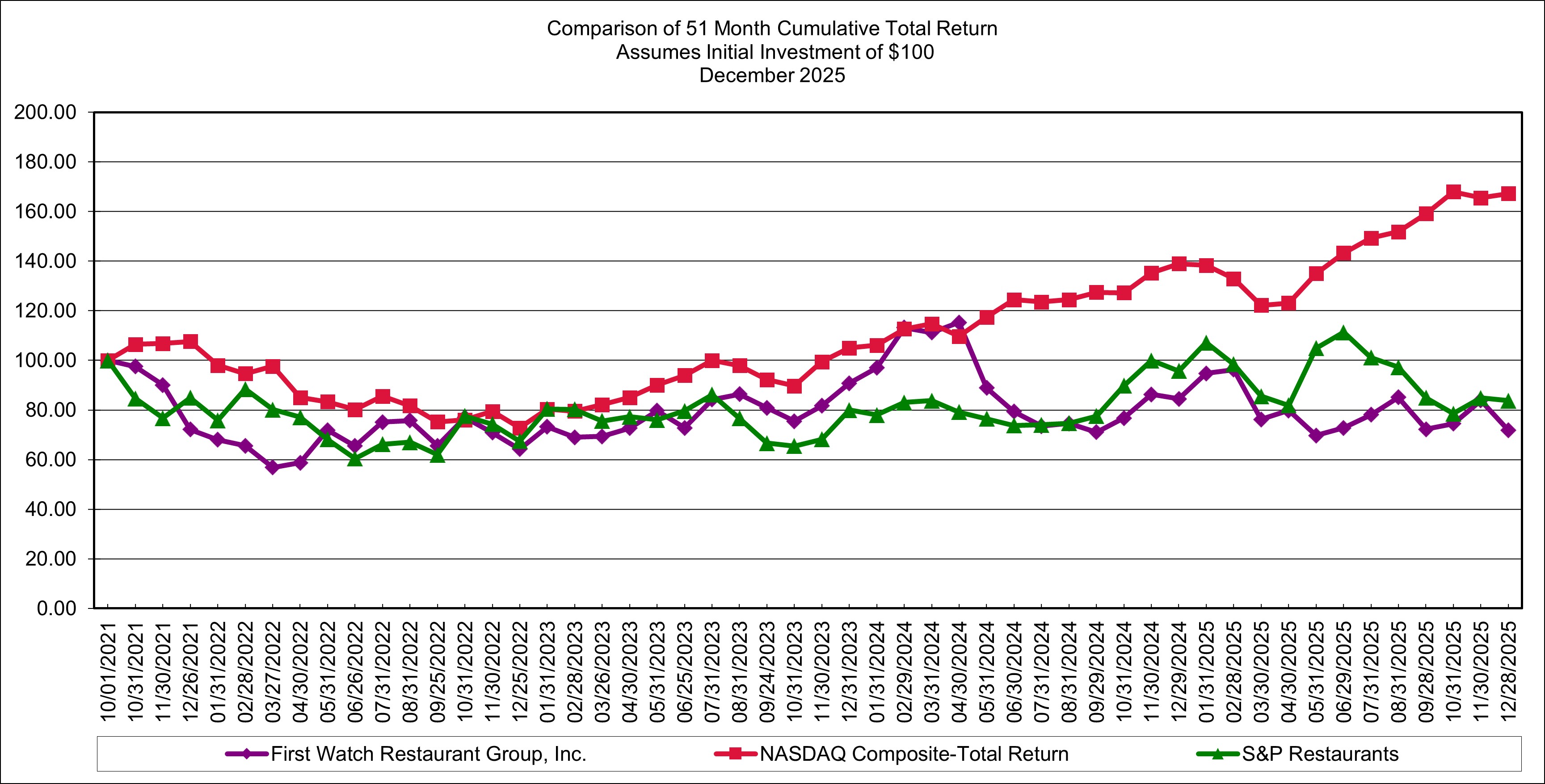
| October 1, 2021 | December 26, 2021 | December 25, 2022 | December 31, 2023 | December 29, 2024 | December 28, 2025 | ||||||||||||||||||||||||||||||
| First Watch Restaurant Group, Inc. | $ | 100.00 | $ | 72.16 | $ | 64.20 | $ | 90.80 | $ | 84.46 | $ | 71.85 | |||||||||||||||||||||||
| Nasdaq Composite Index | $ | 100.00 | $ | 107.62 | $ | 72.77 | $ | 104.97 | $ | 138.90 | $ | 167.24 | |||||||||||||||||||||||
| S&P Restaurants Index | $ | 100.00 | $ | 84.95 | $ | 67.46 | $ | 79.93 | $ | 95.74 | $ | 83.75 | |||||||||||||||||||||||
Item 6. [Reserved]
37
Item 7. Management’s Discussion and Analysis of Financial Condition and Results of Operations
Overview
First Watch is an award-winning Daytime Dining concept serving made-to-order breakfast, brunch and lunch using fresh ingredients. Our common stock trades on Nasdaq under the ticker symbol “FWRG.” A recipient of many local “Best Breakfast” and “Best Brunch” accolades, First Watch’s award-winning chef-driven menu includes elevated executions of classic favorites for breakfast, brunch and lunch. For four consecutive years, First Watch has been named a Top 100 Most Loved Workplace® by the Best Practice Institute, and in 2025, was named the #1 Most Loved Workplace for the second year in a row, featured in The Wall Street Journal. Also, in 2025, First Watch was named one of Yelp’s Most-Loved Brands nationwide.
We operate and franchise restaurants in 32 states under the “First Watch” trade name and as of December 28, 2025, had 560 company-owned restaurants and 73 franchise-owned restaurants. We do not operate outside of the United States.
Our 52- or 53-week fiscal years end on the last Sunday of each calendar year. Our fiscal quarters are comprised of 13 weeks each and end on the 13th Sunday of each quarter, except for 53-week years, during which the fourth quarter ends on the 14th Sunday of the fourth quarter. All references to 2025 and 2024 reflect the results of the 52-week fiscal years ended December 28, 2025 and December 29, 2024, respectively. All references to 2023 reflect the results of the 53-week fiscal year ended December 31, 2023 unless otherwise stated. We report financial and operating information in one segment.
This section of this Annual Report on the Form 10-K generally discusses Fiscal 2025 and Fiscal 2024 and year-over-year comparisons between Fiscal 2025 and Fiscal 2024. A discussion of Fiscal 2023 and year-over-year comparisons between Fiscal 2024 and Fiscal 2023 that are not included in this Annual Report on Form 10-K can be found in Part II, Item 7. “Management’s Discussion and Analysis of Financial Condition and Results of Operations” in our Annual Report on Form 10-K for the fiscal year ended December 31, 2023, as filed with the SEC on March 5, 2024.
Key Performance Indicators
Throughout this“Management’s Discussion and Analysis of Financial Condition and Results of Operations” we commonly discuss the following key operating metrics that we believe will drive our financial results and long-term growth model. We believe these metrics are useful to investors because our Management uses these metrics to evaluate performance and assess the growth of our business as well as the effectiveness of our marketing and operational strategies.
New Restaurant Openings (“NROs”): the number of new company-owned First Watch restaurants commencing operations during the period. Management reviews the number of new restaurants to assess new restaurant growth and company-owned restaurant sales.
Franchise-owned New Restaurant Openings (“Franchise-owned NROs”): the number of new franchise-owned First Watch restaurants commencing operations during the period.
Same-Restaurant Sales Growth: the percentage change in year-over-year restaurant sales (excluding gift card breakage) for the comparable restaurant base, which we define as the number of company-owned First Watch branded restaurants open for 18 months or longer as of the beginning of the fiscal year (“Comparable Restaurant Base”). This operating metric compares the 52-week periods ended December 28, 2025, December 29, 2024 and December 31, 2023, rather than, the 53-week fiscal year ended December 31, 2023, in order to compare like-for-like periods. For the 52-weeks ended December 28, 2025, December 29, 2024 and December 31, 2023 there were 381, 344 and 327 restaurants, in our Comparable Restaurant Base, respectively. Measuring our same-restaurant sales growth allows Management to evaluate the performance of our existing restaurant base. We believe this measure is useful for investors to provide a consistent comparison of restaurant sales results and trends across periods within our core, established restaurant base, unaffected by results of store openings, closings and other transitional changes.
Same-Restaurant Traffic Growth: the percentage change in year-over-year traffic counts using the Comparable Restaurant Base. This operating metric compares the 52-week periods ended December 28, 2025, December 29, 2024 and December 31, 2023, - (rather than the 53-week fiscal year ended December 31, 2023), in order to compare like-for-like periods. Measuring our same-restaurant traffic growth allows our Management to evaluate the performance of our existing
38
restaurant base. We believe this measure is useful for investors because same-restaurant traffic provides an indicator as to the development of our brand and the effectiveness of our marketing strategy.
Average Unit Volume (“AUV”): the total restaurant sales (excluding gift card breakage) recognized in the Comparable Restaurant Base, divided by the number of restaurants in the Comparable Restaurant Base during the period. This measurement allows Management to assess changes in consumer spending patterns at our restaurants and the overall performance of our restaurant base.
System-wide restaurants: the total number of restaurants, including all company-owned and franchise-owned restaurants.
System-wide sales: consists of restaurant sales from our company-owned restaurants and franchise-owned restaurants. We do not recognize the restaurant sales from our franchise-owned restaurants as revenue.
Non-GAAP Financial Measures
To supplement the consolidated financial statements, which are prepared in accordance with accounting principles generally accepted in the United States of America (“GAAP”), we use the following non-GAAP measures, which present operating results on an adjusted basis: (i) Adjusted EBITDA, (ii) Adjusted EBITDA margin, (iii) Restaurant level operating profit and (iv) Restaurant level operating profit margin. Our presentation of these non-GAAP measures includes isolating the effects of some items that are either nonrecurring in nature or have no meaningful correlation to our ongoing core operating performance. These supplemental measures of performance are not required by or presented in accordance with GAAP. Management believes these non-GAAP measures provide investors with additional visibility into our operations, facilitate analysis and comparisons of our ongoing business operations because they exclude items that may not be indicative of our ongoing operating performance, help to identify operational trends and allow for greater transparency with respect to key metrics used by Management in our financial and operational decision making. Our non-GAAP measures may not be comparable to similarly titled measures used by other companies and have important limitations as analytical tools. These non-GAAP measures should not be considered in isolation or as substitutes for analysis of our results as reported under GAAP as they may not provide a complete understanding of our performance. These non-GAAP measures should be reviewed in conjunction with our consolidated financial statements prepared in accordance with GAAP.
We use Adjusted EBITDA and Adjusted EBITDA margin (i) as factors in evaluating management’s performance when determining incentive compensation, (ii) to evaluate our operating results and the effectiveness of our business strategies and (iii) internally as benchmarks to compare our performance to that of our competitors.
We use Restaurant level operating profit and Restaurant level operating profit margin (i) to evaluate the performance and profitability of operating restaurants, individually and in the aggregate, and (ii) to make decisions regarding future spending and other operational decisions.
Adjusted EBITDA: represents Net income before depreciation and amortization, interest expense, income taxes and items that we do not consider in our evaluation of ongoing core operating performance as identified in the reconciliation of Net income, the most directly comparable measure in accordance with GAAP, to Adjusted EBITDA, included in the section Non-GAAP Financial Measure Reconciliations below.
Adjusted EBITDA Margin: represents Adjusted EBITDA as a percentage of total revenues. See Non-GAAP Financial Measure Reconciliations below for a reconciliation to Net income margin, the most directly comparable GAAP measure.
Restaurant Level Operating Profit: represents restaurant sales, less restaurant operating expenses, which include food and beverage costs, labor and other related expenses, other restaurant operating expenses, pre-opening expenses and occupancy expenses. Restaurant level operating profit excludes corporate-level expenses and other items that we do not consider in the evaluation of the ongoing core operating performance of our restaurants as identified in the reconciliation of Income from operations, the most directly comparable GAAP measure, to Restaurant level operating profit, included in the section Non-GAAP Financial Measure Reconciliations below.
Restaurant Level Operating Profit Margin: represents Restaurant level operating profit as a percentage of restaurant sales. See Non-GAAP Financial Measure Reconciliations below for a reconciliation to Income from operations margin, the most directly comparable GAAP measure.
39
Financial Highlights
The financial results of 2025 reflect the continued growth of the Company. In 2025, we executed our growth strategy with 55 new restaurant openings and the acquisition of 19 operating restaurants from our franchisees.
Financial highlights for 2025 as compared to 2024 include the following:
•Total revenues increased 20.3% to $1.2 billion from $1.0 billion in 2024
•System-wide sales increased to $1.4 billion from $1.2 billion in 2024
•Same-restaurant sales growth of 3.6%
•Same-restaurant traffic growth of 0.5%
•Income from operations decreased to $27.5 million from $38.9 million in 2024
•Income from operations margin decreased to 2.3% from 3.9% in 2024
•Restaurant level operating profit* increased to $224.1 million from $201.8 million in 2024
•Restaurant level operating profit margin* decreased to 18.5% from 20.1% in 2024
•Net income increased to $19.4 million from $18.9 million in 2024
•Adjusted EBITDA* increased to $120.9 million from $113.8 million in 2024
•Opened 64 system-wide restaurants (55 company-owned and 9 franchise-owned) across 23 states, resulting in a total of 633 system-wide restaurants (560 company-owned and 73 franchise-owned) across 32 states
___________________
* See Non-GAAP Financial Measure Reconciliations section below.
Business Trends
During 2025, our same-restaurant sales growth was 3.6% with positive traffic growth. We expect annual same-restaurant sales growth in 2026 to be between 1% and 3%.
Commodity inflation was 5.0% in 2025, largely driven by eggs, coffee, avocado and bacon. We expect 2026 commodity prices to increase approximately 1% to 3% as compared to the prior year, primarily related to coffee.
Restaurant level labor inflation during 2025 was 3.7%, largely offset by price increases. At year end, we were staffed with over 100 managers to lead and operate future new company-owned restaurants. We expect 3% to 5% labor inflation in 2026.
Continuing our growth strategy, we intend to open 59 to 63 net new system-wide restaurants in 2026.
Development Highlights
During 2025, we had a total of 64 new system-wide restaurants in 23 states. Three company-owned restaurants closed in 2025. We also acquired 19 operating restaurants from our franchisees in the execution of our growth strategy. See Note 3, Business Acquisitions, in the accompanying notes to the consolidated financial statements for additional information. At December 28, 2025, the Company had a total of 633 system-wide restaurants.
FISCAL YEAR 2025 | |||||||||||||||||
| Company-owned | Franchise-owned | Total | |||||||||||||||
Beginning of period | 489 | 83 | 572 | ||||||||||||||
New restaurants | 55 | 9 | 64 | ||||||||||||||
| Acquisitions of franchise-owned restaurants | 19 | (19) | — | ||||||||||||||
Closures | (3) | — | (3) | ||||||||||||||
End of period | 560 | 73 | 633 | ||||||||||||||
We expect to open between 53 to 55 company-owned restaurants and 9 to 11 franchise-owned restaurants during 2026. We also plan to close three company-owned restaurants, resulting in a total of 59 to 63 net new system-wide restaurants in 2026.
40
Selected Operating Data
________________
| FISCAL YEAR | |||||||||||||||||
| 2025 | 2024 | 2023 | |||||||||||||||
| Number of weeks in fiscal year | 52 | 52 | 53 | ||||||||||||||
| System-wide restaurants | 633 | 572 | 524 | ||||||||||||||
| Company-owned | 560 | 489 | 425 | ||||||||||||||
| Franchise-owned | 73 | 83 | 99 | ||||||||||||||
| System-wide sales (in thousands) | 1,375,045 | 1,184,469 | 1,103,089 | ||||||||||||||
Same-restaurant sales growth (1) | 3.6 | % | (0.5) | % | 7.6 | % | |||||||||||
Same-restaurant traffic growth (1) | 0.5 | % | (4.0) | % | 0.2 | % | |||||||||||
| AUV (in thousands) | $ | 2,294 | $ | 2,204 | $ | 2,250 | |||||||||||
| Income from operations (in thousands) | $ | 27,511 | $ | 38,907 | $ | 41,267 | |||||||||||
| Income from operations margin | 2.3 | % | 3.9 | % | 4.7 | % | |||||||||||
Restaurant level operating profit (in thousands) (2) | $ | 224,125 | $ | 201,761 | $ | 175,658 | |||||||||||
Restaurant level operating profit margin (2) | 18.5 | % | 20.1 | % | 20.0 | % | |||||||||||
| Net income (in thousands) | $ | 19,432 | $ | 18,925 | $ | 25,385 | |||||||||||
| Net income margin | 1.6 | % | 1.9 | % | 2.8 | % | |||||||||||
Adjusted EBITDA (in thousands) (3) | $ | 120,918 | $ | 113,836 | $ | 99,483 | |||||||||||
Adjusted EBITDA margin (3) | 9.9 | % | 11.2 | % | 11.2 | % | |||||||||||
(1) Comparing the 52-week periods ended December 28, 2025, December 29, 2024 and December 31, 2023 in order to compare like-for-like periods. See “Key Performance Indicators” for additional information.
(2) Reconciliations from Income from operations and Income from operations margin, the most comparable GAAP measures to Restaurant level operating profit and Restaurant level operating profit margin, respectively, are set forth in the schedules within the Non-GAAP Financial Measure Reconciliations section below.
(3) Reconciliations from Net income and Net income margin, the most comparable GAAP measures to Adjusted EBITDA and Adjusted EBITDA margin, respectively, are set forth in the schedules within the Non-GAAP Financial Measure Reconciliations section below.
41
Results of Operations
The discussion that follows includes a comparison of our results of operations for 2025 and 2024.
The following table summarizes our results of operations and the percentages of items in our Consolidated Statements of Operations and Comprehensive Income in relation to Total revenues or, where indicated, Restaurant sales for 2025 and 2024:
| FISCAL YEAR | |||||||||||||||||||||||
| (in thousands) | 2025 | 2024 | |||||||||||||||||||||
| Revenues | |||||||||||||||||||||||
| Restaurant sales | $ | 1,212,173 | 99.2 | % | $ | 1,004,355 | 98.9 | % | |||||||||||||||
| Franchise revenues | 10,328 | 0.8 | % | 11,555 | 1.1 | % | |||||||||||||||||
| Total revenues | 1,222,501 | 100.0 | % | 1,015,910 | 100.0 | % | |||||||||||||||||
| Operating costs and expenses | |||||||||||||||||||||||
Restaurant operating expenses (1) (exclusive of depreciation and amortization shown below): | |||||||||||||||||||||||
| Food and beverage costs | 280,098 | 23.1 | % | 223,097 | 22.2 | % | |||||||||||||||||
| Labor and other related expenses | 405,544 | 33.5 | % | 335,038 | 33.4 | % | |||||||||||||||||
| Other restaurant operating expenses | 188,685 | 15.6 | % | 151,968 | 15.1 | % | |||||||||||||||||
| Occupancy expenses | 100,788 | 8.3 | % | 82,694 | 8.2 | % | |||||||||||||||||
| Pre-opening expenses | 12,933 | 1.1 | % | 10,109 | 1.0 | % | |||||||||||||||||
| General and administrative expenses | 128,950 | 10.5 | % | 113,270 | 11.1 | % | |||||||||||||||||
| Depreciation and amortization | 75,011 | 6.1 | % | 57,715 | 5.7 | % | |||||||||||||||||
| Impairments and loss on disposal of assets | 448 | — | % | 525 | 0.1 | % | |||||||||||||||||
| Transaction expenses, net | 2,533 | 0.2 | % | 2,587 | 0.3 | % | |||||||||||||||||
| Total operating costs and expenses | 1,194,990 | 97.7 | % | 977,003 | 96.2 | % | |||||||||||||||||
Income from operations (1) | 27,511 | 2.3 | % | 38,907 | 3.9 | % | |||||||||||||||||
| Interest expense | (16,699) | (1.4) | % | (12,640) | (1.2) | % | |||||||||||||||||
| Other income, net | 1,321 | 0.1 | % | 1,759 | 0.2 | % | |||||||||||||||||
| Income before income taxes | 12,133 | 1.0 | % | 28,026 | 2.8 | % | |||||||||||||||||
| Income tax benefit (expense) | 7,299 | 0.6 | % | (9,101) | (0.9) | % | |||||||||||||||||
| Net income | $ | 19,432 | 1.6 | % | $ | 18,925 | 1.9 | % | |||||||||||||||
(1) As a percentage of restaurant sales.
Restaurant Sales
Restaurant sales represent the aggregate sales of food and beverages, net of discounts, at company-owned restaurants. Restaurant sales in any period are directly influenced by the number of operating weeks in the period, the number of open restaurants, customer traffic and average check. Average check growth is driven by our menu price increases and changes to our menu mix.
| FISCAL YEAR | |||||||||||||||||||||||
| (in thousands) | 2025 | 2024 | Change | ||||||||||||||||||||
| Restaurant sales: | |||||||||||||||||||||||
| In-restaurant dining sales | $ | 982,349 | $ | 829,048 | $ | 153,301 | 18.5 | % | |||||||||||||||
| Third-party delivery sales | 142,255 | 97,444 | 44,811 | 46.0 | % | ||||||||||||||||||
| Take-out sales | 87,569 | 77,863 | 9,706 | 12.5 | % | ||||||||||||||||||
| Total Restaurant sales | $ | 1,212,173 | $ | 1,004,355 | $ | 207,818 | 20.7 | % | |||||||||||||||
The increase in total restaurant sales was primarily due to (i) new restaurant openings and acquiring restaurants from franchisees in 2025, (ii) recognizing a full year of sales for restaurants opened and acquired in 2024, (iii) positive same-
42
restaurant sales growth of 3.6%, and (iv) positive traffic of 0.5%. The increase was partially offset by increased promotional usage.
Franchise Revenues
Franchise revenues are comprised of sales-based royalty fees, system fund contributions and the amortization of upfront initial franchise fees, which are recognized as revenue on a straight-line basis over the term of the franchise agreement. Franchise revenues in any period are directly influenced by the number of open franchise-owned restaurants.
| FISCAL YEAR | |||||||||||||||||||||||
| (in thousands) | 2025 | 2024 | Change | ||||||||||||||||||||
| Franchise revenues: | |||||||||||||||||||||||
| Royalty and system fund contributions | $ | 9,705 | $ | 10,864 | $ | (1,159) | (10.7) | % | |||||||||||||||
| Initial fees | 225 | 278 | (53) | (19.1) | % | ||||||||||||||||||
| Business combinations - revenues recognized | 398 | 413 | (15) | — | % | ||||||||||||||||||
| Total Franchise revenues | $ | 10,328 | $ | 11,555 | $ | (1,227) | (10.6) | % | |||||||||||||||
The decrease in franchise revenues during 2025 as compared to 2024 was primarily driven by the Company’s acquisition of 19 and 22 franchise-owned restaurants during 2025 and 2024, respectively, partially offset by incremental revenue from nine franchise-owned NROs in 2025 and seven franchise-owned NROs in 2024.
Food and Beverage Costs
Food and beverage costs at company-owned restaurants vary with sales volume and are subject to increases and declines in commodity costs.
| FISCAL YEAR | ||||||||||||||||||||||||||
| (in thousands) | 2025 | 2024 | Change | |||||||||||||||||||||||
| Food and beverage costs | $ | 280,098 | $ | 223,097 | $ | 57,001 | 25.5 | % | ||||||||||||||||||
| As a percentage of restaurant sales | 23.1 | % | 22.2 | % | 0.9% | |||||||||||||||||||||
Food and beverage costs as a percent of restaurant sales increased during 2025 as compared to 2024 primarily due to (i) commodity inflation of 5.0%, as discussed below, and (ii) increased portion size in certain menu items. The increase was partially offset by the impact of menu price increases.
Food and beverage costs increased during 2025 as compared to 2024 primarily as a result of (i) the 20.7% increase in restaurant sales, (ii) opening and acquiring restaurants in 2025, (iii) recognizing a full year of costs for restaurants opened and acquired in 2024, (iv) commodity inflation experienced in eggs, coffee, bacon and avocados and (v) increased portion size in certain menu items.
Labor and Other Related Expenses
Labor and other related expenses include hourly and management wages, bonuses, payroll taxes, workers’ compensation expense and employee benefits. Factors that influence labor costs include minimum wage and payroll tax legislation, health care costs, the number and performance of our company-owned restaurants and competition for qualified staff.
| FISCAL YEAR | |||||||||||||||||||||||
| (in thousands) | 2025 | 2024 | Change | ||||||||||||||||||||
| Labor and other related expenses | $ | 405,544 | $ | 335,038 | $ | 70,506 | 21.0 | % | |||||||||||||||
| As a percentage of restaurant sales | 33.5 | % | 33.4 | % | 0.1% | ||||||||||||||||||
Labor and other related expenses as a percentage of restaurant sales increased during 2025 as compared to 2024 primarily as a result of (i) wage increases and (ii) higher health insurance costs. This increase was mostly offset by (i) menu price increases and (ii) improved hourly labor efficiency.
The increase in labor and other related expenses during 2025 as compared to 2024 was primarily due to (i) the increase in staffing levels to support the increase in company-owned restaurants, (ii) wage increases and (iii) higher health insurance costs. The increase was partially offset by hourly labor efficiency.
43
Other Restaurant Operating Expenses
Other restaurant operating expenses consist of marketing and advertising expenses, utilities, insurance and other variable expenses incidental to operating company-owned restaurants, such as operating supplies (including paper products, menus and to-go supplies), credit card fees, repairs and maintenance and third-party delivery services fees.
| FISCAL YEAR | ||||||||||||||||||||||||||
| (in thousands) | 2025 | 2024 | Change | |||||||||||||||||||||||
| Other restaurant operating expenses | $ | 188,685 | $ | 151,968 | $ | 36,717 | 24.2 | % | ||||||||||||||||||
| As a percentage of restaurant sales | 15.6 | % | 15.1 | % | 0.5% | |||||||||||||||||||||
Other restaurant operating expenses as a percentage of restaurant sales during 2025 increased as compared to 2024 primarily due to (i) third-party delivery fees, (ii) utility expenses and (iii) supply costs, which increased as a percentage of restaurant sales. This increase was partially offset by (i) leveraging menu price increases and (ii) credit card, restaurant-level legal, accounting, and licensing fees, which decreased as a percentage of restaurant sales.
The increase in other restaurant operating expenses during 2025 as compared to 2024 was primarily due to the increase in the number of restaurants driving increases in certain expenses including (i) $10.9 million related to operating supplies, (ii) $10.4 million in utilities and repair and maintenance expenses, (iii) $9.1 million in third-party delivery fees, (iv) $4.0 million in credit card fees and (v) $1.4 million in insurance expenses.
Occupancy Expenses
Occupancy expenses primarily consist of rent expense, property insurance, common area expenses and property taxes.
| FISCAL YEAR | ||||||||||||||||||||||||||
| (in thousands) | 2025 | 2024 | Change | |||||||||||||||||||||||
| Occupancy expenses | $ | 100,788 | $ | 82,694 | $ | 18,094 | 21.9 | % | ||||||||||||||||||
| As a percentage of restaurant sales | 8.3 | % | 8.2 | % | 0.1% | |||||||||||||||||||||
The increase in occupancy expenses as a percentage of restaurant sales during 2025 as compared to 2024 was primarily due to higher rent expense associated with new restaurants mostly offset by leveraging increased restaurant sales.
The increase in occupancy expenses during 2025 as compared to 2024 was primarily due to the increase in the number of company-owned restaurants.
Pre-opening Expenses
Pre-opening expenses are costs incurred to open new company-owned restaurants. Pre-opening expenses include rent expense, manager salaries, recruiting expenses, employee payroll and training costs. Pre-opening expenses can fluctuate from period to period, based on the number and timing of new company-owned restaurant openings.
| FISCAL YEAR | |||||||||||||||||||||||
| (in thousands) | 2025 | 2024 | Change | ||||||||||||||||||||
| Pre-opening expenses | $ | 12,933 | $ | 10,109 | $ | 2,824 | 27.9 | % | |||||||||||||||
The increase in 2025 pre-opening expenses as compared to 2024 was primarily due to (i) the higher number of new restaurants opened and under construction and (ii) the related increase in rent expense.
44
General and Administrative Expenses
General and administrative expenses primarily consist of costs associated with our corporate and administrative functions that support restaurant development and operations including marketing and advertising costs incurred as well as legal fees, professional fees, stock-based compensation and expenses associated with being a public company, including costs associated with our compliance with the Sarbanes-Oxley Act. General and administrative expenses are impacted by changes in our employee headcount and costs related to strategic and growth initiatives.
| FISCAL YEAR | |||||||||||||||||||||||
| (in thousands) | 2025 | 2024 | Change | ||||||||||||||||||||
| General and administrative expenses | $ | 128,950 | $ | 113,270 | $ | 15,680 | 13.8 | % | |||||||||||||||
The increase in general and administrative expenses during 2025 as compared to 2024 was mainly due to (i) an $8.0 million increase in marketing expenses, (ii) a $6.7 million increase in compensation and other related expenses from wage increases and additional employee headcount to support growth, and (iii) a $2.1 million increase in licenses and fees related to information technology due to increase in restaurants. The increase in 2025 was partially offset in part by a $2.4 million decrease in recruiting and training expenses.
Depreciation and Amortization
Depreciation and amortization consists of the depreciation of fixed assets, including leasehold improvements, fixtures and equipment and the amortization of definite-lived intangible assets, which are primarily comprised of franchise rights.
| FISCAL YEAR | |||||||||||||||||||||||
| (in thousands) | 2025 | 2024 | Change | ||||||||||||||||||||
| Depreciation and amortization | $ | 75,011 | $ | 57,715 | $ | 17,296 | 30.0 | % | |||||||||||||||
The increase in depreciation and amortization during 2025 as compared to 2024 was primarily due to additional NRO assets and restaurants acquired, including reacquired rights from franchisees.
Transaction Expenses, Net
Transaction expenses, net principally include (i) costs incurred in connection with the acquisition of franchise-owned restaurants and (ii) costs related to secondary equity offerings.
| FISCAL YEAR | |||||||||||||||||||||||
| (in thousands) | 2025 | 2024 | Change | ||||||||||||||||||||
| Transaction expenses, net | $ | 2,533 | $ | 2,587 | $ | (54) | (2.1)% | ||||||||||||||||
Income from Operations
| FISCAL YEAR | |||||||||||||||||||||||
| (in thousands) | 2025 | 2024 | Change | ||||||||||||||||||||
| Income from operations | $ | 27,511 | $ | 38,907 | $ | (11,396) | (29.3) | % | |||||||||||||||
| Income from operations margin | 2.3 | % | 3.9 | % | (1.6)% | ||||||||||||||||||
Income from operations margin decreased during 2025 as compared to 2024 due to increases in operating expenses as a percentage of restaurant sales, primarily (i) food and beverage cost inflation, (ii) other restaurant operating expenses and (iii) depreciation and amortization expense driven by restaurant growth and our acquisition of restaurants from franchisees, offset in part by the leveraging of certain general and administrative expenses.
Income from operations decreased during 2025 as compared to 2024 due to higher (i) restaurant operating expenses, (ii) depreciation and amortization expenses driven by our restaurant growth and our acquisition of restaurants from franchisees, and (iii) general and administrative expenses primarily attributable to increased marketing costs, additional employee headcount and compensation. This was partially offset by the increase in revenues.
45
Interest Expense
Interest expense primarily consists of interest and fees on our outstanding debt and the amortization expense for debt discount and deferred issuance costs.
| FISCAL YEAR | |||||||||||||||||||||||
| (in thousands) | 2025 | 2024 | Change | ||||||||||||||||||||
| Interest expense | $ | (16,699) | $ | (12,640) | $ | (4,059) | 32.1 | % | |||||||||||||||
The increase in interest expense during 2025 as compared to 2024 was primarily due an increase in borrowings associated with franchise acquisitions.
Other Income, Net
Other income, net includes items deemed to be non-operating based on Management’s assessment of the nature of the item in relation to our core operations.
| FISCAL YEAR | |||||||||||||||||||||||
| (in thousands) | 2025 | 2024 | Change | ||||||||||||||||||||
| Other income, net | $ | 1,321 | $ | 1,759 | $ | (438) | (24.9) | % | |||||||||||||||
Other income, net decreased in 2025 primarily due to a reduction in interest income, partially offset by an increase in insurance recoveries recognized in 2025.
Income Tax
Income tax consists of federal and state taxes.
| FISCAL YEAR | |||||||||||||||||||||||
| (in thousands) | 2025 | 2024 | Change | ||||||||||||||||||||
| Income tax benefit (expense) | $ | 7,299 | $ | (9,101) | $ | 16,400 | (180.2)% | ||||||||||||||||
| Effective income tax rate | (60.2) | % | 32.5 | % | (92.7)% | ||||||||||||||||||
The change in the effective income tax rate and provision for income taxes for 2025 as compared to 2024 was primarily due to the favorable impact of the increase in the tax benefit from the FICA tip credits and the net change in the valuation allowance against the FICA tip credit carryforward. The adjustment to the valuation allowance was determined as part of Management’s year-end assessment of the realizability of the Company’s deferred tax assets.
Net Income
| FISCAL YEAR | |||||||||||||||||||||||
| (in thousands) | 2025 | 2024 | Change | ||||||||||||||||||||
| Net income | $ | 19,432 | $ | 18,925 | $ | 507 | 2.7 | % | |||||||||||||||
| Net income margin | 1.6 | % | 2.8 | % | (1.2)% | ||||||||||||||||||
The decrease in net income margin during 2025 as compared to 2024 was primarily due to (i) the decrease in income from operations as expenses inflated rapidly early in the year, (ii) increased depreciation and amortization associated with new company-owned restaurants opened and acquired in 2025 and 2024 and (iii) interest expense from the borrowings to fund acquisitions, partially offset by the impact of the income tax benefit recognized in 2025.
The increase in net income during 2025 as compared to 2024 was primarily due to the impact of the income tax benefit recognized in 2025. The increase was partially offset by (i) the decrease in income from operations, (ii) the increase in depreciation and amortization attributed primarily to locations opened and acquired in 2025 and 2024, and (iii) the increase in interest expense associated with increased borrowings to fund acquisitions.
46
Restaurant Level Operating Profit and Restaurant level Operating Profit Margin
| FISCAL YEAR | |||||||||||||||||||||||
| (in thousands) | 2025 | 2024 | Change | ||||||||||||||||||||
| Restaurant level operating profit | $ | 224,125 | $ | 201,761 | $ | 22,364 | 11.1 | % | |||||||||||||||
| Restaurant level operating profit margin | 18.5 | % | 20.1 | % | (1.6)% | ||||||||||||||||||
Restaurant level operating profit margin during 2025 decreased as compared to 2024 primarily due to an increase in (i) food and beverage costs as a percent of sales and (ii) other restaurant operating expenses as a percent of sales. This was partially offset by leverage associated with our positive same-restaurant sales growth.
Restaurant level operating profit during 2025 increased as compared to 2024 due to sales growth driven primarily by the increase in (i) restaurant locations, (ii) menu prices and (iii) traffic. This was partially offset by (i) the increase in inflation across commodities and (ii) increases in operating expenses due to restaurant growth.
Adjusted EBITDA and Adjusted EBITDA Margin
| FISCAL YEAR | |||||||||||||||||||||||
| (in thousands) | 2025 | 2024 | Change | ||||||||||||||||||||
| Adjusted EBITDA | $ | 120,918 | $ | 113,836 | $ | 7,082 | 6.2 | % | |||||||||||||||
| Adjusted EBITDA margin | 9.9 | % | 11.2 | % | (1.3)% | ||||||||||||||||||
The decrease in Adjusted EBITDA margin during 2025 as compared to 2024 was primarily due the decrease in restaurant level operating profit margin, partially offset by the decrease in general and administrative expenses as a percentage of revenues.
The increase in Adjusted EBITDA during 2025 as compared to 2024 was primarily due to the increase in restaurant level operating profit. This was partially offset by the increase in general and administrative expenses.
47
Non-GAAP Financial Measure Reconciliations
Adjusted EBITDA and Adjusted EBITDA margin - The following table reconciles Net income and Net income margin, the most directly comparable GAAP measures to Adjusted EBITDA and Adjusted EBITDA margin, respectively, for the periods indicated:
| FISCAL YEAR | |||||||||||||||||
| (in thousands) | 2025 | 2024 | 2023 | ||||||||||||||
| Net income | $ | 19,432 | $ | 18,925 | $ | 25,385 | |||||||||||
| Depreciation and amortization | 75,011 | 57,715 | 41,223 | ||||||||||||||
| Interest expense | 16,699 | 12,640 | 8,063 | ||||||||||||||
| Income taxes | (7,299) | 9,101 | 10,690 | ||||||||||||||
| EBITDA | 103,843 | 98,381 | 85,361 | ||||||||||||||
Stock-based compensation, net of amounts capitalized (1) | 10,760 | 8,525 | 7,604 | ||||||||||||||
Transaction expenses, net (2) | 2,533 | 2,587 | 3,147 | ||||||||||||||
Strategic transition costs (3) | 3,279 | 1,843 | 892 | ||||||||||||||
Impairments and loss on disposal of assets (4) | 448 | 525 | 1,359 | ||||||||||||||
Delaware Voluntary Disclosure Agreement Program (5) | 55 | 126 | 1,250 | ||||||||||||||
Recruiting and relocation costs (6) | — | 888 | 465 | ||||||||||||||
Severance costs (7) | — | 204 | 26 | ||||||||||||||
Insurance proceeds in connection with natural disasters, net (8) | — | 329 | (621) | ||||||||||||||
| Loss on extinguishment of debt | — | 428 | — | ||||||||||||||
| Adjusted EBITDA | $ | 120,918 | $ | 113,836 | $ | 99,483 | |||||||||||
| Total revenues | $ | 1,222,501 | $ | 1,015,910 | $ | 891,551 | |||||||||||
| Net income margin | 1.6 | % | 1.9 | % | 2.8 | % | |||||||||||
| Adjusted EBITDA margin | 9.9 | % | 11.2 | % | 11.2 | % | |||||||||||
| Additional information | |||||||||||||||||
Deferred rent expense (9) | $ | 309 | $ | 1,318 | $ | 2,090 | |||||||||||
(1) Represents non-cash, stock-based compensation expense, net of amounts capitalized, which is recorded within General and administrative expenses on the Consolidated Statements of Operations and Comprehensive Income.
(2) Represents costs incurred in connection with the acquisition of franchise-owned restaurants, secondary offering costs, costs related to restaurant closures, expenses related to debt and revaluations of contingent consideration liability.
(3) Represents costs related to process improvements and strategic initiatives. These costs are recorded within General and administrative expenses on the Consolidated Statements of Operations and Comprehensive Income.
(4) Represents impairment charges and costs related to the disposal of assets due to retirements, replacements, restaurant closures and natural disasters.
(5) Represents professional service costs incurred in connection with the Delaware Voluntary Disclosure Agreement Program related to unclaimed or abandoned property. These costs are recorded in General and administrative expenses on the Consolidated Statements of Operations and Comprehensive Income.
(6) Represents costs incurred for hiring qualified individuals. These costs are recorded within General and administrative expenses on the Consolidated Statements of Operations and Comprehensive Income.
(7) Severance costs are recorded in General and administrative expenses on the Consolidated Statements of Operations and Comprehensive Income.
(8) Represents insurance recoveries, net of costs incurred, in connection with hurricane damage, which were recorded in Other income, net on the Consolidated Statements of Operations and Comprehensive Income.
(9) Represents the non-cash portion of straight-line rent expense recorded within both Occupancy expenses and General and administrative expenses on the Consolidated Statements of Operations and Comprehensive Income.
48
Restaurant level operating profit and Restaurant level operating profit margin - The following table reconciles Income from operations and Income from operations margin, the most comparable GAAP measures to Restaurant level operating profit and Restaurant level operating profit margin, respectively, for the periods indicated:
| FISCAL YEAR | |||||||||||||||||
| (in thousands) | 2025 | 2024 | 2023 | ||||||||||||||
| Income from operations | $ | 27,511 | $ | 38,907 | $ | 41,267 | |||||||||||
| Less: Franchise revenues | (10,328) | (11,555) | (14,459) | ||||||||||||||
| Add: | |||||||||||||||||
| General and administrative expenses | 128,950 | 113,270 | 103,121 | ||||||||||||||
| Depreciation and amortization | 75,011 | 57,715 | 41,223 | ||||||||||||||
Transaction expenses, net (1) | 2,533 | 2,587 | 3,147 | ||||||||||||||
Impairments and loss on disposal of assets (2) | 448 | 525 | 1,359 | ||||||||||||||
Costs in connection with natural disasters (3) | — | 312 | — | ||||||||||||||
| Restaurant level operating profit | $ | 224,125 | $ | 201,761 | $ | 175,658 | |||||||||||
| Restaurant sales | $ | 1,212,173 | $ | 1,004,355 | $ | 877,092 | |||||||||||
| Income from operations margin | 2.3 | % | 3.9 | % | 4.7 | % | |||||||||||
| Restaurant level operating profit margin | 18.5 | % | 20.1 | % | 20.0 | % | |||||||||||
| Additional information | |||||||||||||||||
Deferred rent expense (4) | $ | 167 | $ | 1,119 | $ | 1,891 | |||||||||||
(1) Represents costs incurred in connection with the acquisition of franchise-owned restaurants, secondary offering costs, costs related to restaurant closures, expenses related to debt and revaluations of contingent consideration liability.
(2) Represents impairment charges and costs related to the disposal of assets due to retirements, replacements, restaurant closures and natural disasters.
(3) Represents costs incurred in connection with hurricane damage. The costs include inventory spoilage and labor costs, which were recorded in Food and beverage costs and Labor and other related expenses, respectively, on the Consolidated Statements of Operations and Comprehensive Income.
(4) Represents the non-cash portion of straight-line rent expense recorded within Occupancy expenses on the Consolidated Statements of Operations and Comprehensive Income.
Liquidity and Capital Resources
Liquidity
As of December 28, 2025, we had cash and cash equivalents of $21.2 million and outstanding borrowings under the Credit Facility of $267.6 million, excluding unamortized debt discount and deferred issuance costs. We had availability of $66.9 million under our revolving credit facility of $125.0 million, of which $2.1 million is reserved under letters of credit pursuant to our credit agreement dated as of October 6, 2021 as amended (“Credit Agreement”). Our principal uses of cash include capital expenditures for the development, acquisition or remodeling of restaurants, lease obligations, debt service payments and strategic infrastructure investments. Our working capital requirements are low due to our restaurants storing minimal inventory and customers pay for purchases at the time of the sale, which frequently precedes our payment terms with suppliers.
We believe that our cash flow from operations combined with our availability under the Credit Facility and our cash and cash equivalents will be sufficient to meet our liquidity needs for at least the next 12 months. We anticipate that to the extent that we require additional liquidity, or should we decide to pursue one or more significant acquisitions, the funds would be furnished first through additional indebtedness and thereafter through the issuance of equity. Although we believe that our current level of total available liquidity is sufficient to meet our short-term and long-term liquidity requirements, we regularly evaluate opportunities to improve our liquidity position in order to enhance financial flexibility.
We estimate that our capital expenditures will total approximately $150.0 million to $160.0 million in 2026. This capital is invested primarily in new restaurant projects and planned remodels. We intend to fund the capital expenditures primarily with cash generated from our operating activities as well as with borrowings pursuant to our Credit Agreement.
49
Summary of Cash Flows
The following table presents a summary of our cash provided by (used in) operating, investing and financing activities for 2025 and 2024:
| FISCAL YEAR | |||||||||||
| (in thousands) | 2025 | 2024 | |||||||||
| Cash provided by operating activities | $ | 125,912 | $ | 115,673 | |||||||
| Cash used in investing activities | (213,764) | (206,653) | |||||||||
| Cash provided by financing activities | 75,786 | 74,331 | |||||||||
| Net decrease in cash and cash equivalents | $ | (12,066) | $ | (16,649) | |||||||
Cash provided by operations is our typical source of liquidity used (i) to fund capital expenditures for new restaurants, (ii) to maintain and remodel existing restaurants and (iii) for debt service. Cash provided by operations increased in 2025 as compared to 2024 primarily due to (i) the addition of new and acquired restaurants, (ii) the timing of operational payments and (iii) the impact of non-cash charges, offset by the decrease to income from operations.
Cash used in investing activities increased during 2025 from 2024 primarily as a result of the increase in capital expenditures to support our restaurant growth, partially offset by the decrease in amounts paid to acquire restaurants from our franchisees.
Cash provided by financing activities increased slightly in 2025 compared to 2024 and included borrowings under our Credit Agreement to fund capital projects and the acquisition of restaurants from our franchisees and proceeds from stock option exercises, partially offset by debt repayments.
Contractual Obligations
Material contractual obligations arising in the normal course of business primarily consist of operating and finance lease obligations, long-term debt and purchase obligations. The timing and nature of these commitments are expected to have an impact on our liquidity and capital requirements in future periods. Refer to Note 10, Debt, in the accompanying consolidated financial statements for additional information relating to our long-term debt and Note 12, Leases, in the accompanying consolidated financial statements included in Item 8 of Part II of this Annual Report on Form 10-K for additional information related to our operating and financing leases.
Purchase obligations include agreements related to the construction or remodeling of restaurant facilities, the purchase of food, beverages, paper goods and other supplies, equipment purchases, marketing-related contracts, software license commitments, technology and other service contracts in the normal course of business. These obligations are generally pursuant to short-term purchase orders at prevailing market prices and are recorded as liabilities when the related goods are received or services rendered. These commitments are cancellable and there are no material financial penalties associated with these commitments in the event of early termination.
Purchase obligations also include firm minimum commitments in excess of 12 months for certain contracts. Refer to Note 18, Commitments and Contingencies, in the accompanying consolidated financial statements included in Item 8 of Part II of this Annual Report on Form 10-K for additional information.
Critical Accounting Policies and Estimates
Our discussion and analysis of our financial condition and results of operations is based upon our consolidated financial statements and related notes included elsewhere in this Annual Report on Form 10-K, which have been prepared in accordance with GAAP. The preparation of these financial statements and related notes requires us to make estimates and assumptions that affect the reported amounts of assets, liabilities, revenue and expenses. Certain of our accounting policies require the application of significant judgment by Management in selecting the appropriate assumptions for calculating financial estimates. By their nature, these judgments are subject to an inherent degree of uncertainty. These judgments are based on our historical experience, terms of existing contracts, our evaluation of trends in the industry, and information available from other outside sources, as appropriate. We evaluate our estimates and judgments on an on-going basis. Our actual results may differ from these estimates. Judgments and uncertainties affecting the application of those policies may result in materially different amounts being reported under different conditions or using different assumptions. The
50
accounting policies and estimates that we believe to be the most critical to an understanding of our financial condition and results of operations and that require the most complex and subjective management judgments are discussed below.
Business Combinations
We account for acquisitions using the purchase method of accounting. As such, the fair value of purchase consideration is allocated to the tangible assets acquired, liabilities assumed and intangible assets acquired based on estimated fair values at the acquisition date. The excess of the purchase consideration over the fair values of identifiable assets and liabilities is recorded as goodwill. The fair values assigned, defined as the price that would be received to sell an asset or paid to transfer a liability in an orderly transaction between willing market participants, are based on estimates and assumptions determined by Management. We determine the fair values of tangible and intangible assets acquired generally in consultation with a third-party valuation advisor. In addition, we have estimated the value and economic lives of certain tangible assets based on historical information, industry estimates and averages, which are used to calculate depreciation and amortization expense. If the subsequent actual results and updated projections of the underlying business activity change, compared with the assumptions and projections used to develop these values, we could experience impairment charges. If our estimates of the economic lives change, depreciation or amortization expense could be accelerated or extended. Management’s estimates of fair value are based upon assumptions believed to be reasonable, but which are inherently uncertain and unpredictable and, as a result, actual results may differ from estimates.
If the initial accounting for a business combination is incomplete at the end of a reporting period that falls within a measurement period not to exceed a year from the date of acquisition, we report provisional amounts in our consolidated financial statements. During the measurement period, we adjust the provisional amounts recognized at the acquisition date to reflect new information obtained about facts and circumstances that existed as of the acquisition date that, if known, would have affected the measurement of the amounts recognized as of that date. We record these adjustments to the provisional amounts with a corresponding adjustment to goodwill. Any adjustments identified after the measurement period are recorded in the Consolidated Statements of Operations and Comprehensive Income.
The results of operations of acquired businesses are included in the consolidated financial statements from the acquisition date and costs that we incur to complete the business combination, such as legal and other professional fees, are expensed as they are incurred.
Goodwill and Indefinite-Lived Intangibles
Goodwill and indefinite-lived intangibles are tested for impairment annually on the first day of the fourth quarter of the fiscal year, or when events or changes in circumstances indicate that the carrying amount may not be recoverable. Significant judgments are used to determine if an indicator of impairment has occurred. Such indicators could include negative operating performance of our restaurants, economic and restaurant industry trends, legal factors, significant competition or changes in our business strategy. Adverse changes in these factors could have a significant impact on the recoverability of our goodwill and indefinite-lived intangible assets and could have a material impact on our consolidated financial statements.
We have identified one reporting unit to which we have attributed goodwill. Management may elect to perform a qualitative assessment to determine whether it is more likely than not that the reporting unit and/or asset group is impaired. If the qualitative assessment is not performed, or if it is not more likely than not that the estimated fair value of the reporting unit and indefinite-lived intangible assets exceeds the respective carrying value, a quantitative analysis is required.
If the qualitative assessment is not performed or if we determine that it is not more likely than not that the fair value of the reporting unit exceeds the carrying value, the fair value of the reporting unit is calculated using the best information available, including market information (also referred to as the market approach) and discounted cash flow projections (also referred to as the income approach). The market approach estimates fair value by applying projected cash flow earnings multiples to the reporting unit’s operating performance. The multiples are derived from comparable publicly-traded companies with similar operating and investment characteristics. The income approach uses internal future cash flow estimates, which are influenced by revenue growth rates, operating margins and new restaurant openings, that are discounted using a weighted-average cost of capital that reflects current market conditions. We recognize an impairment loss when the carrying value of the reporting unit exceeds the estimated fair value.
In performing the quantitative assessment for indefinite-lived intangibles, we estimate the fair value of trade names and trademarks using the relief-from-royalty method, which requires assumptions related to projected sales, assumed royalty
51
rates that could be payable if we did not own the trademarks and a discount rate. We recognize an impairment loss when the carrying value of the asset exceeds the estimated fair value.
The subjective estimates associated with Management’s judgments and assumptions in fair value calculations at the measurement date are affected by various factors including changes in economic conditions, our operating performance and our business strategies.
During 2025 and 2024, we elected to perform a qualitative assessment for our annual impairment review of goodwill and indefinite-lived intangibles. In considering the qualitative approach related to goodwill, we considered factors including, but not limited to, macro-economic conditions, market and industry conditions, the competitive environment, results of prior impairment tests, operational stability, the overall financial performance of the reporting unit and the impacts of the discount rates. Management also considered the specific future outlook for the reporting unit. As it relates to our trade names and trademarks, we evaluate similar factors as the goodwill assessment, in addition to impacts of potential changes to the assumed royalty rate. Based on the results of the qualitative assessment, Management concluded that impairment of goodwill and its indefinite-lived intangibles was not likely and as a result, Management was not required to perform a quantitative assessment.
Long-Lived Assets and Definite-Lived Intangible Assets
Long-lived assets deployed at company-owned restaurants include (i) property, fixtures and equipment, (ii) operating lease right-of-use assets, net of the related operating lease liabilities and (iii) reacquired rights to the extent the restaurants have been acquired by the Company. Long-lived assets are reviewed for impairment whenever events or changes in circumstances indicate that the carrying amount of an asset group may not be recoverable. Recoverability is measured by a comparison of the carrying amount of an asset group to the estimated undiscounted future cash flows expected to be generated by the asset group. The comparison is performed at the lowest level of identifiable cash flows, which is primarily at the individual restaurant level. Significant judgment is used to determine the expected useful lives of long-lived assets and the estimated future cash flows, including projected sales growth, operating margins and ongoing maintenance and improvement of the assets. If the carrying amount of the asset group exceeds its estimated undiscounted future cash flows, an impairment charge is recognized.
Definite-lived intangible assets consist of rights valued in business combinations. Definite-lived intangible assets are amortized on a straight-line basis over their estimated useful lives and are reviewed for impairment when events or change in circumstances indicate that the carrying amount of such assets may not be recoverable. Significant judgment is used to determine if an indicator of impairment has occurred. Such indicators may include, among others: negative operating performance of our restaurants, economic and restaurant industry trends, legal factors, significant competition or changes in our business strategy. Adverse changes in these factors could have a significant impact on the recoverability of these assets and the resulting impairment charge could be material to our consolidated financial statements.
Recoverability of definite-lived intangible assets is measured by a comparison of the carrying amount of the asset group to the estimated undiscounted future cash flows expected to be generated by the asset group. If the total future undiscounted net cash flows are less than the carrying amount, this may be an indication of impairment. An impairment loss is recognized when the asset’s carrying value exceeds its estimated fair value, which is generally estimated using discounted future cash flows expected from future use of the asset group.
Leases
We lease our restaurant facilities and corporate offices, as well as certain restaurant equipment, under various non-cancelable agreements. At the inception of each lease, we evaluate the expected term which includes reasonably certain renewal options, and classify the lease as either an operating leases or a finance lease. Lease liabilities represent the present value of future lease payments. To determine the present value of the lease liability, we estimate the incremental borrowing rates corresponding to the reasonably certain lease term as our leases do not provide implicit rates. Assumptions used in determining our incremental borrowing rate include a market yield implied by our outstanding secured term loans interpolated for various maturities using our synthetic credit rating, which is determined using a regression analysis of rated comparable publicly-traded companies and their financial data.
We assess the impairment of the right-of-use asset at the asset group level whenever events or changes in circumstances indicate that the carrying value of the asset may not be recoverable.
52
Changes in Management’s judgments and in the assumptions being used may produce materially different amounts in the recognition of the right-of-use assets, lease liabilities and lease expense.
Income Taxes
The provision for income taxes, deferred income tax assets and liabilities and any related valuation allowance requires the use of estimates based on Management’s interpretation and application of complex tax laws and accounting guidance. The estimates made under this method include, among other items, depreciation and amortization expense allowable for tax purposes, credits for items such as taxes paid on reported employee tip wages, effective tax rates for state and local income taxes and the deductibility of certain items.
Income taxes are accounted for utilizing the asset and liability method, under which deferred income tax assets and liabilities are recognized based on the differences between the financial reporting bases and the respective tax bases of assets and liabilities.
Deferred tax assets and liabilities are measured using enacted tax rates expected to apply to taxable income in the years in which we expect the temporary differences to reverse. Any effects of changes in the income tax rates or tax laws are included in the provision for income taxes in the period that includes the enacted date.
Management routinely assesses the realizability of deferred tax assets and may record a valuation allowance if, based on all available positive and negative evidence, the determination is reached that some portion of the deferred tax assets may not be realized prior to expiration. If we determine that we may be able to realize the deferred tax assets in the future, we would make an adjustment to the deferred tax asset valuation allowance, which would reduce the provision for income taxes during the period in which the determination was made.
Stock-Based Compensation and Fair Value of Common Stock
Stock-based compensation expense is measured based on the award’s fair value at the date of grant. Stock-based compensation expense related to time-based stock option awards issued under our 2017 Equity Plan is recognized on an accelerated recognition method over the requisite service period. No awards were granted under the 2017 Equity Plan during 2025, 2024 and 2023, and we do not intend to grant any further awards under the 2017 Equity Plan. Stock-based compensation expense related to time-based stock option awards issued under our 2021 Equity Plan is recognized on a straight-line basis over the requisite service period. Forfeitures are recognized as they occur for all awards.
Management estimates the fair value of stock option awards using the Black-Scholes valuation model, which involves several assumptions and judgments including the expected term of the stock option, expected volatility, the risk-free interest rate and the expected dividend yield. The Company does not have sufficient historical stock option exercise activity and therefore the expected term of stock options granted under the 2021 Equity Plan is estimated using the simplified method, which represents the mid-point between the vesting period and the contractual term for each grant. Prior to our IPO in October 2021, the expected term of stock option awards was determined based on data from publicly-traded companies. The expected volatility of stock option awards is based on the historical volatilities of a set of publicly-traded peer companies in a similar industry, as we lack company-specific historical or implied volatility information. The risk-free interest rate is determined by reference to the U.S. Treasury yield curve for time periods approximately equal to the expected term of the stock option award. The expected dividend yield is based on the fact that the Company has never paid cash dividends and there is no intent to pay dividends in the foreseeable future. These assumptions represented Management’s best estimate, which involved inherent uncertainties and the application of Management’s judgment. As a result, use of significantly different assumptions or estimates could yield a materially different stock-based compensation expense.
The fair value of our common stock and our stock-based awards’ grant date fair value is determined based on the closing price on our common stock on Nasdaq.
See Note 17, Stock-Based Compensation, in the accompanying notes to the consolidated financial statements included in Item 8 of Part II of this Annual Report on Form 10-K for additional information.
53
Insurance Reserves
The Company is self-insured for employee group health claims and Ohio workers’ compensation and carry retention levels and per-claim deductibles for a significant portion of expected losses associated with other workers’ compensation and general liability programs. Liabilities for unresolved and incurred but not reported claims are recognized at the anticipated cost below applicable retention levels or per-claim deductible amounts. Insurance reserve liabilities are established using actuarial assumptions and judgments regarding the frequency and severity of claims.
Recently Issued Accounting Pronouncements
For a discussion of recently issued accounting pronouncements, see Note 2, Summary of Significant Accounting Policies, in the accompanying notes to the consolidated financial statements included in Item 8 of Part II of this Annual Report on Form 10-K.
Item 7A. Quantitative and Qualitative Disclosures About Market Risk
Commodity and Food Price Risks
Our profitability is dependent on, among other things, our ability to anticipate and react to changes in the costs of key operating resources, including food and beverage, energy, fuel costs and other commodities. We have been able to partly offset cost increases resulting from a number of factors, including market conditions, shortages or interruptions in supply due to weather, the macroeconomic impacts of regional conflicts, including the ongoing Russia-Ukraine conflict, or other conditions beyond our control, governmental regulations and inflation, by increasing our menu prices, as well as making other operational adjustments that increase productivity. However, elevated inflation in commodity markets and substantial increases in costs and expenses could impact our results of operations to the extent that such increases cannot be offset by menu price increases. Currently we do not use financial instruments to hedge our commodity risk.
Our market basket experienced cost inflation of 5% in 2025. We expect a 1% to 3% increase in our 2026 commodity prices as compared to the prior year.
In 2026, we expect that we will negotiate annual pricing for approximately 30% of our market basket. Other commodities are purchased based upon price ranges established with vendors and are subject to fixed prices or fixed formulas for 30-to-90 day periods.
Interest Rate Risk
As of December 28, 2025, we had $267.6 million in outstanding borrowings, excluding unamortized debt discount and deferred issuance costs. Our loans pursuant to our Credit Agreement incur interest at a floating rate and we also pay an unused commitment fee of between 37.5 and 50 basis points on the undrawn commitments, depending on the Total Rent Adjusted Net Leverage Ratio, as defined in our Credit Agreement. On June 23, 2023, we entered into a variable-to-fixed interest rate swap agreement with two financial institutions to hedge $90 million of the outstanding variable rate debt. Under the terms of these interest rate swap agreements, we will pay a weighted average fixed rate of 4.16% on the notional amount and will receive payments from the counterparties based on the three-month secured overnight financing rate. On May 17, 2024, we entered into two additional variable-to-fixed interest rate swaps. These interest rate swaps have an aggregate notional amount of $60 million and mature on June 30, 2027. Under the terms of these interest rate swaps, we will pay a weighted average fixed rate of 4.42% on the notional amount and will receive payments from the counterparties based on the three-month secured overnight financing rate. Refer to Note 10, Debt, and Note 11, Interest Rate Swaps, in the accompanying notes to the consolidated financial statements included in Item 8 of Part II of this Annual Report on Form 10-K for more information.
54
Item 8. Financial Statements and Supplementary Data
INDEX TO FINANCIAL INFORMATION
Report of Independent Registered Public Accounting Firm (PCAOB ID | |||||
55
Report of Independent Registered Public Accounting Firm
To the Board of Directors and Shareholders of First Watch Restaurant Group, Inc.
Opinions on the Financial Statements and Internal Control over Financial Reporting
We have audited the accompanying consolidated balance sheets of First Watch Restaurant Group, Inc. and its subsidiaries (the "Company") as of December 28, 2025 and December 29, 2024, and the related consolidated statements of operations and comprehensive income, of equity and of cash flows for each of the three years in the period ended December 28, 2025, including the related notes (collectively referred to as the “consolidated financial statements”). We have also audited the Company’s internal control over financial reporting as of December 28, 2025, based on criteria established in Internal Control - Integrated Framework (2013) issued by the Committee of Sponsoring Organizations of the Treadway Commission (COSO).
In our opinion, the consolidated financial statements referred to above present fairly, in all material respects, the financial position of the Company as of December 28, 2025 and December 29, 2024, and the results of its operations and its cash flows for each of the three years in the period ended December 28, 2025 in conformity with accounting principles generally accepted in the United States of America. Also in our opinion, the Company maintained, in all material respects, effective internal control over financial reporting as of December 28, 2025, based on the criteria established in Internal Control - Integrated Framework (2013) issued by the COSO.
Basis for Opinion
The Company’s management is responsible for the consolidated financial statements, for maintaining effective internal control over financial reporting, and for its assessment of the effectiveness of internal control over financial reporting, included in Managements’s Report on Internal Control Over Financial Reporting appearing under Item 9A. Our responsibility is to express opinions on the Company’s consolidated financial statements and on the Company’s internal control over financial reporting based on our audits. We are a public accounting firm registered with the Public Company Accounting Oversight Board (United States) (PCAOB) and are required to be independent with respect to the Company in accordance with the U.S. federal securities laws and the applicable rules and regulations of the Securities and Exchange Commission and the PCAOB.
We conducted our audits in accordance with the standards of the PCAOB. Those standards require that we plan and perform the audits to obtain reasonable assurance about whether the consolidated financial statements are free of material misstatement, whether due to error or fraud, and whether effective internal control over financial reporting was maintained in all material respects.
Our audits of the consolidated financial statements included performing procedures to assess the risks of material misstatement of the consolidated financial statements, whether due to error or fraud, and performing procedures that respond to those risks. Such procedures included examining, on a test basis, evidence regarding the amounts and disclosures in the consolidated financial statements. Our audits also included evaluating the accounting principles used and significant estimates made by management, as well as evaluating the overall presentation of the consolidated financial statements. Our audit of internal control over financial reporting included obtaining an understanding of internal control over financial reporting, assessing the risk that a material weakness exists, and testing and evaluating the design and operating effectiveness of internal control based on the assessed risk. Our audits included performing such other procedures as we considered necessary in the circumstances. We believe that our audits provide a reasonable basis for our opinions.
Definition and Limitations of Internal Control over Financial Reporting
A company’s internal control over financial reporting is a process designed to provide reasonable assurance regarding the reliability of financial reporting and the preparation of financial statements for external purposes in accordance with generally accepted accounting principles. A company’s internal control over financial reporting includes those policies and procedures that (i) pertain to the maintenance of records that, in reasonable detail, accurately and fairly reflect the transactions and dispositions of the assets of the company; (ii) provide reasonable assurance that transactions are recorded as necessary to permit preparation of financial statements in accordance with generally accepted accounting principles, and that receipts and expenditures of the company are being made only in accordance with authorizations of management and directors of the company; and (iii) provide reasonable assurance regarding prevention or timely detection of unauthorized acquisition, use, or disposition of the company’s assets that could have a material effect on the financial statements.
56
Because of its inherent limitations, internal control over financial reporting may not prevent or detect misstatements. Also, projections of any evaluation of effectiveness to future periods are subject to the risk that controls may become inadequate because of changes in conditions, or that the degree of compliance with the policies or procedures may deteriorate.
Critical Audit Matters
The critical audit matters communicated below are matters arising from the current period audit of the consolidated financial statements that were communicated or required to be communicated to the audit committee and that (i) relate to accounts or disclosures that are material to the consolidated financial statements and (ii) involved our especially challenging, subjective, or complex judgments. The communication of critical audit matters does not alter in any way our opinion on the consolidated financial statements, taken as a whole, and we are not, by communicating the critical audit matters below, providing separate opinions on the critical audit matters or on the accounts or disclosures to which they relate.
Valuation of Insurance Reserves
As described in Note 2 to the consolidated financial statements, the Company’s estimated unpaid claims and other insurance liabilities was $6.3 million as of December 28, 2025. The Company is self-insured for employee group health claims and Ohio workers’ compensation. The Company also carries retention levels and per-claim deductibles associated with other workers’ compensation and general liability insurance programs. Stop loss coverage is maintained with third-party insurers to limit loss exposure. Management records liabilities for unresolved and incurred but not reported claims at the anticipated cost below applicable retention levels or per-claim deductible amounts. Insurance reserve liabilities are established at the balance sheet date using actuarial assumptions and historical data including the frequency and severity of claims.
The principal considerations for our determination that performing procedures relating to the valuation of insurance reserves is a critical audit matter are (i) the significant judgment by management when developing the estimate of insurance reserves; (ii) a high degree of auditor judgment, subjectivity, and effort in performing procedures and evaluating management’s significant assumptions related to the frequency and severity of claims; and (iii) the audit effort involved the use of professionals with specialized skill and knowledge.
Addressing the matter involved performing procedures and evaluating audit evidence in connection with forming our overall opinion on the consolidated financial statements. These procedures included testing the effectiveness of controls relating to management’s valuation of insurance reserves, including controls over the development of significant assumptions. These procedures also included, among others (i) testing management’s process for developing the estimate of insurance reserves, (ii) evaluating the appropriateness of the actuarial methods used by management, (iii) evaluating the reasonableness of the significant assumptions used by management related to the frequency and severity of claims, and (iv) testing the completeness and accuracy of the underlying data used in the valuation. Evaluating management’s assumptions related to the frequency and severity of claims involved considering (i) the consistency with external market data; and (ii) whether the assumptions were consistent with evidence obtained in other areas of the audit. Professionals with specialized skill and knowledge assisted in evaluating the reasonableness of management's estimate by (i) developing an independent estimate of insurance reserves and comparing the independent estimate to management's actuarial determined reserves, (ii) evaluating the appropriateness of management's actuarial methodologies and, (iii) evaluating the reasonableness of management's significant assumptions related to frequency and severity of claims.
Acquisition of Franchise Operated First Watch Restaurants on April 28, 2025 – Valuation of Reacquired Rights
As described in Notes 2 and 3 to the consolidated financial statements, on April 28, 2025, the Company acquired certain franchise operated First Watch restaurants for a net purchase price of $49.2 million. Of the assets acquired, $13.1 million of reacquired rights were recorded. The fair value of reacquired rights is determined as of the acquisition date by management using the excess earnings method. Under this method, the fair value is determined based on estimated future cash flows arising from the reacquired rights over their estimated economic lives. The assumptions that have the most significant effect on the fair value calculations are projected Earnings Before Interest and Taxes (“EBIT”) margins and the discount rate.
The principal considerations for our determination that performing procedures relating to the valuation of reacquired rights acquired in the acquisition of franchise operated First Watch restaurants on April 28, 2025 is a critical audit matter are (i) the significant judgment by management when developing the fair value estimate of the reacquired rights intangible asset acquired; (ii) a high degree of auditor judgment and effort in performing procedures and evaluating management’s significant assumptions related to the projected EBIT margins and the discount rate; and (iii) the audit effort involved the use of professionals with specialized skill and knowledge.
57
Addressing the matter involved performing procedures and evaluating audit evidence in connection with forming our overall opinion on the consolidated financial statements. These procedures included testing the effectiveness of controls relating to the acquisition accounting, including controls over management’s valuation of the reacquired rights intangible asset acquired. These procedures also included, among others, (i) reading the purchase agreement; (ii) testing management’s process for developing the fair value estimate of the reacquired rights intangible asset acquired; (iii) evaluating the appropriateness of the excess earnings method used by management; (iv) testing the completeness and accuracy of the underlying data used in the excess earnings method; and (v) evaluating the reasonableness of the significant assumptions used by management related to the projected EBIT margins and the discount rate. Evaluating management’s assumptions related to projected EBIT margins involved considering (i) the current and past performance of the franchisee’s franchise locations; (ii) the consistency with the historical performance of the Company’s existing restaurants; and (iii) whether the assumptions were consistent with evidence obtained in other areas of the audit. Professionals with specialized skill and knowledge were used to assist in evaluating (i) the appropriateness of the excess earnings method and (ii) the reasonableness of the discount rate assumption.
/s/ PricewaterhouseCoopers LLP
February 24, 2026
We have served as the Company’s auditor since 1999.
58
FIRST WATCH RESTAURANT GROUP, INC.
CONSOLIDATED BALANCE SHEETS
(IN THOUSANDS, EXCEPT SHARE AND PER SHARE AMOUNTS)
| DECEMBER 28, 2025 | DECEMBER 29, 2024 | ||||||||||
| Assets | |||||||||||
| Current assets: | |||||||||||
| Cash and cash equivalents | $ | $ | |||||||||
| Accounts receivable | |||||||||||
| Inventory | |||||||||||
| Prepaid expenses | |||||||||||
| Deposits and other current assets | |||||||||||
| Total current assets | |||||||||||
| Goodwill | |||||||||||
| Intangible assets, net | |||||||||||
| Operating lease right-of-use assets | |||||||||||
Property, fixtures and equipment, net of accumulated depreciation of $ | |||||||||||
| Other long-term assets | |||||||||||
| Total assets | $ | $ | |||||||||
| Liabilities and Equity | |||||||||||
| Current liabilities: | |||||||||||
| Accounts payable | $ | $ | |||||||||
| Accrued liabilities | |||||||||||
| Accrued compensation | |||||||||||
| Deferred revenues | |||||||||||
| Current portion of operating lease liabilities | |||||||||||
| Current portion of long-term debt | |||||||||||
| Interest rate swap liabilities, current | |||||||||||
| Total current liabilities | |||||||||||
| Operating lease liabilities | |||||||||||
| Long-term debt, net | |||||||||||
| Deferred income taxes | |||||||||||
| Derivative liabilities | |||||||||||
| Other long-term liabilities | |||||||||||
| Total liabilities | |||||||||||
| Commitments and contingencies (Note 18) | |||||||||||
| Equity: | |||||||||||
Preferred stock; $ | |||||||||||
Common stock; $ | |||||||||||
| Additional paid-in capital | |||||||||||
| Accumulated deficit | ( | ( | |||||||||
| Accumulated other comprehensive loss | ( | ( | |||||||||
| Total equity | |||||||||||
| Total liabilities and equity | $ | $ | |||||||||
The accompanying notes are an integral part of these consolidated financial statements.
59
FIRST WATCH RESTAURANT GROUP, INC.
CONSOLIDATED STATEMENTS OF OPERATIONS AND COMPREHENSIVE INCOME
(IN THOUSANDS, EXCEPT SHARE AND PER SHARE DATA)
| FISCAL YEAR | ||||||||||||||||||||
| 2025 | 2024 | 2023 | ||||||||||||||||||
| Revenues: | ||||||||||||||||||||
| Restaurant sales | $ | $ | $ | |||||||||||||||||
| Franchise revenues | ||||||||||||||||||||
| Total revenues | ||||||||||||||||||||
| Operating costs and expenses: | ||||||||||||||||||||
| Restaurant operating expenses (exclusive of depreciation and amortization shown below): | ||||||||||||||||||||
| Food and beverage costs | ||||||||||||||||||||
| Labor and other related expenses | ||||||||||||||||||||
| Other restaurant operating expenses | ||||||||||||||||||||
| Occupancy expenses | ||||||||||||||||||||
| Pre-opening expenses | ||||||||||||||||||||
| General and administrative expenses | ||||||||||||||||||||
| Depreciation and amortization | ||||||||||||||||||||
| Impairments and loss on disposal of assets | ||||||||||||||||||||
| Transaction expenses, net | ||||||||||||||||||||
| Total operating costs and expenses | ||||||||||||||||||||
| Income from operations | ||||||||||||||||||||
| Interest expense | ( | ( | ( | |||||||||||||||||
| Other income, net | ||||||||||||||||||||
| Income before income taxes | ||||||||||||||||||||
| Income tax benefit (expense) | ( | ( | ||||||||||||||||||
| Net income | $ | $ | $ | |||||||||||||||||
| Net income | $ | $ | $ | |||||||||||||||||
| Other comprehensive (loss) income: | ||||||||||||||||||||
| Unrealized (loss) gain on derivatives | ( | ( | ||||||||||||||||||
| Income tax related to other comprehensive (loss) income | ( | |||||||||||||||||||
| Other comprehensive (loss) income | ( | ( | ||||||||||||||||||
| Comprehensive income | $ | $ | $ | |||||||||||||||||
| Net income per common share - basic | $ | $ | $ | |||||||||||||||||
| Net income per common share - diluted | $ | $ | $ | |||||||||||||||||
| Weighted average number of common shares outstanding - basic | ||||||||||||||||||||
| Weighted average number of common shares outstanding - diluted | ||||||||||||||||||||
The accompanying notes are an integral part of these consolidated financial statements.
60
FIRST WATCH RESTAURANT GROUP, INC.
CONSOLIDATED STATEMENTS OF EQUITY
(IN THOUSANDS, EXCEPT SHARE AMOUNTS)
| Common Stock | Additional Paid-In Capital | Accumulated Deficit | Accumulated Other Comprehensive Income (Loss) | Total Equity | |||||||||||||||||||||||||||||||
| Shares | Amount | ||||||||||||||||||||||||||||||||||
| Balance at December 25, 2022 | $ | $ | $ | ( | $ | $ | |||||||||||||||||||||||||||||
| Common stock issued under stock-based compensation plans, net | — | — | |||||||||||||||||||||||||||||||||
| Net income | — | — | — | — | |||||||||||||||||||||||||||||||
| Stock-based compensation | — | — | — | — | |||||||||||||||||||||||||||||||
| Other comprehensive loss, net of tax | — | — | — | — | ( | ( | |||||||||||||||||||||||||||||
| Balance at December 31, 2023 | $ | $ | $ | ( | $ | ( | $ | ||||||||||||||||||||||||||||
| Common stock issued under stock-based compensation plans, net | — | — | |||||||||||||||||||||||||||||||||
| Net income | — | — | — | — | |||||||||||||||||||||||||||||||
| Stock-based compensation | — | — | — | — | |||||||||||||||||||||||||||||||
| Other comprehensive income, net of tax | — | — | — | — | |||||||||||||||||||||||||||||||
| Balance at December 29, 2024 | $ | $ | $ | ( | $ | ( | $ | ||||||||||||||||||||||||||||
| Common stock issued under stock-based compensation plans, net | — | — | |||||||||||||||||||||||||||||||||
| Net income | — | — | — | — | |||||||||||||||||||||||||||||||
| Stock-based compensation | — | — | — | — | |||||||||||||||||||||||||||||||
| Other comprehensive loss, net of tax | — | — | — | ( | ( | ||||||||||||||||||||||||||||||
| Balance at December 28, 2025 | $ | $ | $ | ( | $ | ( | $ | ||||||||||||||||||||||||||||
The accompanying notes are an integral part of these consolidated financial statements.
61
FIRST WATCH RESTAURANT GROUP, INC.
CONSOLIDATED STATEMENTS OF CASH FLOWS
(IN THOUSANDS)
| FISCAL YEAR | |||||||||||||||||
| 2025 | 2024 | 2023 | |||||||||||||||
| Cash flows from operating activities: | |||||||||||||||||
| Net income | $ | $ | $ | ||||||||||||||
| Adjustments to reconcile net income to net cash provided by operating activities: | |||||||||||||||||
| Depreciation and amortization | |||||||||||||||||
| Stock-based compensation, net of amounts capitalized | |||||||||||||||||
| Non-cash operating lease costs | |||||||||||||||||
| Non-cash loss on extinguishments and modifications of debt | |||||||||||||||||
| Deferred income taxes | ( | ||||||||||||||||
| Amortization of debt discount and deferred issuance costs | |||||||||||||||||
| Impairments and loss on disposal of assets | |||||||||||||||||
| Changes in assets and liabilities, net of effects of business combinations: | |||||||||||||||||
| Accounts receivable | ( | ||||||||||||||||
| Inventory | ( | ( | ( | ||||||||||||||
| Prepaid expenses | ( | ( | |||||||||||||||
| Deposits and other assets, current and long-term | ( | ( | |||||||||||||||
| Accounts payable | ( | ||||||||||||||||
| Accrued liabilities and other long-term liabilities | |||||||||||||||||
| Accrued compensation and deferred payroll taxes | ( | ||||||||||||||||
| Deferred revenues, current and long-term | ( | ( | |||||||||||||||
| Other liabilities | ( | ( | |||||||||||||||
| Operating lease liabilities | ( | ( | ( | ||||||||||||||
| Net cash provided by operating activities | |||||||||||||||||
| Cash flows from investing activities: | |||||||||||||||||
| Capital expenditures | ( | ( | ( | ||||||||||||||
| Acquisitions, net of cash acquired | ( | ( | ( | ||||||||||||||
| Purchase of intangible assets | ( | ( | ( | ||||||||||||||
| Net cash used in investing activities | ( | ( | ( | ||||||||||||||
The accompanying notes are an integral part of these consolidated financial statements.
62
FIRST WATCH RESTAURANT GROUP, INC.
CONSOLIDATED STATEMENTS OF CASH FLOWS - continued
(IN THOUSANDS)
| FISCAL YEAR | |||||||||||||||||
| 2025 | 2024 | 2023 | |||||||||||||||
| Cash flows from financing activities: | |||||||||||||||||
| Proceeds from borrowings on revolving credit facility | |||||||||||||||||
| Repayments of borrowings on revolving credit facility | ( | ( | |||||||||||||||
| Proceeds from issuance of long-term debt | |||||||||||||||||
| Repayments of long-term debt, including finance lease liabilities | ( | ( | ( | ||||||||||||||
| Payment of debt discount and deferred issuance costs | ( | ||||||||||||||||
| Proceeds from exercise of stock options, net of employee taxes paid | |||||||||||||||||
| Contingent consideration payment | ( | ( | |||||||||||||||
| Repayment of notes payable | ( | ||||||||||||||||
| Net cash provided by financing activities | |||||||||||||||||
| Net (decrease) increase in cash and cash equivalents | ( | ( | |||||||||||||||
| Cash and cash equivalents: | |||||||||||||||||
| Beginning of period | |||||||||||||||||
| End of period | $ | $ | $ | ||||||||||||||
| Supplemental cash flow information: | |||||||||||||||||
| Cash paid for interest, net of amounts capitalized | $ | $ | $ | ||||||||||||||
| Cash paid for income taxes, net of refunds | $ | $ | $ | ||||||||||||||
| Supplemental disclosures of non-cash investing and financing activities: | |||||||||||||||||
Leased assets obtained in exchange for new operating lease liabilities (1) | $ | $ | $ | ||||||||||||||
| Leased assets obtained in exchange for new finance lease liabilities | $ | $ | $ | ||||||||||||||
| Remeasurements and terminations of operating lease assets and lease liabilities | $ | $ | $ | ( | |||||||||||||
| Remeasurements and terminations of finance lease assets and lease liabilities | $ | ( | $ | $ | ( | ||||||||||||
| (Decrease) Increase in liabilities from acquisition of property, fixtures and equipment | $ | ( | $ | $ | |||||||||||||
(1) Leased assets and liabilities obtained in Fiscal 2025 and 2024 include $23.6 million and $28.1 million, respectively, from business acquisitions.
The accompanying notes are an integral part of these consolidated financial statements.
63
1. Nature of Business and Organization
First Watch Restaurant Group, Inc. (collectively with its wholly-owned subsidiaries, “the Company” or “Management”) is a Delaware holding company. The Company operates and franchises restaurants in 32 states operating under the “First Watch” trade name, which are focused on made-to-order breakfast, brunch and lunch. The Company does not operate outside of the United States and all of its assets are located in the United States.
The Company operates restaurants through its wholly owned subsidiary, First Watch Restaurants, Inc., and is a franchisor through its wholly owned subsidiary, First Watch Franchise Development Co. As of December 28, 2025 and December 29, 2024, the Company operated 560 company-owned restaurants and 489 company-owned restaurants, respectively, and had 73 franchise-owned restaurants and 83 franchise-owned restaurants, respectively.
2. Summary of Significant Accounting Policies
Basis of Presentation
Principles of Consolidation
The Company’s consolidated financial statements include the accounts of its wholly owned subsidiaries. All intercompany transactions and balances have been eliminated in consolidation.
Use of Estimates
Business Combinations
The Company’s business combinations are accounted for using the purchase method of accounting. The consideration transferred in a business combination, identifiable assets acquired and liabilities assumed are measured at their estimated fair value as of the date of the acquisition. The fair value of reacquired rights is determined as of the acquisition date by Management using the excess earnings method. Under this method, the fair value is determined based on estimated future cash flows arising from the reacquired rights over their estimated economic lives. The assumptions that have the most significant effect on the fair value calculations are projected Earnings Before Interest and Taxes (“EBIT”) margins and the discount rate. Goodwill is recognized for the amount by which the purchase consideration exceeds the fair values of the net assets acquired. Costs incurred in connection with business combinations are expensed as incurred. The results of operations of the businesses that were acquired are included as of their respective dates of acquisition.
Fair Value of Financial Instruments
Certain assets and liabilities are carried at fair value. Fair value is the exchange price that would be received for an asset or paid to transfer a liability (an exit price) in the principal or most advantageous market for the asset or liability in an orderly transaction between market participants on the measurement date.
64
FIRST WATCH RESTAURANT GROUP, INC.
NOTES TO CONSOLIDATED FINANCIAL STATEMENTS (continued)
Financial assets and liabilities carried at fair value are classified and disclosed in one of the following three levels of the fair value hierarchy, of which the first two are considered observable inputs and the last is considered unobservable. The classification of a financial asset or liability within the hierarchy is determined based on the lowest level input that is significant to the fair value measurement.
| Level 1 | Quoted prices (unadjusted) in active markets for identical assets or liabilities | ||||||||||
| Level 2 | Observable inputs available other than quoted prices included in Level 1 | ||||||||||
| Level 3 | Unobservable inputs based on assumptions that cannot be determined by observable market data | ||||||||||
Interest Rate Swaps
Interest rate swaps are used as an element of the Company’s interest rate risk management strategy with the intent of reducing cash flow exposure to variability in expected future interest rates. Management has elected to designate and qualify the interest rate swaps as cash flow hedges. As such, the instruments are recorded on the balance sheet at fair value. Thereafter, gains or losses on the instruments are recognized in equity as changes to Other comprehensive income (loss) and subsequently reclassified into earnings at the time of the Company’s debt-interest payments. The Company has elected to record cash flows from interest rate swaps within operating activities, the same category as the items being hedged, in its Consolidated Statements of Cash Flows.
Cash and Cash Equivalents
Cash and cash equivalents include all cash balances and highly liquid investments with an original maturity of three months or less. Amounts receivable from credit card processors are considered cash equivalents because they are highly liquid and are typically converted to cash within three business days.
Concentrations of Credit Risk
Accounts Receivable
Inventory
Leases
The Company’s restaurant facilities, corporate offices and certain restaurant equipment are leased under various agreements having initial terms expiring between 2026 and 2041. Restaurant facility leases generally have renewal periods of to 20 years, exercisable at the option of the Company. At the commencement of each lease, an evaluation is performed to determine whether (i) the contract involves the use of property or equipment, (ii) the Company controls the use of the asset and (iii) the Company has the right to direct the use of the asset. Management determines the classification of lease contracts as operating or finance leases. The majority of the Company’s real estate leases are classified as operating leases and the majority of the Company’s equipment leases are classified as finance leases.
65
FIRST WATCH RESTAURANT GROUP, INC.
NOTES TO CONSOLIDATED FINANCIAL STATEMENTS (continued)
For operating leases with lease terms greater than 12 months, a lease liability is recognized for future fixed lease payments and a corresponding right-of-use asset is recognized representing the Company’s right to use the underlying asset during the lease term. The lease liability is initially measured as the present value of the future fixed lease payments that will be made over the lease term using the Company’s incremental borrowing rate as there are no implicit rates provided in the lease contracts. The Company’s incremental borrowing rate is based on a market yield implied by the Company’s outstanding secured term loans interpolated for various maturities using the Company’s synthetic credit rating, which was determined using a regression analysis of rated comparable publicly-traded companies and their financial data. Occupancy expense, which includes the effects of free rent periods and rent escalation clauses within certain of the Company’s leases, is recognized on a straight-line basis over the lease term. Tenant improvement allowances are amortized on a straight-line basis over the term of the lease as a reduction of lease expense. The lease term, which commences on the date the Company has the right to control the use of the property, includes the Company’s options to extend the lease to the extent it is reasonably certain that the renewal options will be exercised.
Leases with indexed rent escalation clauses are recorded using the index that existed at lease commencement or upon the latest modification requiring remeasurement. Subsequent changes in the index are recorded as variable lease expense. Contingent rent payments, which are based on a percentage of sales for certain restaurant facilities, are recorded as variable lease expense when the Company determines that such sales levels will be achieved. In addition to fixed lease payments, certain of the Company’s real estate leases also require payment of a proportionate share of property taxes, insurance and maintenance costs, which are expensed as incurred in the Consolidated Statements of Operations and Comprehensive Income and future variable rent obligations are not included within the lease liabilities on the Consolidated Balance Sheets.
The operating lease right-of-use asset is measured as the amount of the lease liability with adjustments for (i) rent prepayments made prior to or at lease commencement, (ii) landlord incentives and (iii) favorable and unfavorable leasehold positions. The depreciable life of an operating lease right-of-use asset is limited by the lease term. The Company’s leases do not contain any material residual value guarantees or material restrictive covenants.
Fixed lease and non-lease components of the Company’s restaurant facility leases are accounted for as a single lease component. Leases with an initial term of 12 months or less are not recorded on the Consolidated Balance Sheets, however, they are recognized on a straight-line basis over the lease term in the Consolidated Statements of Operations and Comprehensive Income.
Finance lease liabilities and corresponding finance lease assets are recognized at an amount equal to the present value of the minimum lease payments over the lease term. The amortization of finance lease assets is recognized over the shorter of the lease term or useful life of the underlying asset within Depreciation and amortization. The interest expense related to finance leases, including any variable lease payments, is recognized in Interest expense. Finance lease assets are classified in Property, fixtures and equipment, net and current maturities and long-term portions of finance lease liabilities are classified within Current portion of long-term debt and Long-term debt, net, respectively.
Property, Fixtures and Equipment
Property, fixtures and equipment, including capitalized software, are stated at cost less accumulated depreciation. Refurbishments and improvements that increase the productive capacity or extend the useful life of assets are capitalized and depreciated over their estimated useful lives. Repair and maintenance costs are expensed as incurred. Leasehold improvements are depreciated over the shorter of their useful life or the lease term. The carrying amount of assets sold, replaced or retired and the related accumulated depreciation are eliminated at the time of disposal and any resulting gains and losses on disposal are recognized in the Consolidated Statements of Operations and Comprehensive Income.
66
FIRST WATCH RESTAURANT GROUP, INC.
NOTES TO CONSOLIDATED FINANCIAL STATEMENTS (continued)
Depreciation is computed using the straight-line method over the following estimated useful lives:
| Building and land improvements | |||||
| Leasehold improvements | |||||
| Furniture and fixtures | |||||
| Equipment (including capitalized software) | |||||
| Vehicles | |||||
Goodwill and Indefinite-lived Intangible Assets
Goodwill and indefinite-lived intangible assets are evaluated for impairment annually on the first day of the fourth quarter of the fiscal year, or whenever events or changes in circumstances indicate that the carrying amount may not be recoverable. The Company has one reporting unit for goodwill impairment testing purposes.
Management may elect to perform a qualitative assessment to determine whether it is more likely than not that the reporting unit and/or asset group is impaired. If the qualitative assessment is not performed, or if it is not more likely than not that the estimated fair value of the reporting unit and indefinite-lived intangible assets exceeds the respective carrying value, a quantitative analysis is required.
The fair value of the indefinite-lived intangibles is determined through a relief from royalty method using certain unobservable inputs that fall within Level 3 of the fair value hierarchy. The respective carrying values are compared to the related estimated fair values and an impairment loss is recognized in an amount equal to the excess of the carrying value over estimated fair values.
Management performed a qualitative annual impairment assessment for goodwill and indefinite-lived intangible assets as of the first day of the fourth quarter of each of Fiscal 2025 and Fiscal 2024 and concluded that impairment of both goodwill and indefinite-lived intangible assets was not more likely than not. As a result, a quantitative assessment was not required in either year.
Definite-Lived Intangible Assets
Intangible assets with definite lives consist of franchise rights and reacquired rights from the Company’s acquisitions of franchised restaurants. Definite-lived intangible assets are amortized over their estimated useful lives and are tested for impairment whenever events or changes in circumstances indicate that the carrying amount may not be recoverable.
Impairment Assessment of Long-lived Assets
Long-lived assets deployed at company-owned restaurants include (i) property, fixtures and equipment, (ii) operating lease right-of-use asset, net of the related operating lease liability and (iii) reacquired rights to the extent the restaurant had been previously acquired by the Company.
When circumstances indicate that the carrying value may not be recoverable, an evaluation for impairment is performed at the lowest level of identifiable cash flows, which is at the individual restaurant level. If the total future undiscounted net cash flows are less than the carrying value of the long-lived assets at the individual restaurant level, the fair value is determined based on discounted future net cash flows expected to result from the use and eventual disposition of the assets, which are unobservable inputs that fall within Level 3 of the fair value hierarchy. An impairment loss is recognized in an amount equal to the excess of the carrying value over the estimated fair value.
67
FIRST WATCH RESTAURANT GROUP, INC.
NOTES TO CONSOLIDATED FINANCIAL STATEMENTS (continued)
Insurance Reserves
The Company is self-insured for employee group health claims and Ohio workers’ compensation. The Company also carries retention levels and per-claim deductibles associated with other workers’ compensation and general liability insurance programs. Stop loss coverage is maintained with third-party insurers to limit loss exposure.
We record liabilities for unresolved and incurred but not reported claims at the anticipated cost below applicable retention levels or per-claim deductible amounts. Insurance reserve liabilities are established at the balance sheet date using actuarial assumptions and historical data including the frequency and severity of claims. The establishment of the reserves utilizing estimates and assumptions is based, in part, on the premise that historical claims experience is indicative of current and future expected activity, which could differ significantly. If actual results are not consistent with our estimates or assumptions, the Company may be exposed to losses or gains that could be material.
Estimated unpaid claims and other insurance liabilities of $6.3 million and $3.9 million were recorded in the accompanying Consolidated Balance Sheets as of December 28, 2025 and December 29, 2024, respectively.
Revenue Recognition
Revenues from food and beverage sales are reported, net of discounts and taxes. For in-restaurant dining and take-out sales, revenues are recognized when payment is tendered. For delivery sales made through the Company’s mobile application and website, the Company controls the delivery services and recognizes revenue, including delivery fees, when the delivery partner transfers the food and beverage to the customer. With respect to sales made through delivery partners’ mobile applications or websites, the Company recognizes revenue, excluding delivery fees collected by the delivery partner, when control of the food and beverage is transferred to the delivery partner. Payment is received from the delivery partner subsequent to the transfer of food and beverage and the payment terms are short-term.
Franchise revenues include initial franchise fees and ongoing sales-based royalty and system fund contributions, which are used for advertising, marketing and public relations programs and materials. The license granted to develop and operate a restaurant is the distinct performance obligation that is transferred to the franchisee. Ancillary promised services, such as training, which are not considered distinct within the context of the franchise agreement, are combined with the franchise license and are considered one distinct performance obligation. Payments for initial franchise fees are received either upon execution of the franchise agreement and/or upon opening of the restaurant. These payments are deferred and recognized as revenue throughout the contractual term of the related franchise agreement. Unamortized deferred franchise fees are recognized as revenue upon the termination of franchise agreements with franchisees. The short-term and long-term unamortized portion of these liabilities are included in Deferred revenues and in Other long-term liabilities, respectively.
Royalty and system fund contributions from franchisees are based on a percentage of sales and are recognized as revenue in the period the sales occurred.
Food and Beverage Costs
The components of food and beverage costs at company-owned restaurants fluctuate directly with sales volumes and are impacted by changes in commodity prices or promotional activities.
Pre-opening Expenses
Pre-opening expenses are costs incurred to open new company-owned restaurants. Pre-opening expenses include pre-opening rent expense, which is recognized during the period between the date of possession of the restaurant facility and the restaurant opening date. In addition, pre-opening expenses include manager salaries, recruiting expenses, employee payroll and training costs, which are recognized in the period in which the expense was incurred. Pre-opening expenses can fluctuate from period to period, based on the number and timing of new company-owned restaurant openings.
68
FIRST WATCH RESTAURANT GROUP, INC.
NOTES TO CONSOLIDATED FINANCIAL STATEMENTS (continued)
Consideration Received from Vendors
The Company receives consideration from certain vendors for volume rebates and allowances. The Company accounts for consideration from a vendor as a reduction of the purchase price of the goods or services acquired from the vendor.
Advertising Costs
Debt Discount and Deferred Issuance Costs
Debt discount and deferred issuance costs incurred in connection with the issuance of long-term debt are recorded as reductions of long-term debt and are amortized over the term of the related debt. Amortization expense of debt discount and deferred issuance costs is included in Interest expense.
Income Taxes
Income taxes are accounted for under the asset and liability method of accounting. Under this method, deferred tax assets or liabilities are recognized for the estimated future tax effects attributable to temporary differences between the carrying value and their respective tax basis. Deferred tax assets and liabilities are measured using enacted tax rates expected to apply to taxable income in the years in which those temporary differences are expected to be recovered or settled. The effect on deferred tax assets and liabilities of a change in tax rates is recognized in the period that includes the enactment date.
When Management determines it is more likely than not that some portion or all of the deferred tax assets may not be realized, a valuation allowance is established against the deferred tax assets. In the assessment for realization of deferred tax assets, Management considers all sources of taxable income including carryback available, scheduling of anticipated reversal of taxable temporary differences, prudent and feasible tax-planning strategies and future taxable income expected.
Management evaluates our tax filing positions and recognizes a tax benefit from an uncertain tax position only if, based on its technical merits, it is more likely than not that the tax position will be sustained upon examination by the relevant taxing authorities. The tax benefits recognized in the financial statements from such a position would be measured based on the largest tax benefit that has a greater than 50% likelihood of being realized upon settlement with a taxing authority. For uncertain tax positions that do not meet this threshold, we would record a related tax reserve in the period in which it arises. We would adjust our unrecognized tax benefit liability and provision for income taxes in the period in which the uncertain tax position is effectively settled, the statute of limitations expires for the relevant taxing authority to examine the tax position or when new information becomes available that would require a change in recognition and/or measurement of the liability.
We recognize interest to be paid on an underpayment of income taxes in interest expense and any related statutory penalties in the provision for income taxes. Accrued interest and penalties would be included within the related tax reserve on our consolidated balance sheets.
Stock-Based Compensation
Stock-based compensation is recognized in General and administrative expenses based on the fair value of the stock-based awards on the date of grant. The fair value of performance-based awards is recognized as expense when the achievement of the performance condition is probable. Stock-based compensation expense for time-based awards is expensed over the requisite service period.
The fair value of restricted stock units (“RSU”) is determined by the market price of the Company’s stock on the date the RSU is granted. The fair value of stock option awards is determined using the Black-Scholes option pricing model. Determining the fair value of stock option awards at the grant date requires judgment, including estimating the expected term that the stock option awards will be outstanding prior to exercise, volatility, dividend yield and risk-free interest rate. The assumptions underlying these valuations represented Management’s best estimate, which involved inherent uncertainties and the application of Management’s judgment. As a result, if Management had used significantly different assumptions or estimates, the fair value of stock option awards and stock-based compensation expense could have been materially different.
69
FIRST WATCH RESTAURANT GROUP, INC.
NOTES TO CONSOLIDATED FINANCIAL STATEMENTS (continued)
Summary of Recently Issued Accounting Pronouncements
Recently Adopted Accounting Pronouncements
In December 2023, the FASB issued Accounting Standards Update (“ASU”) 2023-09, Improvements to Income Tax Disclosures, which establishes new income tax disclosure requirements including disaggregated information about a reporting entity’s effective tax rate reconciliation as well as disaggregated information on income taxes paid. The Company adopted ASU 2023-09 prospectively on December 28, 2025. See the disclosure included in Note 14, Income Taxes.
New Accounting Pronouncements
In November 2024, the FASB issued ASU 2024-03, Income Statement - Reporting Comprehensive Income - Expense Disaggregation Disclosures, which establishes new disclosure requirements related to purchases of inventory, employee compensation, selling expenses, depreciation and intangible amortization. The new guidance is effective for fiscal years beginning after December 15, 2026, and interim periods beginning after December 15, 2027 and should be applied on a prospective basis with the option to apply the standard retrospectively. Early adoption is permitted. Management is currently evaluating the impact of this new standard.
In September 2025, the FASB issued ASU 2025-06, Intangibles - Goodwill and Other - Internal-Use Software, which updates the accounting for internal-use software by replacing stage-based rules with a principles-based framework, clarifying the criteria for capitalization and merging website development cost guidance. The amendments in this update are effective for annual periods beginning after December 15, 2027, and interim reporting periods within those annual reporting periods. The update may be applied prospectively, retrospectively, or on a modified transition basis based on the status of the project and whether software costs were capitalized before the date of adoption. Management is currently evaluating the impact of this new standard.
In November 2025, the FASB issued ASU 2025-09, Derivatives and Hedging: Hedge Accounting Improvements, which includes amendments to more closely align hedge accounting with the economics of the Company’s risk management activities. The amendments in this update are effective for annual periods beginning after December 15, 2026, and interim reporting periods within those annual reporting periods. Early adoption is permitted. Management is currently evaluating the impact of this new standard.
In December 2025, the FASB issued ASU 2025-11, Interim Reporting: Narrow-Scope Improvements, which makes targeted, narrow scope improvements to interim reporting to clarify application and improve consistency in practice. The amendments in this update are effective for interim reporting periods within annual reporting periods beginning after December 15, 2027. Early adoption is permitted. Management is currently evaluating the impact of this new standard.
Recent accounting guidance not discussed herein is not applicable, did not have, or is not expected to have a material impact on the Company.
3. Business Acquisitions
During Fiscal 2025 and Fiscal 2024, the Company acquired substantially all the assets associated with 19 and 22 franchise operated First Watch restaurants, respectively. The purchase price was allocated to the fair value of assets acquired and liabilities assumed. Fiscal 2025 acquisitions are based on preliminary valuations and are subject to adjustment as additional information is available.
70
FIRST WATCH RESTAURANT GROUP, INC.
NOTES TO CONSOLIDATED FINANCIAL STATEMENTS (continued)
The dates and details of each acquisition are as follows:
| FISCAL YEAR 2025 | FISCAL YEAR 2024 | ||||||||||||||||||||||
| (dollars in thousands) | APRIL 28, 2025 | APRIL 14, 2025 | APRIL 15, 2024 | JANUARY 22, 2024 | |||||||||||||||||||
| Number of acquired restaurants | |||||||||||||||||||||||
| Purchase price (cash) | $ | $ | $ | $ | |||||||||||||||||||
| Transaction costs incurred | $ | $ | $ | $ | |||||||||||||||||||
| Deferred franchise fees recognized as a result of termination of pre-existing franchise agreement | $ | $ | $ | $ | |||||||||||||||||||
| Recognized amounts of identifiable assets acquired and liabilities assumed: | |||||||||||||||||||||||
| Cash | $ | $ | $ | $ | |||||||||||||||||||
| Inventory | $ | $ | $ | $ | |||||||||||||||||||
| Other assets | $ | $ | $ | $ | |||||||||||||||||||
| Property, fixtures and equipment | $ | $ | $ | $ | |||||||||||||||||||
| Reacquired rights | $ | $ | $ | $ | |||||||||||||||||||
| Goodwill (primarily expected synergies and assembled workforce; tax deductible) | $ | $ | $ | $ | |||||||||||||||||||
| Operating right-of-use assets, net of lease positions and prepaid rent | $ | $ | $ | $ | |||||||||||||||||||
| Accounts payable | $ | $ | ( | $ | $ | ||||||||||||||||||
| Operating lease liabilities | $ | ( | $ | ( | $ | ( | $ | ( | |||||||||||||||
| Deferred revenues - gift card liabilities assumed | $ | ( | $ | ( | $ | ( | $ | ( | |||||||||||||||
4. Revenues
The following tables include a detail of liabilities from contracts with customers:
| (in thousands) | DECEMBER 28, 2025 | DECEMBER 29, 2024 | |||||||||
| Deferred revenues: | |||||||||||
| Deferred gift card revenue | $ | $ | |||||||||
| Deferred franchise fee revenue - current | |||||||||||
| Total current deferred revenues | $ | $ | |||||||||
| Other long-term liabilities: | |||||||||||
| Deferred franchise fee revenue - non-current | $ | $ | |||||||||
Changes in deferred gift card contract liabilities were as follows:
| FISCAL YEAR | |||||||||||||||||
| (in thousands) | 2025 | 2024 | 2023 | ||||||||||||||
| Deferred gift card revenue: | |||||||||||||||||
| Balance, beginning of period | $ | $ | $ | ||||||||||||||
| Gift card sales | |||||||||||||||||
| Gift card redemptions | ( | ( | ( | ||||||||||||||
| Gift card breakage | ( | ( | ( | ||||||||||||||
| Gift card liabilities assumed through acquisitions | |||||||||||||||||
| Balance, end of period | $ | $ | $ | ||||||||||||||
71
FIRST WATCH RESTAURANT GROUP, INC.
NOTES TO CONSOLIDATED FINANCIAL STATEMENTS (continued)
Gift cards are combined in one pool and are not separately identifiable. As such, the revenue recognized consists of gift cards that were part of the deferred revenue balance at the beginning of the period as well as gift cards that were issued during the period.
Changes in deferred franchise fee contract liabilities were as follows:
| FISCAL YEAR | |||||||||||||||||
| (in thousands) | 2025 | 2024 | 2023 | ||||||||||||||
| Deferred franchise fee revenue: | |||||||||||||||||
| Balance, beginning of period | $ | $ | $ | ||||||||||||||
| Cash received | |||||||||||||||||
| Franchise revenues recognized | ( | ( | ( | ||||||||||||||
| Business combinations - franchise revenues recognized | ( | ( | ( | ||||||||||||||
| Balance, end of period | $ | $ | $ | ||||||||||||||
Revenues recognized disaggregated by type were as follows:
| FISCAL YEAR | |||||||||||||||||
| (in thousands) | 2025 | 2024 | 2023 | ||||||||||||||
| Restaurant sales: | |||||||||||||||||
| In-restaurant dining sales | $ | $ | $ | ||||||||||||||
| Third-party delivery sales | |||||||||||||||||
| Take-out sales | |||||||||||||||||
| Total restaurant sales | $ | $ | $ | ||||||||||||||
| Franchise revenues: | |||||||||||||||||
| Royalty and system fund contributions | $ | $ | $ | ||||||||||||||
| Initial fees | |||||||||||||||||
| Business combinations - revenues recognized | |||||||||||||||||
| Total franchise revenues | $ | $ | $ | ||||||||||||||
| Total revenues | $ | $ | $ | ||||||||||||||
Deferred revenues as of December 28, 2025 are expected to be recognized as follows:
| FISCAL YEAR | (in thousands) | ||||
| 2026 | $ | ||||
| 2027 | $ | ||||
| 2028 | $ | ||||
| 2029 | $ | ||||
| 2030 | $ | ||||
| Thereafter | $ | ||||
72
FIRST WATCH RESTAURANT GROUP, INC.
NOTES TO CONSOLIDATED FINANCIAL STATEMENTS (continued)
5. Accounts Receivable
Accounts receivable consisted of the following:
| (in thousands) | DECEMBER 28, 2025 | DECEMBER 29, 2024 | |||||||||
| Receivables from third-party delivery providers | $ | $ | |||||||||
| Receivables from franchisees | |||||||||||
| Receivables from vendors | |||||||||||
| Receivables related to gift card sales | |||||||||||
| Other receivables | |||||||||||
| Total accounts receivable | $ | $ | |||||||||
6. Goodwill
The changes in the carrying value of goodwill were as follows:
| (in thousands) | |||||
| Balance as of December 31, 2023 | $ | ||||
| Additions - acquisitions | |||||
| Balance as of December 29, 2024 | |||||
| Additions - acquisitions | |||||
| Balance as of December 28, 2025 | $ | ||||
7. Intangible Assets, Net
Intangible assets, net consisted of the following:
| DECEMBER 28, 2025 | |||||||||||||||||||||||
| (in thousands) | Weighted Average Useful Lives | Gross Carrying Value | Accumulated Amortization | Net Carrying Value | |||||||||||||||||||
| Registered trademarks, trade names, domains, liquor licenses | Indefinite | $ | $ | $ | |||||||||||||||||||
| Franchise rights | ( | ||||||||||||||||||||||
| $ | $ | ( | $ | ||||||||||||||||||||
| DECEMBER 29, 2024 | |||||||||||||||||||||||
| (in thousands) | Weighted Average Useful Lives | Gross Carrying Value | Accumulated Amortization | Net Carrying Value | |||||||||||||||||||
| Registered trademarks, trade names, domains, liquor licenses | Indefinite | $ | $ | $ | |||||||||||||||||||
| Franchise rights | ( | ||||||||||||||||||||||
| $ | $ | ( | $ | ||||||||||||||||||||
Total amortization expense related to definite-lived intangible assets was $8.5 million, $5.6 million and $1.5 million in Fiscal 2025, Fiscal 2024 and Fiscal 2023, respectively.
73
FIRST WATCH RESTAURANT GROUP, INC.
NOTES TO CONSOLIDATED FINANCIAL STATEMENTS (continued)
Estimated future amortization of definite-lived intangible assets as of December 28, 2025 is as follows:
| FISCAL YEAR | (in thousands) | ||||
| 2026 | $ | ||||
| 2027 | $ | ||||
| 2028 | $ | ||||
| 2029 | $ | ||||
| 2030 | $ | ||||
| Thereafter | $ | ||||
8. Property, Fixtures and Equipment
Property, fixtures and equipment, net consisted of the following:
| (in thousands) | DECEMBER 28, 2025 | DECEMBER 29, 2024 | |||||||||
| Building and land improvements | $ | $ | |||||||||
| Leased land asset | |||||||||||
| Leasehold improvements | |||||||||||
| Furniture, fixtures and equipment (including capitalized software) | |||||||||||
| Financing lease assets | |||||||||||
| Vehicles | |||||||||||
| Total property, fixtures and equipment | |||||||||||
| Accumulated depreciation | ( | ( | |||||||||
| Construction-in-progress | |||||||||||
| Total property, fixtures and equipment, net | $ | $ | |||||||||
Depreciation expense was $66.5 million, $52.1 million and $39.7 million during Fiscal 2025, Fiscal 2024 and Fiscal 2023, respectively.
In Fiscal 2025 and Fiscal 2024, there were no 0.5 million, primarily related to the long-lived assets of two company-owned restaurants due to their approved closures.
Loss on disposals of assets of $0.4 million, $0.5 million and $0.8 million were recognized in Fiscal 2025, Fiscal 2024 and Fiscal 2023, respectively, primarily related to the write-off of assets retired as a result of the replacement of assets or restaurant closures.
As of December 28, 2025 and December 29, 2024, Property, fixtures and equipment, net included $1.2
74
FIRST WATCH RESTAURANT GROUP, INC.
NOTES TO CONSOLIDATED FINANCIAL STATEMENTS (continued)
9. Accrued Liabilities
Accrued liabilities consisted of the following:
| (in thousands) | DECEMBER 28, 2025 | DECEMBER 29, 2024 | |||||||||
| Construction liabilities | $ | $ | |||||||||
| Sales tax | |||||||||||
| Insurance liabilities | |||||||||||
| Utilities | |||||||||||
| Credit card fees | |||||||||||
| Property tax | |||||||||||
| Contingent rent | |||||||||||
| Other | |||||||||||
| Total accrued liabilities | $ | $ | |||||||||
10. Debt
Long-term debt, net consisted of the following:
| DECEMBER 28, 2025 | DECEMBER 29, 2024 | ||||||||||||||||||||||
| (in thousands) | Balance | Interest Rate | Balance | Interest Rate | |||||||||||||||||||
| Term Facilities | $ | $ | |||||||||||||||||||||
| Revolving Credit Facility | |||||||||||||||||||||||
| Finance lease liabilities | |||||||||||||||||||||||
| Financing obligation | |||||||||||||||||||||||
| Less: Unamortized debt discount and deferred issuance costs | ( | ( | |||||||||||||||||||||
| Total Debt, net | |||||||||||||||||||||||
| Less: Current portion of long-term debt | ( | ( | |||||||||||||||||||||
| Long-term debt, net | $ | $ | |||||||||||||||||||||
Credit Facilities
FWR Holding Corporation (“FWR”), a subsidiary of the Company, is the borrower under the credit agreement dated October 6, 2021, the terms of which were amended on February 24, 2023 and January 5, 2024, which provides for (i) a $225.0 million term loan A facility and delayed draw facility (the “Term Facilities”) and (ii) a $125.0 million revolving credit facility (the “Revolving Credit Facility” and collectively with the Term Facilities the “Credit Facility”). The Credit Facility matures on January 5, 2029.
During Fiscal 2024, the Company drew $97.5 million of the $125.0 million delayed draw facility. The proceeds were used to repay $22.5 million of borrowings under the Revolving Credit Facility and fund the business acquisition that was completed on April 15, 2024 for approximately $75.1 million. During Fiscal 2025, the Company drew the remaining $27.5 million on the delayed draw facility and $32.5 million on the Revolving Credit Facility, primarily to fund the business acquisitions referenced in Note 3, “Business Acquisitions”. As of December 28, 2025, the delayed draw facility was fully drawn with the same servicing and repayment terms as the term loan A facility. The Company drew an additional $23.5 million on the Revolving Credit Facility during Fiscal 2025 primarily to fund capital expenditures.
As of December 28, 2025, borrowings under the Credit Facility bear interest at the option of FWR at either (i) the alternate base rate plus a margin of between 150 and 225 basis points depending on the total rent adjusted net leverage ratio of FWR and its restricted subsidiaries on a consolidated basis (the “Total Rent Adjusted Net Leverage Ratio”) or (ii) the secured overnight financing rate (“SOFR”), plus a credit spread adjustment of 10 basis points plus a margin of between 250 and 325 basis points depending on the Total Rent Adjusted Net Leverage Ratio. Additionally, an unused commitment fee of between 37.5 and 50 basis points is paid on the undrawn commitments under the New Revolving Credit Facility, also depending on the Total Rent Adjusted Net Leverage Ratio. Refer to Note 11, Interest Rate Swaps, for information about the Company’s variable-to-fixed interest rate swap agreements.
75
FIRST WATCH RESTAURANT GROUP, INC.
NOTES TO CONSOLIDATED FINANCIAL STATEMENTS (continued)
The Term Facilities are subject to amortization of principal, payable in quarterly installments equal to (i) 1.9 % of the original principal amount of the term loans in Fiscal 2024, (ii) 4.4 % of the original principal amount of the term loans in the fiscal year ending December 28, 2025, (iii) 5.0 % of the original principal amount of the term loans in the fiscal year ending December 27, 2026, (iv) 6.9 % of the original principal amount of the term loans in the fiscal year ending December 26, 2027 and (v) 9.4 % of the original principal amount of the term loans in the fiscal year ending December 31, 2028. The remaining principal amount outstanding is payable at maturity.
Principal payments due on the outstanding debt, excluding finance lease liabilities and financing obligations, as of December 28, 2025 are as follows:
| FISCAL YEAR | (in thousands) | ||||
| 2026 | $ | ||||
| 2027 | |||||
| 2028 | |||||
| 2029 | |||||
| $ | |||||
Interest Expense
The following table summarizes our interest expense:
| FISCAL YEAR | |||||||||||||||||
| (in thousands) | 2025 | 2024 | 2023 | ||||||||||||||
| Interest expense | $ | ( | $ | ( | $ | ( | |||||||||||
| Capitalized interest | |||||||||||||||||
| Total interest expense, net | $ | ( | $ | ( | $ | ( | |||||||||||
Fair Value of Debt
The estimated fair value of the outstanding debt, excluding finance lease obligations and financing obligations, is classified as Level 3 in the fair value hierarchy and was estimated using discounted cash flow models, market yield and yield volatility. The following table includes the carrying value and fair value of the Company’s debt as of the dates indicated:
| DECEMBER 28, 2025 | DECEMBER 29, 2024 | ||||||||||||||||||||||
| (in thousands) | Carrying Value | Fair Value | Carrying Value | Fair Value | |||||||||||||||||||
| Term Facilities | $ | $ | $ | $ | |||||||||||||||||||
| Revolving Credit Facility | $ | $ | $ | $ | |||||||||||||||||||
Letter of Credit
The Company utilizes standby letters of credit to satisfy workers’ compensation and general liability insurance requirements. The contract amount of the letters of credit approximates fair value. As of December 28, 2025 and December 29, 2024, the open letters of credit totaled approximately $2.1 million and $1.7 million, respectively, and there were no
Debt Covenants
The Credit Facilities are guaranteed by all of FWR’s wholly-owned domestic restricted subsidiaries, subject to customary exceptions, and by AI Fresh Parent, Inc., a Delaware corporation and the direct parent company of FWR (“Holdings”), and are secured by associated collateral agreements that pledge a lien on substantially all of FWR’s and each guarantor’s assets, including fixed assets and intangibles, in each case, subject to customary exceptions.
76
FIRST WATCH RESTAURANT GROUP, INC.
NOTES TO CONSOLIDATED FINANCIAL STATEMENTS (continued)
11. Interest Rate Swaps
Interest rate swaps are utilized to hedge a portion of the cash flows of the Company’s variable rate debt.
On June 23, 2023, the Company entered into two variable-to-fixed interest rate swaps. The interest rate swaps have an aggregate notional amount of $90.0 million and mature on October 6, 2026. Under the terms of the interest rate swaps, the Company will pay a weighted average fixed rate of 4.16 % on the notional amount and will receive payments from, or make payments to, the counterparties based on the three-month SOFR rate.
On May 17, 2024, the Company entered into two additional variable-to-fixed interest rate swaps. These interest rate swaps have an aggregate notional amount of $60.0 million and mature on June 30, 2027. Under the terms of the interest rate swaps, the Company pays a weighted average fixed rate of 4.42 % on the notional amount and will receive payments from, or make payments to, the counterparties based on the three-month SOFR rate.
The fair value measurement of the interest rate swaps was based on the contractual terms and used observable market-based inputs. The interest rate swaps were valued using a discounted cash flow analysis on the expected cash flows using observable inputs including interest rate curves and credit spreads. Although the majority of the inputs used to value the instruments fall within Level 2 of the fair value hierarchy, the credit valuation adjustments utilized Level 3 inputs, such as estimates of current credit spreads to evaluate the likelihood of default by the Company and the counterparties. The Company has determined that the impact of the credit valuation adjustments was not significant to the overall valuation. As a result, the derivative was classified as Level 2 of the fair value hierarchy.
Amounts reported in Other comprehensive income (loss) related to the interest rate swaps will be reclassified to interest expense as interest payments are made on the Company’s variable-rate debt. During the fiscal year ended December 28, 2025, a total of $0.1 million was reclassified from Other comprehensive income (loss) as an increase to interest expense. During the fiscal year ended December 29, 2024, a total of $1.0 million was reclassified from Other comprehensive income (loss) as a reduction to interest expense. Over the next 12 months, Management estimates that $1.1 million will be reclassified as an increase to interest expense.
12. Leases
The following table includes a detail of lease assets and liabilities:
| (in thousands) | Consolidated Balance Sheets Classification | DECEMBER 28, 2025 | DECEMBER 29, 2024 | ||||||||||||||
| Finance lease assets - current | Deposits and other current assets | $ | $ | ||||||||||||||
| Operating lease right-of-use assets | Operating lease right-of-use assets | ||||||||||||||||
| Finance lease assets | |||||||||||||||||
| Total lease assets | $ | $ | |||||||||||||||
Operating lease liabilities (1) - current | Current portion of operating lease liabilities | $ | $ | ||||||||||||||
| Operating lease liabilities - non-current | Operating lease liabilities | ||||||||||||||||
| Finance lease liabilities - current | |||||||||||||||||
| Finance lease liabilities - non-current | |||||||||||||||||
| Total lease liabilities | $ | $ | |||||||||||||||
_____________
(1) Excludes all variable lease expense.
77
FIRST WATCH RESTAURANT GROUP, INC.
NOTES TO CONSOLIDATED FINANCIAL STATEMENTS (continued)
The components of lease expense were as follows:
| (in thousands) | Consolidated Statements of Operations and Comprehensive Income Classification | FISCAL YEAR | |||||||||||||||||||||
| 2025 | 2024 | 2023 | |||||||||||||||||||||
| Operating lease expense | Other restaurant operating expenses Occupancy expenses Pre-opening expenses General and administrative expenses | $ | $ | $ | |||||||||||||||||||
| Variable lease expense | Food and beverage costs Occupancy expenses General and administrative expenses | ||||||||||||||||||||||
| Finance lease expense: | |||||||||||||||||||||||
| Amortization of leased assets | Depreciation and amortization | ||||||||||||||||||||||
| Interest on lease liabilities | Interest expense | ||||||||||||||||||||||
Total lease expense (1) | $ | $ | $ | ||||||||||||||||||||
_____________
(1) Includes contingent rent expense of $2.1 million, $1.8 million and $2.1 million during Fiscal 2025, Fiscal 2024 and Fiscal 2023, respectively.
Supplemental cash flow information related to leases was as follows:
| FISCAL YEAR | |||||||||||||||||
| (in thousands) | 2025 | 2024 | 2023 | ||||||||||||||
| Cash paid for amounts included in the measurement of lease liabilities: | |||||||||||||||||
| Operating cash flows - operating leases | $ | $ | $ | ||||||||||||||
| Operating cash flows - finance leases | $ | $ | $ | ||||||||||||||
| Financing cash flows - finance leases | $ | ( | $ | $ | |||||||||||||
Supplemental information related to leases was as follows:
| FISCAL YEAR | |||||||||||
| 2025 | 2024 | ||||||||||
| Weighted-average remaining lease term (in years) | |||||||||||
| Operating leases | |||||||||||
| Finance leases | |||||||||||
Weighted-average discount rate (1) | |||||||||||
| Operating leases | % | % | |||||||||
| Finance leases | % | % | |||||||||
(1) Based on the Company’s incremental borrowing rate.
78
FIRST WATCH RESTAURANT GROUP, INC.
NOTES TO CONSOLIDATED FINANCIAL STATEMENTS (continued)
As of December 28, 2025, future minimum lease payments for operating and finance leases consisted of the following:
| (in thousands) | ||||||||||||||
| FISCAL YEAR | OPERATING LEASES | FINANCE LEASES | ||||||||||||
| 2026 | $ | $ | ||||||||||||
| 2027 | ||||||||||||||
| 2028 | ||||||||||||||
| 2029 | ||||||||||||||
| 2030 | ||||||||||||||
| Thereafter | ||||||||||||||
Total future minimum lease payments (1) | ||||||||||||||
| Less: imputed interest | ( | ( | ||||||||||||
| Total present value of lease liabilities | $ | $ | ||||||||||||
(1) Excludes approximately $130.7 million of executed operating leases that have not commenced as of December 28, 2025.
Sale-Leaseback Transactions
In 2015, Management entered into an agreement relating to the sale and leaseback of the land for use in restaurant operations and received cash proceeds of $3.1 million. As the Company had continuing involvement with the property, the sale of the land did not qualify for sale accounting. As a result, the cash proceeds were recorded as a financing obligation. The balance of the financing obligation was $3.1
13. Transaction Expenses, Net
Transaction expenses, net consisted of the following:
| FISCAL YEAR | |||||||||||||||||
| (in thousands) | 2025 | 2024 | 2023 | ||||||||||||||
| Acquisition-related costs | $ | $ | $ | ||||||||||||||
| Secondary offering costs | |||||||||||||||||
| Credit Agreement modification | |||||||||||||||||
| Loss (Gain), net on restaurant closures/relocations | ( | ||||||||||||||||
| Other | ( | ||||||||||||||||
| Total transaction expenses, net | $ | $ | $ | ||||||||||||||
During Fiscal 2025 and 2024, $1.1 million and $1.6 million, respectively, of costs were incurred in connection with the acquisition of certain franchise-owned restaurants.
During both Fiscal 2025 and 2024, $1.3 1.0 million were incurred by the Company in connection with secondary offerings.
79
FIRST WATCH RESTAURANT GROUP, INC.
NOTES TO CONSOLIDATED FINANCIAL STATEMENTS (continued)
14. Income Taxes
Income before taxes were as follows:
| FISCAL YEAR | ||||||||||||||
| (in thousands) | 2025 | 2024 | 2023 | |||||||||||
| U.S. income before tax | $ | $ | $ | |||||||||||
| Income before taxes | $ | $ | $ | |||||||||||
The components of the provision for income taxes were as follows:
| FISCAL YEAR | |||||||||||||||||
| (in thousands) | 2025 | 2024 | 2023 | ||||||||||||||
| Current provision: | |||||||||||||||||
| U.S. Federal | $ | ( | $ | ( | $ | ( | |||||||||||
| State | ( | ( | ( | ||||||||||||||
| Total current provision | ( | ( | ( | ||||||||||||||
| Deferred benefit (provision): | |||||||||||||||||
| U.S. Federal | ( | ( | |||||||||||||||
| State | |||||||||||||||||
| Total deferred benefit (provision) | ( | ( | |||||||||||||||
| Income tax benefit (expense) | $ | $ | ( | $ | ( | ||||||||||||
A reconciliation of the provision for income taxes to the amount computed by applying the federal statutory income tax rate to income before income taxes after the adoption of ASU 2023-09 is as follows:
| FISCAL YEAR | ||||||||
| 2025 | ||||||||
| U.S. Federal statutory rate | $ | % | ||||||
| State and local income taxes, net of federal income tax effect (a) | % | |||||||
| Tax credits | ||||||||
| FICA tip credit | ( | ( | % | |||||
| Change in valuation allowance | ( | ( | % | |||||
| Nontaxable or nondeductible items | ||||||||
| FICA tip expenses | % | |||||||
| Stock-based compensation | % | |||||||
| Secondary offerings - costs | % | |||||||
| Meals | % | |||||||
| Other nondeductible items | % | |||||||
| Other adjustments | % | |||||||
| Effective tax rate | $ | ( | ( | % | ||||
_____________
(a) State taxes in Florida, Texas and Missouri make up the majority (greater than 50 percent) of the tax effect of this category
The effective income tax rate for Fiscal 2025 differed from the federal statutory rate primarily due to (i) the benefit of the tax credits for FICA taxes on certain employee tips, (ii) the change in valuation allowance, (iii) state taxes and (iv) impacts of executive stock-based compensation.
80
FIRST WATCH RESTAURANT GROUP, INC.
NOTES TO CONSOLIDATED FINANCIAL STATEMENTS (continued)
A reconciliation of the federal statutory income tax rate to the Company’s effective income tax rate before the adoption of ASU 2023-09 is as follows:
| FISCAL YEAR | ||||||||||||||
| 2024 | 2023 | |||||||||||||
| Income taxes at federal statutory rate | % | % | ||||||||||||
| State income taxes, net of federal tax effect | ||||||||||||||
| FICA tip credit | ( | ( | ||||||||||||
| Other tax credits | ( | |||||||||||||
| Valuation allowance for federal and state | ||||||||||||||
| Stock-based compensation | ||||||||||||||
| Secondary offerings - costs | ||||||||||||||
| Other permanent items | ||||||||||||||
| Rate change | ( | |||||||||||||
| Other | ( | |||||||||||||
| Total | % | % | ||||||||||||
The effective income tax rate for Fiscal year 2024 and Fiscal year 2023 differed from the blended federal and state statutory rate primarily due to (i) the change in the valuation allowance, (ii) the benefit of the tax credits for FICA taxes on certain employee tips, (iii) impacts of executive stock-based compensation and (iv) non-deductible costs associated with the secondary offerings.
The components of deferred tax assets and liabilities were as follows:
| (in thousands) | DECEMBER 28, 2025 | DECEMBER 29, 2024 | ||||||||||||
| Deferred income tax assets | ||||||||||||||
| FICA tip credit | $ | $ | ||||||||||||
| State tax credits | ||||||||||||||
| Net operating loss | ||||||||||||||
| Operating lease liabilities | ||||||||||||||
| Organizational costs | ||||||||||||||
| Interest limitation | ||||||||||||||
| Accrued compensation | ||||||||||||||
| Deferred revenues | ||||||||||||||
| Stock-based compensation | ||||||||||||||
| Research expenses | ||||||||||||||
| Interest rate swaps | ||||||||||||||
| Other | ||||||||||||||
| Valuation allowance | ( | ( | ||||||||||||
| Total deferred income tax assets | ||||||||||||||
| Deferred income tax liabilities | ||||||||||||||
| Operating lease right-of-use assets | ( | ( | ||||||||||||
| Depreciation | ( | ( | ||||||||||||
| Intangible assets | ( | ( | ||||||||||||
| Total deferred income tax liabilities | ( | ( | ||||||||||||
| Net deferred income tax liabilities | $ | ( | $ | ( | ||||||||||
81
FIRST WATCH RESTAURANT GROUP, INC.
NOTES TO CONSOLIDATED FINANCIAL STATEMENTS (continued)
Tax Carryforwards
The amount and expiration dates of tax carryforwards as of December 28, 2025 are as follows:
| (in thousands) | EXPIRATION DATE | AMOUNT | |||||||||
| Federal net operating loss carryforwards | Indefinite | $ | |||||||||
| General business tax credits (carried forward 20 years) | 2031 - 2045 | $ | |||||||||
The Company also has state net operating loss carryforwards of $11.9 million.
In the U.S., a restaurant company employer may claim a credit against its federal income taxes for FICA taxes paid on certain tipped wages (“FICA tip credit”).
During the first quarter of 2024, the Company’s former majority shareholder sold shares, through a secondary offering. The sale resulted in a change in control event, per the terms of the agreement with previous stockholders, and the contingent liability was reevaluated and final payment to previous stockholders was made in the second quarter of 2024.
Section 382 of the Internal Revenue Code (“IRC § 382”) limits a company’s ability to utilize tax attribute carryforwards in the event of an “ownership change”, which is defined as a change in ownership of more than 50% of a company’s stock within a rolling three-year period. We have considered the impact of potential ownership changes to our ability to realize the benefit of our deferred tax assets and do not believe that any resulting limitation will have a material impact.
Valuation Allowance
As a result of Management’s annual assessment, for the fiscal year ended on December 28, 2025, there was a net decrease to the valuation allowance on federal tax credit carryforwards. Management’s assessment of the valuation allowance considered all available positive and negative evidence, including the scheduled reversal of temporary differences, cumulative income position, recent and projected future taxable income, and prudent and feasible tax planning strategies.
Changes in the deferred tax asset valuation allowance were as follows:
| (in thousands) | |||||
| Balance as of December 25, 2022 | $ | ( | |||
| Increase | ( | ||||
| Balance as of December 31, 2023 | ( | ||||
| Increase | ( | ||||
| Balance as of December 29, 2024 | ( | ||||
| Decrease | |||||
| Balance as of December 28, 2025 | $ | ( | |||
The Company is subject to examination by federal, state and local jurisdictions, where applicable. As of December 28, 2025, the tax years that remain subject to examination by major tax jurisdictions under the statute of limitations are from the year 2017 and forward.
Disclosure of Income Taxes Paid
Income taxes paid by jurisdiction are as follows:
| FISCAL YEAR | |||||
| (in thousands) | 2025 | ||||
| U.S. Federal | $ | ||||
| Florida | |||||
| Texas | |||||
| All other states | |||||
| Total taxes paid | $ | ||||
82
FIRST WATCH RESTAURANT GROUP, INC.
NOTES TO CONSOLIDATED FINANCIAL STATEMENTS (continued)
Enactment of H.R. 1
On July 4, 2025, H.R. 1 - the One Big Beautiful Bill Act (“the Bill”) was enacted in the U.S. The Bill includes a broad range of tax reform provisions, including extending and modifying certain key Tax Cuts and Jobs Act provisions and provisions allowing accelerated tax deductions for qualified property and research expenditures. The Bill has multiple effective dates, with certain provisions effective in 2025 and others to be implemented through 2027. The Bill’s enactment did not materially impact our effective income tax rate or cash tax position for the year ended December 28, 2025.
15. Stockholders’ Equity
The Company is authorized to issue 300,000,000 0.01 10,000,000 0.01
Each share of common stock entitles the holder to one vote for each share of common stock held and common stockholders will not have cumulative voting rights. Common stockholders are entitled to receive dividends, as and if declared by the Board of Directors. In addition, all common stockholders are entitled to share equally on a share-for-share basis in any assets available for distribution to common stockholders upon liquidation, dissolution, or winding up of the Company after payment is made to the preferred stockholders.
During Fiscal 2025, our former majority shareholder sold their remaining 10,289,784 shares of common stock through secondary offerings. During Fiscal 2024 and Fiscal 2023, our former majority shareholder sold 14,900,000 and 7,475,000 shares of common stock through secondary offerings, respectively. The net proceeds from the sales of common stock from the transactions were distributed to the selling stockholders.
No cash dividends were declared or paid in Fiscal 2025, Fiscal 2024 and Fiscal 2023.
16. Employee Savings Plans
Defined Contribution Plan
The Company sponsors a defined contribution 401(k) savings plan (“401(k) Plan”) which requires the Company to match contributions for participants. The Company matches 50 6 five-year service period. Total expense recognized for the Company’s contributions to the 401(k) Plan was $2.3 million, $1.9 million and $1.1 million in Fiscal 2025, Fiscal 2024 and Fiscal 2023, respectively.
Non-Qualified Deferred Compensation Plan
The First Watch Deferred Compensation Plan is a non-qualified plan that allows officers and other eligible key employees to defer a percentage of their base salary and cash bonus on a pre-tax basis. The plan allows participants to make tax-deferred contributions that would otherwise be limited under the 401(k) Plan because of Internal Revenue Service rules. The Company matches 50 6 five-year service period, or vest in full upon an active participant’s death, disability or a Company change in control event, as defined in the plan. Participants’ earnings on contributions fluctuate with the actual earnings and losses of available investment choices selected by the participants. Changes to deferred compensation liabilities incurred under the First Watch Deferred Compensation Plan are recorded as general and administrative expenses. As of December 28, 2025, the deferred compensation obligation was included in Other long-term liabilities and totaled $1.9 million.
83
FIRST WATCH RESTAURANT GROUP, INC.
NOTES TO CONSOLIDATED FINANCIAL STATEMENTS (continued)
17. Stock-Based Compensation
Equity Plans
The Company has two compensation plans that provide for the granting of stock options and other share-based awards to key employees and non-employee members of the Board of Directors. The 2017 Omnibus Equity Incentive Plan (the “2017 Equity Plan”) and the 2021 Equity Incentive Plan (the “2021 Equity Plan”) provide for the grant of incentive stock options, non-qualified stock options, restricted stock awards, restricted stock units, stock appreciation rights and stock-based awards.
2021 Equity Plan
The number of shares of common stock reserved for issuance under the 2021 Equity Plan (“Share Reserve”) for Fiscal 2025, Fiscal 2024 and Fiscal 2023 was 7,630,128 , 6,416,126 , and 5,218,292 , respectively.
The number of shares of common stock that may be issued under the 2021 Equity Plan will automatically increase on the first day of each fiscal year, beginning on December 26, 2022 and continuing for each fiscal year until, and including, the fiscal year ending on December 29, 2030, equal to the least of (i) 2.0 % of the total number of shares of common stock actually issued and outstanding on the last day of the preceding fiscal year, (ii) a number of shares of common stock determined by the Board of Directors; and (iii) the number of shares of common stock equal to the Share Reserve. If any award granted under the 2021 Equity Plan is cancelled, expired, forfeited, or surrendered without consideration or otherwise terminated without delivery of the shares to the participant, then such unissued shares will be returned to the 2021 Equity Plan and be available for future awards under the 2021 Equity Plan. Shares that are withheld from any award in payment of the exercise, base or purchase price or taxes related to such an award, not issued or delivered as a result of the net settlement of any award, or repurchased by the Company on the open market with the proceeds of a stock option will be deemed to have been delivered and will not be available for future awards under the 2021 Equity Plan.
The non-qualified time-based option awards granted under the 2021 Equity Plan in Fiscal 2022 vest over a three-year requisite service period from the date of grant and expire 10 years after the grant date. Restricted stock units are granted at values equal to the market price of the Company’s common stock on the date of grant. Stock-based compensation expense for awards made under the 2021 Equity Plan is recognized on a straight-line recognition method over the requisite service period. There were no stock option awards granted under the 2021 Equity Plan after Fiscal 2022.
2017 Equity Plan
The 2017 Equity Plan authorizes stock-based awards to be granted for up to 6,138,240 shares of common stock. The awards granted under the 2017 Equity Plan consisted of non-qualified stock options that generally vest over a five-year requisite service period from the date of grant (the “time-based option awards”), as well as upon the occurrence of certain events and if certain market conditions were achieved (the “performance-based option awards”). Stock-based compensation expense related to the stock option awards issued under the 2017 Plan is recognized on an accelerated recognition method over the requisite service period. All stock options have an exercisable life of no more than 10 years from the date of grant. No awards were granted under the 2017 Equity Plan after Fiscal 2021, and the Company does not intend to grant any further awards under the 2017 Equity Plan.
Modification of Performance-Based Option Awards - 2017 Equity Plan
On August 31, 2021, the Company’s Board of Directors amended the 2017 Equity Plan such that the performance-based option awards that convert into time-based option awards upon an initial public offering no longer vested over a period of three years , but instead vested one-third (1/3rd) on each of the first two anniversaries of an initial public offering and one-third (1/3rd) on the 273rd day following the second anniversary of an initial public offering. This was accounted for as a modification, resulting in a new fair value for all the performance-based option awards using an option-pricing model as of the modification date.
On September 19, 2021, the Company’s Board of Directors modified performance-based option awards that contained a market condition granted under the 2017 Equity Plan, such that the vesting terms for one such tranche were amended to waive the market condition. Accordingly, upon the Company’s IPO, such tranche converted into time-based option awards and vested one-third (1/3rd) on each of the first two anniversaries of the Company’s IPO and one-third (1/3rd) on the 273rd day following the second anniversary of the Company’s IPO. This was accounted for as a modification resulting in a new fair value using the option-pricing model for such performance-based option awards as of the modification date.
84
FIRST WATCH RESTAURANT GROUP, INC.
NOTES TO CONSOLIDATED FINANCIAL STATEMENTS (continued)
On September 19, 2021, the Company’s Board of Directors modified the terms of performance-based option awards granted under the 2017 Equity Plan to the Company’s Chairman Emeritus. The modification accelerated the vesting period of the performance-based option awards that convert into time-based option awards upon the Company’s IPO such that they no longer vested one-third (1/3rd) on each of the first two anniversaries of the Company’s IPO and one-third (1/3rd) on the 273rd day following the second anniversary of the Company’s IPO, but instead vested on August 1, 2022. Additionally, the exercise period of these time-based and performance-based vested option awards was modified such that any vested option may be exercised at any time prior to the 10th anniversary of the original grant date. These actions were accounted for as modifications and resulted in an increase of $0.3 million to the fair value of these awards.
Upon the consummation of the Company’s IPO in October 2021, certain performance-based option awards converted into time-based option awards and stock compensation expense of $2.4 million was recognized in the fourth quarter of Fiscal 2021. The remaining expense is being recognized on an accelerated recognition method over the remaining service period. An immediate one-time charge of $5.6 million was recognized upon closing of the IPO, which included (i) the expense from the date of the modifications through the IPO date and (ii) the expense related to performance-based option awards for which the market condition was not satisfied upon the IPO.
Stock Options
The following table summarizes stock option activity for Fiscal 2025:
| NUMBER OF OPTIONS | WEIGHTED AVERAGE EXERCISE PRICE | AGGREGATE INTRINSIC VALUE (in thousands) | WEIGHTED AVERAGE REMAINING CONTRACTUAL LIFE (in years) | ||||||||||||||||||||
Outstanding, December 29, 2024 | $ | $ | |||||||||||||||||||||
| Forfeited | ( | $ | |||||||||||||||||||||
| Exercised | ( | $ | |||||||||||||||||||||
Outstanding, December 28, 2025 | $ | $ | |||||||||||||||||||||
Exercisable, December 28, 2025 | $ | $ | |||||||||||||||||||||
The aggregate intrinsic value is based on the difference between the exercise price of the stock option and the closing price of the Company’s common stock on the Nasdaq Global Select Market on the last day of the trading period. The total intrinsic value of stock options exercised was $0.9 million, $6.6 million, and $5.7 million during Fiscal 2025, Fiscal 2024 and Fiscal 2023, respectively.
A summary of the non-vested stock option activity during Fiscal 2025 is as follows:
| NUMBER OF OPTIONS | WEIGHTED AVERAGE GRANT DATE FAIR VALUE | ||||||||||
Nonvested, December 29, 2024 | $ | ||||||||||
| Vested | ( | $ | |||||||||
| Forfeited | ( | $ | |||||||||
Nonvested, December 28, 2025 | $ | ||||||||||
The total grant date fair value of stock options that vested during Fiscal 2025, Fiscal 2024 and Fiscal 2023 was $2.1 million, $6.8 million and $7.1 million, respectively. There were no stock options granted after Fiscal 2022.
85
FIRST WATCH RESTAURANT GROUP, INC.
NOTES TO CONSOLIDATED FINANCIAL STATEMENTS (continued)
Fair Value of Stock Options
The Black-Scholes valuation model is used to estimate the fair value of stock option awards granted. The Company has not had sufficient historical stock option exercise activity and therefore the expected term of stock options granted is estimated using the simplified method, which represents the mid-point between the vesting period and the contractual term for each grant. The expected volatility of stock options is based on the historical volatilities of a set of publicly traded peer companies in a similar industry as the Company lacks company-specific historical or implied volatility information. The risk-free interest rate is determined by reference to the U.S. Treasury yield curve for time periods approximately equal to the expected term of the stock option award. The expected dividend yield is based on the fact that the Company has never paid cash dividends and does not have intentions of paying dividends in the foreseeable future.
Restricted Stock Units
The following table summarizes RSU activity for Fiscal 2025:
| RESTRICTED STOCK UNITS | WEIGHTED AVERAGE GRANT DATE FAIR VALUE | AGGREGATE INTRINSIC VALUE (in thousands) | |||||||||||||||
Outstanding, December 29, 2024 | $ | $ | |||||||||||||||
| Granted | $ | ||||||||||||||||
| Vested | ( | $ | |||||||||||||||
| Forfeited | ( | $ | |||||||||||||||
Outstanding, December 28, 2025 | $ | $ | |||||||||||||||
Of the 1,572,044 RSUs granted in Fiscal 2025, 597,737 will vest ratably over a period of three years from the grant date, 65,364 will vest one year from the grant date, and the remaining 908,943 will vest four years from the grant date.
The total intrinsic value of restricted stock units that vested in Fiscal 2025 and Fiscal 2024 was $5.8 million and $4.7 million, respectively.
Stock-Based Compensation Expense
Stock-based compensation expense, net of amounts capitalized, was $10.8 million, $8.5 million and $7.6 million during Fiscal 2025, Fiscal 2024 and Fiscal 2023, respectively. Capitalized stock-based compensation included in property, fixtures and equipment totaled $0.2 million during Fiscal 2025.
The total related income tax benefit for stock-based compensation expense was $0.3 million, $0.8 million and $0.6 million for Fiscal 2025, Fiscal 2024 and Fiscal 2023, respectively.
Cash received from stock options exercised was $1.2 million, $6.4 million and $5.8 million for Fiscal 2025, Fiscal 2024 and Fiscal 2023, respectively. The tax benefit realized from stock option exercises and vesting of restricted stock units was $1.5 million, $2.3 million and $1.6 million in Fiscal 2025, Fiscal 2024 and Fiscal 2023, respectively.
Unrecognized Stock-Based Compensation Expense
The following represents unrecognized stock-based compensation expense and the remaining weighted average vesting period as of December 28, 2025:
UNRECOGNIZED STOCK-BASED COMPENSATION EXPENSE (in thousands) | REMAINING WEIGHTED AVERAGE VESTING PERIOD (in years) | ||||||||||
| Stock options | $ | ||||||||||
| Restricted stock units | $ | ||||||||||
18. Commitments and Contingencies
Purchase Commitments
We enter into various purchase obligations in the ordinary course of business, generally of a short-term nature. These purchase obligations include commitments for inventory purchases, marketing-related contracts, corporate sponsorships,
86
FIRST WATCH RESTAURANT GROUP, INC.
NOTES TO CONSOLIDATED FINANCIAL STATEMENTS (continued)
software/license commitments and service contracts. We also enter into long-term, exclusive contracts with vendors to supply us with certain goods and services, however, they generally do not include firm minimum purchase commitments.
Unconditional Purchase Obligations
The Company has entered into certain off–balance sheet commitments that require the future purchase of goods or services
(“unconditional purchase obligations”). Future payments of noncancellable unconditional purchase obligations with a remaining term in excess of one year were $14.4 million and $11.7 million as of December 28, 2025 and December 29, 2024, respectively. The majority of these purchase obligations are due within two years, however commitments with various vendors extend through 2029. The Company’s unconditional purchase obligations primarily consist of payments for subscriptions, technology, restaurant level services, and marketing-related platforms.
In July 2022, Management entered into an agreement with a vendor to purchase product. The agreement will remain in effect through the later of (i) the purchase of 585,940 gallons of product or (ii) 5 years from the effective date of the agreement. The remaining minimum purchase commitment as of December 28, 2025 was approximately $3.0 million.
Legal Proceedings
The Company is subject to legal proceedings, claims and liabilities that arise in the ordinary course of business. The amount of the ultimate liability with respect to these matters was not material as of December 28, 2025. In the event any litigation losses become probable and estimable, the Company will recognize any anticipated losses.
19. Segment Information
Management determined the Company’s single operating segment on the basis that the Company’s Chief Operating Decision Maker (the “CODM”), the Chief Executive Officer, assesses performance and allocates resources at the Company's consolidated level. The Company’s CODM uses consolidated net income to evaluate performance and make key operating decisions, such as investments in our long-term growth strategy. This measure is also used to monitor budget against actual results.
Segment accounting policies are consistent with those described in Note 2, Summary of Significant Accounting Policies. Revenue is derived from sales of food and beverage, net discounts, by our restaurants as well as franchise royalty, system fund and initial franchise fees. The measure of total assets for the reporting segment is reported on the consolidated balance sheets as total assets. The measure of capital expenditures for the reporting segment is reported on the consolidated statements of cash flows as total capital expenditures.
87
FIRST WATCH RESTAURANT GROUP, INC.
NOTES TO CONSOLIDATED FINANCIAL STATEMENTS (continued)
The following table details consolidated net income for the segment for the periods indicated:
| FISCAL YEAR | |||||||||||||||||
| (in thousands) | 2025 | 2024 | 2023 | ||||||||||||||
| Total revenues | $ | $ | $ | ||||||||||||||
| Less: | |||||||||||||||||
| Food and beverage costs | |||||||||||||||||
| Labor and other related expenses | |||||||||||||||||
| Other restaurant operating expenses | |||||||||||||||||
| Occupancy expenses | |||||||||||||||||
| Pre-opening expenses | |||||||||||||||||
| Stock-based compensation, net of amounts capitalized | |||||||||||||||||
General and administrative expenses(1) | |||||||||||||||||
| Depreciation and amortization | |||||||||||||||||
Other segment items(2) | |||||||||||||||||
| Interest expense | |||||||||||||||||
| Other income, net | ( | ( | ( | ||||||||||||||
| Income tax (benefit) expense | ( | ||||||||||||||||
| Net income | $ | $ | $ | ||||||||||||||
(1) General and administrative expenses excludes stock-based compensation, net of amounts capitalized, presented separately.
(2) Other segment items included in segment net income primarily includes transaction expenses, and impairments and loss on disposal of assets.
20. Net Income Per Common Share
The following table sets forth the computations of basic and diluted net income per common share:
| FISCAL YEAR | |||||||||||||||||
| (in thousands, except share and per share data) | 2025 | 2024 | 2023 | ||||||||||||||
| Numerator: | |||||||||||||||||
| Net income | $ | $ | $ | ||||||||||||||
| Denominator: | |||||||||||||||||
| Weighted average common shares outstanding - basic | |||||||||||||||||
| Weighted average common shares outstanding - diluted | |||||||||||||||||
| Net income per common share - basic | $ | $ | $ | ||||||||||||||
| Net income per common share - diluted | $ | $ | $ | ||||||||||||||
| Stock options outstanding not included in diluted net income per common share as their effect is anti-dilutive | |||||||||||||||||
| Restricted stock units outstanding not included in diluted net income per common share as their effect is anti-dilutive | |||||||||||||||||
88
FIRST WATCH RESTAURANT GROUP, INC.
NOTES TO CONSOLIDATED FINANCIAL STATEMENTS (continued)
21. Condensed Financial Information of Registrant (Parent Company Only)
FIRST WATCH RESTAURANT GROUP, INC.
(PARENT COMPANY ONLY)
CONSOLIDATED BALANCE SHEETS
(IN THOUSANDS, EXCEPT SHARE AND PER SHARE AMOUNTS)
| DECEMBER 28, 2025 | DECEMBER 29, 2024 | ||||||||||
| Assets | |||||||||||
| Investment in subsidiaries | $ | $ | |||||||||
| Equity | |||||||||||
Preferred stock; $ | |||||||||||
Common stock; $ | |||||||||||
| Additional paid-in capital | |||||||||||
| Accumulated deficit | ( | ( | |||||||||
| Accumulated other comprehensive loss | ( | ( | |||||||||
| Total equity attributable to First Watch Restaurant Group, Inc. | $ | $ | |||||||||
FIRST WATCH RESTAURANT GROUP, INC.
CONSOLIDATED STATEMENTS OF OPERATIONS AND COMPREHENSIVE INCOME
(IN THOUSANDS, EXCEPT SHARE AND PER SHARE AMOUNTS)
| FISCAL YEAR | |||||||||||||||||
| 2025 | 2024 | 2023 | |||||||||||||||
| Equity in net income of subsidiaries | |||||||||||||||||
| Net income and comprehensive income | $ | $ | $ | ||||||||||||||
| Net income per common share attributable to First Watch Restaurant Group, Inc. - basic | $ | $ | $ | ||||||||||||||
| Net income per common share attributable to First Watch Restaurant Group, Inc. - diluted | $ | $ | $ | ||||||||||||||
| Weighted average number of common shares outstanding - basic | |||||||||||||||||
| Weighted average number of common shares outstanding - diluted | |||||||||||||||||
Statements of cash flows have not been presented as First Watch Restaurant Group, Inc. did not have any cash as of, or for Fiscal 2025, Fiscal 2024 and Fiscal 2023.
Basis of Presentation
The Company is a holding company without any operations of its own (the “Parent Company”). Pursuant to the terms of the Credit Agreement discussed in Note 10, Debt, the Company and certain subsidiaries of the Company have restrictions on their ability to, among other things, (i) incur additional indebtedness, pay dividends or make certain intercompany loans and advances, and (ii) exceed a maximum total rent adjusted net leverage ratio or fall below a minimum fixed charge coverage ratio. As a result of these restrictions, these parent company financial statements have been prepared in accordance with Rule 12-04 of Regulation S-X, as restricted net assets of the Company’s subsidiaries (as defined in Rule 4-08(e)(3) of Regulation S-X) exceed 25
89
FIRST WATCH RESTAURANT GROUP, INC.
NOTES TO CONSOLIDATED FINANCIAL STATEMENTS (continued)
These condensed financial statements have been prepared on a “parent-only” basis. These condensed parent company financial statements have been prepared using the same accounting principles and policies described in the notes to the Company’s consolidated financial statements, with the only exception being that the parent company accounts for its subsidiaries using the equity method. Certain information and footnote disclosures normally included in financial statements prepared in accordance with GAAP have been condensed or omitted. The accompanying financial information should be read in conjunction with the accompanying Company’s consolidated financial statements and related notes thereto.
90
Item 9. Changes in and Disagreements With Accountants on Accounting and Financial Disclosure
None.
Item 9A. Controls and Procedures
Evaluation of Disclosure Controls and Procedures
We are responsible for establishing and maintaining disclosure controls and procedures, as defined in Rules 13a-15(e) and 15d-15(e) under the Securities Exchange Act of 1934, as amended (the “Exchange Act”), that are designed to ensure that information required to be disclosed in our reports filed or submitted under the Exchange Act, such as this Annual Report on Form 10-K, is recorded, processed, summarized and reported within the time periods specified in the SEC’s rules and forms.
Disclosure controls and procedures are also designed to ensure that information allowing for timely disclosure decisions is accumulated and communicated to Management, including the Chief Executive Officer and Chief Financial Officer, as appropriate.
Management, including our Chief Executive Officer and Chief Financial Officer, has evaluated the effectiveness of our disclosure controls and procedures as of the end of the period covered by this Annual Report on Form 10-K. Based on that evaluation, our Chief Executive Officer and Chief Financial Officer concluded that, as of December 28, 2025, our disclosure controls and procedures were effective.
Management’s Report on Internal Control Over Financial Reporting
Management is responsible for establishing and maintaining adequate internal control over financial reporting, as such term is defined in Exchange Act Rules 13a-15(f) and 15d-15(f). Under the supervision and with the participation of our Management, including our Chief Executive Officer and Chief Financial Officer, we conducted an evaluation of the effectiveness of our internal control over financial reporting as of December 28, 2025 using the criteria described in “Internal Control-Integrated Framework” (2013) issued by the Committee of Sponsoring Organizations of the Treadway Commission. Based on this evaluation, Management concluded the Company’s internal control over financial reporting was effective as of December 28, 2025.
The effectiveness of our internal control over financial reporting as of December 28, 2025 has been audited by PricewaterhouseCoopers LLP, an independent registered public accounting firm, as stated in their report included herein.
Remediation of Previously Identified Material Weaknesses in Internal Control Over Financial Reporting
As previously disclosed in our Annual Report on Form 10-K for the year ended December 29, 2024, and in subsequent quarterly reports, Management concluded that the following material weaknesses existed in our internal control over financial reporting:
–We did not design and maintain an effective internal control environment commensurate with the financial reporting requirements of a public company. Specifically, we lacked a sufficient complement of personnel with an appropriate level of knowledge, experience and training in internal control over financial reporting and the reporting requirements of a public company. Additionally, we did not formally delegate authority or establish appropriate segregation of duties in our finance and accounting functions. As a result, we did not perform an effective risk assessment nor did we design and maintain internal controls in response to the risks of material misstatement.
These material weaknesses contributed to the following additional material weaknesses:
–We did not design and maintain effective controls over the period-end financial reporting process, including controls over the preparation and review of account reconciliations and journal entries, and the appropriate classification and presentation of accounts and disclosures in the consolidated financial statements.
Management, with the participation of the Audit Committee and the Board of Directors, began the implementation of remediation measures in 2021 and continued to develop remediation plans and implement additional measures throughout 2025, with all measures being completed as of December 28, 2025.
Management completed its operating effectiveness testing of the newly designed and enhanced control activities that were implemented as part of the remediation plan and determined that, as of December 28, 2025, these control activities are
91
appropriately designed and have operated effectively for a sufficient period of time to conclude that the previously identified material weaknesses have been remediated as of December 28, 2025.
Changes in Internal Control over Financial Reporting
There have been no changes in our internal control over financial reporting during the quarter ended December 28, 2025 that have materially affected, or are reasonably likely to materially affect, the Company’s internal control over financial reporting.
Item 9B. Other Information
Insider Adoption or Termination of Trading Arrangements
During the fiscal quarter ended December 28, 2025, none of our directors or officers adopted or terminated
| Name & Title | Date Adopted | Character of Trading Arrangement (1) | Aggregate Number of Shares of Common Stock to be Sold Pursuant to Trading Arrangement | Duration (2) | ||||||||||||||||||||||
Up to | ||||||||||||||||||||||||||
Up to | ||||||||||||||||||||||||||
_____________________
(1) Each trading arrangement marked as a “Rule 10b5-1 Trading Arrangement” is intended to satisfy the affirmative defense of Rule 10b5-1(c), as amended (the “Rule”).
(2) Each trading arrangement permits transactions through and including the earliest to occur of (i) the completion of all purchases or sales or the expiration of all of the orders relating to such trades, or (ii) the date listed in the table. Trading arrangements marked as a “Rule 10b5-1 Trading Arrangement” only permit transactions upon the expiration of the applicable mandatory cooling-off period under the Rule.
(3) Mr. Eisenacher’s trading plan provides for the sale of up to 62,986 shares after the applicable mandatory cooling-off period subject to limit prices.
(4) Mr. Wolszczak’s trading plan provides for the sale of up to 70,000 shares after the applicable mandatory cooling-off period subject to limit prices.
Item 9C. Disclosure Regarding Foreign Jurisdictions that Prevent Inspections
None.
PART III
Item 10. Directors, Executive Officers and Corporate Governance
We have adopted a Code of Ethics and Business Conduct that applies to, among others, our chief executive officer, chief financial officer (who is also our principal accounting officer), and other finance and accounting leaders, which is a “code of ethics” as defined by applicable rules of the SEC. This code is publicly available on our website. The Internet address for our website is www.firstwatch.com, and the Code of Ethics and Business Conduct may be found on our main webpage by clicking first on “Investors” and then on “Corporate Governance” and next on “Code of Ethics and Business Conduct.” If we make any amendments to this code other than technical, administrative or other non-substantive amendments, or grant any waivers, including implicit waivers, from a provision of this code to our chief executive officer, chief financial officer (who is also our principal accounting officer), or other finance and accounting leaders, we will disclose the nature of the amendment or waiver, its effective date and to whom it applies on our website as specified above or in a report on Form 8-K filed with the SEC.
92
The remaining information required by this item is incorporated herein by reference to the sections entitled “Proposal 1: Director Election Proposal,” “Information Regarding the Board of Directors and Corporate Governance” and “Executive Officers” in our definitive Proxy Statement for the Annual Meeting of Stockholders expected to be held on May 20, 2026 (the “Proxy Statement”).
We will provide disclosure of delinquent Section 16(a) reports, if any, in our Proxy Statement, and such disclosure, if any, is incorporated herein by reference.
Item 11. Executive Compensation
The information required by this item is incorporated by reference to the sections entitled “Executive Compensation,” “Director Compensation” and “Information Regarding the Board of Directors and Corporate Governance” in the Proxy Statement.
Item 12. Security Ownership of Certain Beneficial Owners and Management and Related Stockholder Matters
The information required by this item is incorporated by reference to the section entitled “Security Ownership of Certain Beneficial Owners and Management” in the Proxy Statement.
Item 13. Certain Relationships and Related Transactions, and Director Independence
The information required by this item is incorporated by reference to the sections entitled “Certain Relationships and Related Person Transactions” and “Proposal 1: Director Election Proposal” in the Proxy Statement.
Item 14. Principal Accountant Fees and Services
The information required by this item is incorporated by reference to the sections entitled “Proposal 4: Auditor Ratification Proposal,” “Auditor Fees and Services” and “Policy for Approval of Audit and Permitted Non-Audit Services” in the Proxy Statement.
PART IV
Item 15. Exhibits and Financial Statement Schedules
(a) Documents filed as part of this Annual Report on Form 10-K:
1.Financial Statements
Consolidated financial statements filed as part of this report are listed under Item 8, “Financial Statements and Supplementary Data.”
2.Financial Statement Schedules
No schedules are required because either the required information is not present or is not present in amounts sufficient to require submission of the schedule, or because the information required is included in the consolidated financial statements or notes thereto.
3.Exhibits
| Exhibit No. | DESCRIPTION | FILINGS REFERENCED FOR INCORPORATION BY REFERENCE | |||||||||||||||
| 3.1 | October 6, 2021, Form 8-K, Exhibit 3.1 | ||||||||||||||||
| 3.2 | March 11, 2025, Form 10-K, Exhibit 3.2 | ||||||||||||||||
| 3.3 | October 6, 2021, Form 8-K, Exhibit 3.2 | ||||||||||||||||
| 4.1 | September 7, 2021, Form S-1, Exhibit 4.1 | ||||||||||||||||
93
| 4.2 | March 23, 2022, Form 10-K, Exhibit 4.2 | ||||||||||||||||
| 4.3 | Filed herewith | ||||||||||||||||
| 10.1(a) | October 6, 2021, Form 8-K, Exhibit 10.1 | ||||||||||||||||
| 10.1(b) | March 7, 2023, Form 10-K, Exhibit 10.2 | ||||||||||||||||
| 10.1(c) | January 8, 2024, Form 8-K, Exhibit 10.1 | ||||||||||||||||
| 10.2* | March 11, 2022, Form 8-K, Exhibit 10.1 | ||||||||||||||||
| 10.3* | September 7, 2021, Form S-1, Exhibit 10.5 | ||||||||||||||||
| 10.4* | September 7, 2021, Form S-1, Exhibit 10.4 | ||||||||||||||||
| 10.5* | September 7, 2021, Form S-1, Exhibit 10.8 | ||||||||||||||||
| 10.6* | March 23, 2022, Form 10-K, Exhibit 10.7 | ||||||||||||||||
| 10.7* | Filed herewith | ||||||||||||||||
| 10.8* | September 7, 2021, Form S-1, Exhibit 10.3 | ||||||||||||||||
| 10.9* | March 23, 2022, Form 10-K, Exhibit 10.9 | ||||||||||||||||
| 10.10* | March 23, 2022, Form 10-K, Exhibit 10.10 | ||||||||||||||||
| 10.11* | March 7, 2023, Form 10-K, Exhibit 10.11 | ||||||||||||||||
| 10.12* | March 5, 2024, Form 10-K, Exhibit 10.12 | ||||||||||||||||
| 10.13* | March 5, 2024, Form 10-K, Exhibit 10.13 | ||||||||||||||||
| 10.14* | Filed herewith | ||||||||||||||||
| 10.15* | September 7, 2021, Form S-1, Exhibit 10.7 | ||||||||||||||||
| 10.16 | March 7, 2023, Form 10-K, Exhibit 10.13 | ||||||||||||||||
| 10.17*** | January 8, 2024, Form 8-K, Exhibit 2.1 | ||||||||||||||||
| 10.18*** | November 12, 2024, Form 8-K, Exhibit 2.1 | ||||||||||||||||
| 10.19* | March 11, 2025, Form 10-K, Exhibit 10.16 | ||||||||||||||||
| 10.20* | Filed herewith | ||||||||||||||||
| 19.1 | March 11, 2025, Form 10-K, Exhibit 19.1 | ||||||||||||||||
| 21.1 | Filed herewith | ||||||||||||||||
| 23.1 | Filed herewith | ||||||||||||||||
| 31.1 | Filed herewith | ||||||||||||||||
| 31.2 | Filed herewith | ||||||||||||||||
94
| 32.1 | Furnished herewith | ||||||||||||||||
| 97.1 | March 5, 2024, Form 10-K, Exhibit 97.1 | ||||||||||||||||
| 101 | The financial information from First Watch Restaurant Group, Inc.’s Annual Report on Form 10-K for the fiscal year ended December 28, 2025, filed on February 24, 2026, formatted in Inline Extensible Business Reporting Language (“iXBRL”) | Filed herewith | |||||||||||||||
| 104 | Cover Page Interactive Date File (formatted as iXBRL and contained in Exhibit 101) | Filed herewith | |||||||||||||||
* Denotes a management contract or compensatory plan or arrangement.
** This certification is not deemed to be “filed” for purposes of Section 18 of the Exchange Act, or otherwise subject to the liability of that section. This certification will not be deemed to be incorporated by reference into any filing under the Securities Act or the Exchange Act, except to the extent that the registrant specifically incorporates them by reference.
***Disclosure schedules omitted pursuant to Item 601(b)(2) of Regulation S-K. The Company will furnish supplementally a copy of any omitted schedule to the SEC upon request. The Company may request confidential treatment pursuant to Rule 24b-2 of the Securities Exchange Act of 1934, as amended, for any schedules so furnished.
Item 16. Form 10-K Summary
None.
SIGNATURES
Pursuant to the requirements of Section 13 or 15(d) of the Securities Exchange Act of 1934, the registrant has duly caused this report to be signed on its behalf by the undersigned, thereunto duly authorized.
| FIRST WATCH RESTAURANT GROUP, INC. | ||||||||
| By: | /s/ Mel Hope | |||||||
| Name | Mel Hope | |||||||
| Title: | Chief Financial Officer (Principal Financial Officer and Principal Accounting Officer) | |||||||
95
Pursuant to the requirements of the Securities Exchange Act of 1934, this report has been signed below by the following persons on behalf of the registrant and in the capacities and on the dates indicated.
| Signature | Title | Date | ||||||||||||
| /s/ Christopher A. Tomasso | President, Chief Executive Officer and Director (Principal Executive Officer) | February 24, 2026 | ||||||||||||
| Christopher A. Tomasso | ||||||||||||||
| /s/ Mel Hope | Chief Financial Officer (Principal Financial Officer and Principal Accounting Officer) | February 24, 2026 | ||||||||||||
| Mel Hope | ||||||||||||||
| /s/ Ralph Alvarez | Director and Chairman of the Board | February 24, 2026 | ||||||||||||
| Ralph Alvarez | ||||||||||||||
| /s/ Irene Chang Britt | Director | February 24, 2026 | ||||||||||||
| Irene Chang Britt | ||||||||||||||
| /s/ Michael Fleisher | Director | February 24, 2026 | ||||||||||||
| Michael Fleisher | ||||||||||||||
| /s/ Charles Jemley | Director | February 24, 2026 | ||||||||||||
| Charles Jemley | ||||||||||||||
| /s/ William Kussell | Director | February 24, 2026 | ||||||||||||
| William Kussell | ||||||||||||||
| /s/ Stephanie Lilak | Director | February 24, 2026 | ||||||||||||
| Stephanie Lilak | ||||||||||||||
| /s/ Jostein Solheim | Director | February 24, 2026 | ||||||||||||
| Jostein Solheim | ||||||||||||||
| /s/ Rachel Tipograph | Director | February 24, 2026 | ||||||||||||
| Rachel Tipograph | ||||||||||||||
96
Exhibit 3.2
CERTIFICATE OF AMENDMENT
OF THE
AMENDED AND RESTATED CERTIFICATE OF INCORPORATION OF
FIRST WATCH RESTAURANT GROUP, INC.
OF THE
AMENDED AND RESTATED CERTIFICATE OF INCORPORATION OF
FIRST WATCH RESTAURANT GROUP, INC.
May 22, 2024
First Watch Restaurant Group, Inc. (the “Corporation”), a corporation organized and existing under the General Corporation Law of the State of Delaware, as amended (the “DGCL”), does hereby certify as follows:
FIRST: The name of the Corporation is First Watch Restaurant Group, Inc.
SECOND: The Corporation filed its original Certificate of Incorporation with the Secretary of State of the State of Delaware on August 10, 2017 under the name AI Fresh Super Holdco, Inc., and the Corporation filed a Certificate of Amendment of Certificate of Incorporation to change its name to First Watch Restaurant Group, Inc. on December 20, 2019. The Corporation filed the Amended and Restated Certificate of Incorporation (the “Amended and Restated Certificate”) with the Secretary of State of the State of Delaware on October 5, 2021.
THIRD: This Amendment to the Amended and Restated Certificate was duly adopted by the Board of Directors of the Corporation and the stockholders of the Corporation in accordance with Section 242 of the DGCL.
FOURTH: Section 7.1 of the Amended and Restated Certificate is hereby amended in its entirety to read as follows:
7.1 Limited Liability of Directors and Officers. To the fullest extent permitted by the DGCL, as the same exists or as may hereafter be amended, no director or officer of the Corporation shall have any personal liability to the Corporation or any of its stockholders for monetary damages for any breach of fiduciary duty as a director or officer, as applicable. If the DGCL is amended hereafter to permit the further elimination or limitation of the liability of directors or officers, then the liability of a director or officer of the Corporation shall be eliminated or limited to the fullest extent permitted by the DGCL, as so amended, without further action by the Corporation. Any alteration, amendment, addition to or repeal of this Section 7.1, or adoption of any provision of this Certificate (including any certificate of designations relating to any series of Preferred Stock) inconsistent with this Section 7.1, shall not reduce, eliminate or adversely affect any right or protection of a director or officer of the Corporation existing at the time of such alteration, amendment, addition to, repeal or adoption with respect to acts or omissions occurring prior to such alteration, amendment, addition to, repeal or adoption. For purposes of this Article VII, "officer" shall have the meaning provided in Section 102(b)(7) of the DGCL as it presently exists or hereafter may be amended from time to time.
[The remainder of this page is intentionally left blank.]
IN WITNESS WHEREOF, the Corporation has caused this Amendment to the Amended and Restated Certificate to be duly executed on its behalf as of the date first written above.
FIRST WATCH RESTAURANT GROUP, INC.
By: /s/ Jay Wolszczak
Name: Jay Wolszczak
Title: Chief Legal Officer,
Name: Jay Wolszczak
Title: Chief Legal Officer,
General Counsel & Secretary
[Signature of Certificate of Amendment to A&R Certificate of Incorporation]
Exhibit 4.3
DESCRIPTION OF REGISTRANT’S SECURITIES REGISTERED PURSUANT TO SECTION 12 OF THE SECURITIES EXCHANGE ACT OF 1934
The following is a brief description of the common stock, par value $0.01 per share (the “common stock”) of First Watch Restaurant Group, Inc. (the “Company”), which is the only security of the Company registered pursuant to Section 12 of the Securities Exchange Act of 1934, as amended (the “Exchange Act”).
The following description does not purport to be complete and is qualified in its entirety by reference to the Company’s amended and restated certificate of incorporation (our “certificate of incorporation”), our amended and restated bylaws (our “bylaws”) and the General Corporation Law of the State of Delaware (the “DGCL”).
References in this exhibit to “we,” “us” and “our” refer to the Company and not to any of its subsidiaries.
General
Our authorized capital stock consists of 300,000,000 shares of common stock, par value $0.01 per share and 10,000,000 shares of preferred stock, par value $0.01 per share. Shares of preferred stock have not been issued. Unless our board of directors (our “Board”) determines otherwise, we will issue all shares of our capital stock in uncertificated form.
Common Stock
Holders of our common stock are entitled to the rights set forth below.
Voting Rights
At any meeting of stockholders at which directors are to be elected, directors will be elected by a plurality of the votes cast by the holders of shares present in person or represented by proxy at the meeting and entitled to vote on the election of directors. Our stockholders do not have cumulative voting rights. Except as otherwise provided in our certificate of incorporation, our bylaws or as required by law, all matters to be voted on by our stockholders other than matters relating to the election and removal of directors must be approved by a majority of the shares present in person or represented by proxy at the meeting and voting on the subject matter.
Dividend Rights
Holders of common stock share equally in any dividend declared by our Board, subject to the rights of the holders of any outstanding preferred stock.
Liquidation Rights
In the event of any voluntary or involuntary liquidation, dissolution, distribution of assets or winding up of our affairs, holders of our common stock would be entitled to share ratably in our assets that are legally available for distribution to stockholders after payment of liabilities. If we have any preferred stock outstanding at such time, holders of the preferred stock may be entitled to distribution
and/or liquidation preferences. In either such case, we must pay the applicable distribution to the holders of our preferred stock before we may pay distributions to the holders of our common stock.
Other Rights
Our stockholders have no preemptive or other rights to subscribe for additional shares. There are no redemption, conversion or sinking fund provisions applicable to our common stock. All holders of our common stock are entitled to share equally on a share-for-share basis in any assets available for distribution to common stockholders upon our liquidation, dissolution or winding up. All outstanding shares are validly issued, fully paid and non-assessable.
Preferred Stock
No shares of preferred stock have been issued. Our Board is authorized to provide for the issuance of preferred stock in one or more series and to fix the preferences, powers and relative, participating, optional or other special rights and qualifications, limitations or restrictions thereof, including the dividend rate, conversion rights, voting rights, redemption rights and liquidation preference and to fix the number of shares to be included in any such series without any further vote or action by our stockholders. Any preferred stock so issued may rank senior to our common stock with respect to the payment of dividends or amounts upon liquidation, dissolution or winding up, or both. In addition, any such shares of preferred stock may have class or series voting rights. The issuance of preferred stock may have the effect of delaying, deferring or preventing a change in control of our company without further action by the stockholders and may adversely affect the voting and other rights of the holders of our common stock.
Anti-takeover Provisions
Our certificate of incorporation and bylaws contain provisions that delay, defer or discourage transactions involving an actual or potential change in control of us or change in our management. We expect that these provisions, which are summarized below, will discourage coercive takeover practices or inadequate takeover bids. These provisions will be designed to encourage persons seeking to acquire control of us to first negotiate with our Board, which we believe may result in an improvement of the terms of any such acquisition in favor of our stockholders. However, they will also give our Board the power to discourage transactions that some stockholders may favor, including transactions in which stockholders might otherwise receive a premium for their shares or transactions that our stockholders might otherwise deem to be in their best interests. Accordingly, these provisions could adversely affect the price of our common stock.
Classified Board of Directors
Our Board is divided into three classes, Class I, Class II and Class III, with members of each class serving staggered three-year terms. Our certificate of incorporation provides that the authorized number of directors may be changed only by resolution of the Board. Any additional directorships resulting from an increase in the number of directors will be distributed among the three classes so that, as nearly as possible, each class will consist of one-third of the directors. Our certificate of incorporation and our bylaws also provide that a director may be removed by the affirmative vote of the holders of a majority of the voting power of our outstanding shares of capital stock entitled to vote generally in the election of
directors, voting together as a single class, and only for cause so long as our Board is classified. Any vacancy on our Board, including a vacancy resulting from an enlargement of our Board, may be filled only by vote of a majority of our directors then in office. Our classified Board could have the effect of delaying or discouraging an acquisition of us or a change in our management.
Special Meetings of Stockholders and Advance Notice Requirements for Stockholder Meetings, Nominations and Proposals
Our bylaws provide that special meetings of the stockholders may be called only upon the request of a majority of our Board, the Chairperson of our Board or the Chief Executive Officer. Our bylaws prohibit the conduct of any business at an annual or special meeting other than as specified in the notice for such meeting or otherwise brought before the meeting by or at the direction of the Board or a duly authorized committee or authorized officer to whom the Board or committee delegated such authority. These provisions may have the effect of deferring, delaying or discouraging hostile takeovers or changes in control or management of our company.
Our bylaws establish advance notice procedures with respect to stockholder proposals and the nomination of candidates for election as directors, other than nominations made by or at the direction of our Board or a committee of our Board. In order for any matter to be “properly brought” before a meeting, a stockholder will have to comply with the advance notice requirements of directors, which may be filled only by a vote of a majority of directors then in office, even though less than a quorum, and not by the stockholders. Our bylaws allow the presiding officer at a meeting of the stockholders to adopt rules and regulations for the conduct of meetings, which may have the effect of precluding the conduct of certain business at a meeting if the rules and regulations are not followed. These provisions may also defer, delay or discourage a potential acquirer from conducting a solicitation of proxies to elect the acquirer’s own slate of directors or otherwise attempting to obtain control of our company.
No Stockholder Action by Written Consent
Our certificate of incorporation and our bylaws provide that, subject to the rights of any holders of preferred stock to act by written consent instead of a meeting, stockholder action may be taken only at an annual meeting or special meeting of stockholders and may not be taken by written consent instead of a meeting. Failure to satisfy any of the requirements for a stockholder meeting could delay, prevent or invalidate stockholder action.
Section 203 of the DGCL
Our certificate of incorporation provides that the provisions of Section 203 of the DGCL, which relate to business combinations with interested stockholders, do not apply to us. Section 203 of the DGCL prohibits a publicly held Delaware corporation from engaging in a business combination transaction with an interested stockholder (a stockholder who owns more than 15% of our common stock) for a period of three years after the interested stockholder became such unless the transaction fits within an applicable exemption, such as Board approval of the business combination or the transaction that resulted in such stockholder becoming an interested stockholder. These provisions apply even if the business combination could be considered beneficial by some stockholders. Our certificate of incorporation contains provisions that have the same effect as Section 203 of the DGCL. Although we have elected to opt out of the statute’s provisions, we could elect to be subject to Section 203 in the future.
Amendment to Bylaws and Certificate of Incorporation
Any amendment to our certificate of incorporation must first be approved by a majority of our Board and if required by law, thereafter be approved by a majority of the outstanding shares entitled to vote on the amendment. Our bylaws may be amended (x) by the affirmative vote of a majority of the directors then in office, without further stockholder action or (y) by the affirmative vote of at least a majority of the voting power of the then outstanding shares entitled to vote generally in the election of directors, voting together as a single class, without further action by our Board.
Exhibit 10.7
April 10, 2018
Jay Wolszczak
[***]
[***]
[***]
[***]
Dear Jay,
It is my pleasure to extend the following offer of employment to you to join First Watch Restaurants, Inc. (the “Company”), subject to the terms and conditions set forth in this letter agreement (this “Letter Agreement”).
•EMPLOYMENT: Your employment with the Company will be “at-will” at all times and you or the Company may terminate your employment at any time and for any reason. Except as otherwise provided herein, upon and after such termination, all obligations of the Company under this Letter Agreement will cease.
•TITLE: Your official title will be General Counsel, Chief Legal Officer. In this role – which is based at our corporate office in University Park, FL -- you will report directly to Chris Tomasso, President.
•BASE SALARY: Your base salary will be paid in bi-weekly installments equal to a $301,600.00 annual salary less withholdings required by law, and will be paid in installments consistent with company payroll procedures/policies.
•BONUS: Your bonus target will be 70% of your earned base salary, which will be prorated based upon your start date. The amount of your bonus shall be determined by the Board of Directors of the Company (the “Board”) in its sole discretion and paid at the same time bonuses are paid to Company executives; provided, that you shall only be eligible to receive the bonus if you are actively employed by the Company through the completion of the full bonus period. The details of our bonus plan will be determined by the Board in its sole discretion and shared in a separate document.
•EQUITY INCENTIVE PROGRAM: You will be entitled to participate in the Company’s equity incentive program. The Company will grant you the right and option to purchase, on the terms and conditions set forth in a separate plan and award agreement, 18,000 Shares (the “Option”), subject to adjustment as set forth in the plan, with an exercise price equal to the fair market value of a share of the Company’s common stock on the date of grant, as determined by the Company in good faith. Furthermore, on your first anniversary, you will have the opportunity to be granted the right and option to purchase 7,000 additional Shares for a total of 25,000 Shares. Full details of the plan will be provided under separate cover in your Nonqualified Stock Option Award Agreement, which shall be controlling in all respects in the event of any inconsistency between such agreement and this Letter Agreement.
•RELOCATION BONUS: You will receive a Relocation Bonus of $150,000 (the “Relocation Bonus”) to facilitate your transition and ultimate relocation from Orlando to Sarasota. Half of this bonus will be paid
upon your start with the Company and the remainder will be paid upon completion of your relocation to Sarasota. This bonus is provided to cover move-related expenses such as realtor commissions, closing costs, moving company fees and other transition related expenses. If you terminate your employment with the Company within two years following your start date, you will be required to return to the Company a pro rata portion of the Relocation Bonus determined by multiplying the total amount of the Relocation Bonus by a fraction, the numerator of which is the number of days remaining between the date of your termination and the end of such two year period and the denominator of which is 730.
•START DATE: Your official start date is TBD but is anticipated to be May 7, 2018. As a condition of employment, you will be required to sign a non-compete and confidentiality agreement prior to your start date. If you do not commence employment with the Company prior to May 31, 2018, this Letter Agreement will automatically terminate and be null and void ab initio.
•HEALTH CARE COVERAGE: You will be eligible for health care coverage beginning the 1st of the month after 60 days of employment, inclusive of dental insurance. First Watch will cover the cost of the premiums applicable to the plan that you select upon completion of your first 60 days of employment. In the interim, First Watch will cover COBRA payments for the first two months gap until First Watch coverage begins.
•ADDITIONAL HEALTH CARE: You will be included in the executive health program that includes a concierge doctor. You will be able to add family members at your own expense. The cost of the concierge coverage is paid by the Company but is considered taxable income to the employee.
•SHORT TERM DISABILITY: Short Term Disability insurance will be provided as a Company-sponsored benefit to you at no cost and Long Term Disability will be provided as offered by the Company. Please see our attached 2018 Employee Benefits Guide.
•LIFE INSURANCE BENEFIT: You will be eligible to participate in the Company’s Life Insurance Plan as a member of the leadership team, with a total benefit of up to $500,000.
•PAID TIME OFF (PTO): The Company will provide to you paid time off in the form of personal time off / PTO in the amount of 15 days annually.
•401K – You will be eligible to participate in our 401k program after one year of service; this program includes a Company match, the details of which are outlined in the 401k Summary Plan Document.
•MISC:
(a)Cell phone reimbursement of lesser of actual cost or $150.00 per month
(b)You are eligible for complimentary meals at any First Watch restaurant
•SEVERANCE: Upon a termination of your employment by the Company without Cause, subject to your execution and non-revocation of a general release of claims within 60 days following the date of such termination, you will be entitled to continued payment of your base salary for a period of 12 months, payable consistent with Company payroll procedures/policies (the “Severance Payments”). If such 60-day period spans two of your taxable years, the Severance Payments shall not commence until the second taxable year, with the first payment including any payments that would have been made had the 60-day delay period provided herein not applied. For purposes of this Letter Agreement, “Cause” means the occurrence of any of the following: (a) your indictment for any crime involving moral turpitude, fraud or misrepresentation or your pleading guilty or nolo contendere to, any felony or crime involving moral turpitude that is damaging to the reputation of the Company; (b) your commission of any act which is a felony; (c) your gross misconduct or fraud involving the operations of the Company; (d) your misappropriation or embezzlement of funds or property of the Company; (e) your willful conduct which is materially injurious to the reputation, business or business relationships of the Company; (f) your violation of any of the provisions of this Letter Agreement or any material Company policy or work rule (including, for example, the Company’s sexual harassment policy, drug policy, etc.); or (g) your failure to
follow the reasonable directions or instructions issued to you by the Board, or the your refusal or failure to substantially perform your duties and responsibilities under this Letter Agreement to the reasonable satisfaction of the Board; provided however, that prior to any termination for Cause, the Company must give written notice to you stating the reasons triggering such termination and you shall thereafter have the right to remedy the condition, if such condition can be remedied in the good faith determination of the Board, within 30 days of the date your receiving such written notice. If you do not remedy the condition within the 30-day cure period to the reasonable satisfaction of the Board, then the Board may deliver a notice of termination for Cause at any time within 30 days following the expiration of such cure period, in which case termination will be effective upon delivery of such notice.
•WITHHOLDING: The Company will be entitled to withhold from any amounts payable under this Letter Agreement, including any perquisites to the extent required by law, any federal, state, local or foreign withholding or other taxes or charges which it is from time to time required to withhold.
•SECTION 409A: This Letter Agreement is intended to be exempt from or comply with the requirements of Section 409A of the Internal Revenue Code of 1986, as amended (the “Code”), and the Treasury Regulations promulgated thereunder (the “Section 409A”), and shall be interpreted and construed consistently with such intent; provided, that in no event shall the Company be responsible to you for any taxes or penalties under Section 409A. You understand and agree that you bear the entire risk of any adverse federal, state or local tax consequences and penalty taxes which may result from payment on a basis contrary to the provisions of Section 409A or comparable provisions of any applicable state or local income tax laws.
A termination of employment shall not be deemed to have occurred for purposes of any provision of this Letter Agreement providing for the payment of any amounts or benefits subject to Section 409A upon or following a termination of employment unless such termination is also a “separation from service” as defined in Section 409A, and for purposes of any such provision of this Letter Agreement, references to a “resignation,” “termination,” “terminate,” “termination of employment” or like terms shall mean “separation from service. If you are deemed on the date of termination to be a “specified employee” within the meaning of that term under Section 409A(a)(2)(B), then with regard to any payment or the provision of any benefit that is considered nonqualified deferred compensation under Section 409A payable on account of a “separation from service,” such payment or benefit shall be made or provided at the date which is the earlier of (i) the expiration of the six (6)-month period measured from the date of such “separation from service”, and (ii) the date of your death (the “Delay Period”). Upon the expiration of the Delay Period, all payments and benefits delayed pursuant to this Section 17 (whether they would have otherwise been payable in a single sum or in installments in the absence of such delay) shall be paid or reimbursed on the first business day following the expiration of the Delay Period to you in a lump sum with interest during the Delay Period at the prime rate, and any remaining payments and benefits due under this Letter Agreement shall be paid or provided in accordance with the normal payment dates specified for them herein.
For purposes of Section 409A, your right to receive any installment payments pursuant to this Letter Agreement shall be treated as a right to receive a series of separate and distinct payments. With regard to any provision herein that provides for reimbursement of costs and expenses or in-kind benefits, except as permitted by Code Section 409A, (i) the right to reimbursement or in-kind benefits shall not be subject to liquidation or exchange for another benefit, (ii) the amount of expenses eligible for reimbursement, or in-kind benefits, provided during any taxable year shall not affect the expenses eligible for reimbursement, or in-kind benefits, to be provided in any other taxable year, provided, that, this clause (ii) shall not be violated with regard to expenses reimbursed under any arrangement covered by Internal Revenue Code Section 105(b) solely because such expenses are subject to a limit related to the period the arrangement is in effect and (iii) such payments shall be made on or before the last day of Executive’s taxable year following the taxable year in which the expense occurred.
•COMPLETE AGREEMENT: This Letter Agreement, the AI Fresh Super Holdco, Inc. 2017 Omnibus Equity Incentive Plan, your Nonqualified Stock Option Agreement thereunder and your non-compete and confidentiality agreement constitute the entire and complete understanding and agreement between the parties with respect to the subject matter hereof, and supersedes all prior and contemporaneous oral and written agreements, representations and understandings between you and the Company, or its subsidiaries and affiliates, relating to the subject matter herein. Other than expressly set forth herein, you and the Company acknowledge and represent that there are no other promises, terms, conditions or representations (oral or written) regarding any matter relevant hereto.
•GOVERNING LAW: This Letter Agreement and the rights and obligations hereunder shall be governed by and construed in accordance with the laws of the State of Florida without reference to principles of conflicts of law of Florida or any other jurisdiction, and, where applicable, the laws of the United States.
This Letter Agreement may be executed in separate counterparts, any one of which need not contain signatures of more than one party, but all of which taken together will constitute one and the same agreement.
This Letter Agreement and your employment with First Watch are conditional upon satisfactory results from a number of pre-employment inquiries which can include, but may not be limited to, a leadership assessment, a criminal background check, credit check, social security check, references and at minimum a phone interview or in-person interview with at least one board member.
Once you review this offer, if you have any questions, please do not hesitate to contact me, Ken or our Chief People Officer, Laura Sorensen at 941-907-9800, ext. 210.
On behalf of the entire First Watch team, congratulations Jay! We are excited to have someone with your talents join our Company.
Sincerely,
/s/ Chris Tomasso
Chris Tomasso
President
First Watch Restaurants
*Employment at First Watch is “at will” and nothing in this offer letter should be construed to guarantee or contract employment for any length of time. Employment at First Watch may be terminated at any time by the Company with or without notice, and with or without cause. In accordance with the at-will philosophy, compensation plans, bonus and commission programs, benefits, benefit features, employer contributions, policies, and all other terms and conditions of employment are subject to change at any time, or may be discontinued at any time, with or without notice, as deemed appropriate by, and at the sole discretion of the President and/or CEO. The benefit information in this letter is meant as a source of general information and is not all-inclusive. Please review the policies and plan documents for more details. In the event of a conflict between the summaries noted in this letter and benefit plan documents, official plan documents will prevail.
Agreed and Accepted:
/s/ Jay Wolszczak
Name: Jay Wolszczak
Date: 4/12/2018
Exhibit 10.12
FIRST WATCH RESTAURANT GROUP, INC.
2021 EQUITY INCENTIVE PLAN
Restricted Stock Unit Award Agreement
This Restricted Stock Unit Award Agreement (this “Agreement”) is made by and between First Watch Restaurant Group, Inc., a Delaware corporation (the “Company”), and [●] (the “Participant”), effective as of April 10, 2025 (the “Date of Grant”).
RECITALS
WHEREAS, the Company has adopted the First Watch Restaurant Group, Inc., 2021 Equity Incentive Plan (the “Plan”), which is incorporated herein by reference and made a part of this Agreement. Capitalized terms not otherwise defined in this Agreement shall have the meanings ascribed to those terms in the Plan; and
WHEREAS, the Committee has authorized and approved the grant of an Award to the Participant that will provide the Participant the opportunity to receive shares of Common Stock upon the settlement of stock units on the terms and conditions set forth in the Plan and this Agreement (“Restricted Stock Units”).
NOW THEREFORE, in consideration of the premises and mutual covenants set forth in this Agreement, the parties agree as follows:
1.Grant of Award. The Company hereby grants to the Participant, effective as of the Date of Grant, [●]1 Restricted Stock Units, on the terms and conditions set forth in the Plan and this Agreement.
2.Vesting and Forfeiture. Subject to the terms and conditions set forth in the Plan and this Agreement, the Restricted Stock Units shall vest as follows:
(a)General. One hundred percent (100%) of the Restricted Stock Units shall vest on the fourth anniversary of the Date of Grant, subject to the Participant’s continued Service through the vesting date.
(b)Upon termination of Participant’s Service for any reason or no reason, any then unvested Restricted Stock Units will be forfeited immediately, automatically and without consideration.
3.Payment
(a)Settlement. The Company shall deliver to the Participant within sixty (60) days following the vesting date of the Restricted Stock Units, a number of shares of
1 NTD: Determined by dividing target award grant value by the closing price of FWRG common stock on the date of grant and rounding down to the nearest whole share.
Common Stock equal to the aggregate number of Restricted Stock Units that have vested pursuant to Section 2(a). No fractional shares of Common Stock shall be delivered and the Committee shall determine whether cash, other securities or other property shall be paid or transferred in lieu of any fractional shares of Common Stock or whether such fractional shares or any rights thereto shall be canceled, terminated or otherwise eliminated. The Company may deliver such shares of Common Stock either through book entry accounts held by, or in the name of, the Participant or cause to be issued a certificate or certificates representing the number of shares to be issued in respect of the Restricted Stock Units, registered in the name of the Participant.
(b)Withholding Requirements. As a condition to receipt of the Restricted Stock Units, to the fullest extent permitted under the Plan and applicable law and until further action by the Committee to elect a different method, withholding taxes and other tax related items shall be satisfied through the sale of only such number of the shares of Common Stock subject to the Restricted Stock Units as are necessary to satisfy tax withholding obligations arising exclusively from the vesting or settlement of the Restricted Stock Units through a broker of the Company’s choosing and the remittance of the cash proceeds to the Company. The Company is authorized and directed by the Participant to make payment(s) from the cash proceeds of this sale directly to the appropriate taxing authorities. The mandatory sale of shares of Common Stock to cover withholding taxes and tax related items is imposed by the Company on the Participant in connection with the receipt of the Restricted Stock Units, and it is intended by the Participant to (i) comply with the requirements of Rule 10b5-1(c)(1)(i)(B) of the Exchange Act, (ii) constitute a sell-to-cover transaction within the meaning of Rule 10b5-1(c)(1)(ii)(D)(3) of the Exchange Act and (iii) be interpreted to meet the requirements of Rule 10b5-1(c) of the Exchange Act. The Participant hereby represents and certifies to the Company that the Participant is not aware of any material nonpublic information about the Restricted Stock Units, shares of Common Stock underlying the Restricted Stock Units or the Company, and the Participant is executing this Agreement in good faith and not as part of a plan or scheme to evade the prohibitions of Rule 10b5-1(c) of the Exchange Act.
4.Section 280G. In the event that it is determined that any payments or benefits provided under the Plan and this Agreement, together with any payments or benefits to be provided under any other plan, program, arrangement or agreement, would constitute parachute payments within the meaning of Section 280G of the Code and would, but for this Section 4 be subject to the excise tax imposed under Section 4999 of the Code (or any successor provision thereto) or any similar tax imposed by state or local law or any interest or penalties with respect to such taxes (the “Excise Tax”), then the amounts of any such payments or benefits under the Plan, this Agreement and such other arrangements shall be either (a) paid in full or (b) reduced to the minimum extent necessary to ensure that no portion of the payments or benefits is subject to the Excise Tax, whichever of the foregoing (a) or (b) results in the Participant’s receipt on an after-
2
tax basis of the greatest amount of payments and benefits after taking into account the applicable federal, state, local and foreign income, employment and excise taxes (including the Excise Tax). The Company shall cooperate in good faith with the Participant in making such determination, including but not limited to providing the Participant with an estimate of any parachute payments as soon as reasonably practicable prior to an event constituting a change in the ownership or effective control of the Company or in the ownership of a substantial portion of the assets of the Company (within the meaning of Section 280G(b)(2)(A) of the Code). Any such reduction pursuant to this Section 4 shall be made in a manner that results in the greatest economic benefit for the Participant and is consistent with the requirements of Section 409A of the Code. Any determination required under this Section 4 shall be made in writing in good faith by a nationally recognized public accounting firm selected by the Company. The Company and the Participant shall provide the accounting firm with such information and documents as the accounting firm may reasonably request in order to make a determination under this Section 4.
5.Miscellaneous Provisions
(a)Rights of a Shareholder; Dividend Equivalents. Prior to settlement of the Restricted Stock Units in shares of Common Stock, neither the Participant nor the Participant’s representative will have any rights as a shareholder of the Company with respect to any shares of Common Stock underlying the Restricted Stock Units. If cash dividends or other cash distributions are paid in respect of the shares of Common Stock underlying unvested Restricted Stock Units, then a dividend equivalent equal to the amount paid in respect of one share of Common Stock shall accumulate and be paid with respect to each unvested Restricted Stock Unit at time of settlement; provided that any dividend equivalent rights granted shall be subject to the same vesting terms as the related Restricted Stock Units.
(b)Transfer Restrictions. The shares of Common Stock delivered hereunder will be subject to such stop transfer orders and other restrictions as the Committee may deem advisable under the Plan or the rules, regulations and other requirements of the Securities and Exchange Commission, any stock exchange upon which such shares are listed, any applicable federal or state laws and any agreement with, or policy of, the Company or the Committee to which the Participant is a party or subject, and the Committee may cause orders or designations to be placed upon the books and records of the Company’s transfer agent to make appropriate reference to such restrictions.
(c)[Restrictions Applicable to Shares. Except with respect to such sales executed pursuant to Section 3(b) or otherwise pre-approved in writing by the Committee, any shares of Common Stock delivered pursuant to Section 3(a) shall be subject to restrictions that prohibit the sale, exchange, transfer, assignment, pledge, hypothecation, fractionalization, hedge or other disposal (including through the use of any cash-settled instrument), whether voluntary or involuntary or directly
3
or indirectly by Participant until the one-year anniversary of the date on which the Restricted Stock Units have vested pursuant to Section 2(a). Any purported sale, exchange, transfer, assignment, pledge, hypothecation, fractionalization, hedge or other disposition in violation of this Section 5(c) will be void.]2
(d)Change in Control. For the avoidance of doubt, Section 4.2(f) of the Company’s Executive Severance Plan shall apply to the Restricted Stock Units and this Agreement shall be interpreted consistent therewith. In the event of a Change in Control, Section 5(c) of this Agreement, shall no longer apply.
(e)Clawback Policy. The Participant acknowledges that the Participant is subject to the provisions of Section 12 (Forfeiture Events) and Section 14.6 (Trading Policy and Other Restrictions) of the Plan, the First Watch Restaurant Group, Inc. Incentive-Based Compensation Recovery Policy and any similar policy adopted by the Company from time to time and/or made applicable by law including the provisions of Section 954 of the Dodd-Frank Wall Street Reform and Consumer Protection and Act and the rules, regulations and requirements adopted thereunder by the Securities and Exchange Commission and/or any national securities exchange on which the Company’s equity securities may be listed.
(f)Adjustments. In the event of any change with respect to the outstanding shares of Common Stock contemplated by Section 4.5 of the Plan, the Restricted Stock Units may be adjusted in accordance with Section 4.5 of the Plan.
(g)No Right to Continued Service. Nothing in this Agreement or the Plan confers upon the Participant any right to continue in Service for any period of specific duration or interfere with or otherwise restrict in any way the rights of the Company (or any Subsidiary retaining the Participant) or of the Participant, which rights are hereby expressly reserved by each, to terminate his or her Service at any time and for any reason, with or without cause.
(h)Successors and Assigns. The provisions of this Agreement will inure to the benefit of, and be binding upon, the Company and its successors and assigns and upon the Participant, the Participant’s executor, personal representative(s), distributees, administrator, permitted transferees, permitted assignees, beneficiaries, and legatee(s), as applicable, whether or not any such person will have become a party to this Agreement and have agreed in writing to be joined herein and be bound by the terms hereof.
(i)Severability. The provisions of this Agreement are severable, and if any one or more provisions are determined to be illegal or otherwise unenforceable, in whole or in part, then the remaining provisions will nevertheless be binding and enforceable.
2 NTD: Applicable to CEO only
4
(j)Amendment. Except as otherwise provided in the Plan, this Agreement will not be amended unless the amendment is agreed to in writing by both the Participant and the Company.
(k)Choice of Law; Jurisdiction. This Agreement and all claims, causes of action or proceedings (whether in contract, in tort, at law or otherwise) that may be based upon, arise out of or relate to this Agreement will be governed by the internal laws of the State of Delaware, excluding any conflicts or choice-of-law rule or principle that might otherwise refer construction or interpretation of this Agreement to the substantive law of another jurisdiction.
(l)Signature in Counterparts. This Agreement may be signed in counterparts, manually or electronically, each of which will be an original, with the same effect as if the signatures to each were upon the same instrument.
(m)Electronic Delivery. The Company may, in its sole discretion, decide to deliver any documents related to any Awards granted under the Plan by electronic means or to request the Participant’s consent to participate in the Plan by electronic means. The Participant hereby consents to receive such documents by electronic delivery and to agree to participate in the Plan through an on-line or electronic system established and maintained by the Company or another third party designated by the Company.
(n)Acceptance. The Participant hereby acknowledges receipt of a copy of the Plan and this Agreement. The Participant has read and understands the terms and provisions of the Plan and this Agreement, and accepts the Restricted Stock Units subject to all of the terms and conditions of the Plan and this Agreement. In the event of a conflict between any term or provision contained in this Agreement and a term or provision of the Plan, the applicable term and provision of the Plan will govern and prevail. The Participant understands they have a right to consult with counsel and have been afforded the opportunity to consult with an attorney to the extent they wish to do so.
[Signature page follows.]
5
IN WITNESS WHEREOF, the Company and the Participant have executed this Restricted Stock Unit Award Agreement as of the dates set forth below.
| PARTICIPANT | FIRST WATCH RESTAURANT GROUP, INC. | ||||
| By: | By: | ||||
| Date: | Title: | ||||
| Date: | |||||
Exhibit 10.16
First Watch Restaurant Group, Inc.
Executive Severance Plan
I.PURPOSE
The purpose of this First Watch Restaurant Group, Inc. Executive Severance Plan (this “Plan”) is to retain certain officers and other key employees of the Company by providing appropriate severance benefits to such individuals and to ensure their continued dedication to their duties, including in the event of a Change of Control.
II.Eligible Participants
Participants in the Plan will include the Executive Officers of the Company and any other individuals selected by the Committee in its sole discretion, in each case, who executes a Participation Agreement (each, an “Executive”).
III.DEFINITIONS AND CONSTRUCTION
3.1Definitions. Where the following capitalized words and phrases appear in this Plan, they shall have the respective meanings set forth below:
(a)“Applicable Factor” shall mean the relevant factor specified as applicable to the Executive, as set forth on the attached Schedule I opposite such Executive’s job level in the column titled “Applicable Factor”.
(b)“Applicable CIC Factor” shall mean the relevant factor specified as applicable to the Executive, as set forth on the attached Schedule I opposite such Executive’s job level in the column titled “Applicable CIC Factor”.
(c)“Board” shall mean the Board of Directors of the Company.
(d)“Cause” shall mean with respect to an Executive’s termination of service, the following: (i) in the case where there is no employment agreement or similar agreement in effect between the Company and the Executive (or where there is such an agreement but it does not define “cause” (or words of like import, which shall include, but not be limited to “gross misconduct”)), termination due to the Executive’s (A) failure to substantially perform the Executive’s duties or obey lawful directives that continues after receipt of written notice from the Company and a ten (10)-day opportunity to cure; (B) gross misconduct or gross negligence in the performance of Participant’s duties; (C) fraud, embezzlement, theft, or any other act of material dishonesty or misconduct; (D) conviction of, indictment for, or plea of guilty or nolo contendere to, a felony or any crime involving moral turpitude, (E) (x) material breach or violation of any agreement with the Company or its affiliates, including any restrictive covenant agreement applicable to the Executive, or (y) significant violation of the code of conduct or similar written policy, including, without limitation, any sexual harassment policy, of the Company or its affiliates; or (F) other conduct, acts, or omissions that, in the good faith judgment of the Company, are likely to significantly injure the reputation, business, or a business relationship of the Company or any of its affiliates; or (ii) in the case where
there is an employment agreement, change in control agreement, or similar agreement in effect between the Company and the Executive that defines “cause” (or words of like import, which shall include but not be limited to “gross misconduct”), “cause” as defined under such agreement.
(e)“Change of Control” shall mean the first to occur of any of the following:
i.any Person (other than the Company, any trustee or other fiduciary holding securities under any employee benefit plan of the Company or any company owned, directly or indirectly, by the stockholders of the Company in substantially the same proportions as their ownership of shares of Common Stock) becomes the “beneficial owner” (as defined in Rule 13d-3 under the Exchange Act), directly or indirectly, of securities of the Company representing more than 50% of the combined voting power of the Company’s then outstanding securities;
ii.during any period of two consecutive years (the “Board Measurement Period”) individuals who at the beginning of such period constitute the Board and any new director (other than a director designated by a Person who has entered into an agreement with the Company to effect a transaction described in paragraph (i), (iii), or (iv) of this section, or a director initially elected or nominated as a result of an actual or threatened election contest with respect to directors or as a result of any other actual or threatened solicitation of proxies by or on behalf of any Person other than the Board) whose election by the Board or nomination for election by the Company’s stockholders was approved by a vote of at least two-thirds of the directors then still in office who either were directors at the beginning of the Board Measurement Period or whose election or nomination for election was previously so approved, cease for any reason to constitute at least a majority of the Board;
iii.a merger or consolidation of the Company with any other corporation, other than a merger or consolidation which would result in the voting securities of the Company outstanding immediately prior thereto continuing to represent (either by remaining outstanding or by being converted into voting securities of the surviving entity) more than 50% of the combined voting power of the voting securities of the Company or such surviving entity outstanding immediately after such merger or consolidation; provided, however that a merger or consolidation effected to implement a recapitalization of the Company (or similar transaction) in which no Person (other than those covered by the exceptions in (i) above) acquires more than 50% of the combined voting power of the Company’s then outstanding securities shall not constitute a Change of Control of the Company; or
iv.the consummation of a sale or disposition by the Company of all or substantially all of the Company’s assets other than (A) the sale or disposition of all or substantially all of the assets of the Company to a Person or Persons who beneficially own, directly or indirectly, more than 50% of the combined voting power of the outstanding voting securities of the Company at the time of the sale
or disposition or (B) pursuant to a spinoff type transaction, directly or indirectly, of such assets to the stockholders of the Company.
Notwithstanding the foregoing, to the extent necessary to comply with Section 409A of the Code with respect to the payment of “nonqualified deferred compensation,” “Change in Control” shall be limited to a “change in control event” as defined under Section 409A of the Code. For purposes of this definition of Change of Control, “Person” shall mean an individual, corporation, partnership, association, trust, unincorporated organization, limited liability company or other legal entity. All references to Person shall include an individual Person or a group (as defined in Rule 13d-5 under the Exchange Act) of Persons.
(f)“COBRA” means the Consolidated Omnibus Budget Reconciliation Act of 1985, as amended.
(g)“Code” shall mean the Internal Revenue Code of 1986, as amended from time to time, or any successor thereto, and the applicable rulings and regulations issued thereunder.
(h)“Committee” means (i) the Compensation Committee of the Board, (ii) such other committee of no fewer than two members of the Board who are appointed by the Board to administer the Plan, or (iii) the Board, as determined by the Board.
(i)“Company” shall mean First Watch Restaurant Group, Inc., a Delaware corporation, together with its direct and indirect subsidiaries.
(j)“Equity Plan” means the Company’s 2021 Equity Incentive Plan, as such may be amended from time to time, and any successor plan thereto and any award agreements evidencing awards granted thereunder.
(k)“Exchange Act” means the Securities Exchange Act of 1934, as amended, and the rules and regulations promulgated thereunder, as the same may be amended from time to time.
(l)“Executive Officer” shall have the definition set forth in Rule 3(b)(7) of the Exchange Act.
(m)“Good Reason” shall mean the occurrence of any of the following events without the consent of the Executive: (i) the Company materially reduces the Executive’s annual base salary (other than as part of an across-the-board reduction applicable to all similarly situated employees unrelated to a Change of Control) or annual bonus opportunity percentage; (ii) a material diminution in the Executive’s responsibilities or (iii) the Company relocates the Executive’s principal place of employment more than twenty-five (25) miles from the existing location (unless such relocation results in a reduction in the Executive’s one-way commute). Notwithstanding the foregoing, the events described in clauses (i), (ii), or (iii) shall not constitute Good Reason unless (A) the Executive has given the Company written notice of the Executive’s resignation for Good Reason, setting forth the conduct of the Company that is alleged to constitute Good Reason, within thirty (30) days following the date on which such conduct occurred, and (B) the
Executive has provided the Company at least thirty (30) days following the date on which notice is provided to cure such conduct and the Company has failed to do so.
(n)“Outplacement Period” shall mean the relevant number of months specified as applicable to the Executive, as set forth on the attached Schedule I opposite such Executive’s job level in the column titled “Outplacement Period”.
(o)“Participation Agreement” shall mean an agreement between the Company and an Executive in the form attached hereto as Exhibit A, which shall be incorporated into and made part of this Plan.
(p)“Payment Date” shall mean the first regularly scheduled payroll date that is at least sixty (60) days following the effective date of the Qualifying Termination.
(q)“Protection Period” shall mean the period commencing on the consummation of a Change of Control and ending on the second anniversary of such Change of Control.
(r)“Qualifying Termination” shall mean a termination of the Executive’s employment by the Company without Cause or a resignation by the Executive for Good Reason.
(s)“Restricted Period” shall mean the period of the Executive’s employment with the Company and a period of twelve (12) consecutive months immediately following the termination of the Executive’s employment with the Company for any reason.
(t)“Section 409A” shall mean Section 409A of the Code.
(u)“Specified Employee” shall mean a person who is, as of the date of the person’s termination of employment, a “specified employee” within the meaning of Section 409A, taking into account the elections made and procedures established by the Company.
3.2Number and Gender. Wherever appropriate herein, a word used in the singular shall be considered to include the plural and the plural to include the singular. The masculine gender, where appearing in this Plan, shall be deemed to include the feminine gender.
3.3Headings. The headings of Articles and Sections herein are included solely for convenience and if there is any conflict between such headings and the text of this Plan, the text shall control.
IV.SEVERANCE BENEFITS
4.1Payments and Benefits upon a Qualifying Termination (Unrelated to a Change of Control). Subject to the further provisions of this Article IV and the Executive’s continued compliance with the obligations under Article V hereof, upon an Executive’s Qualifying Termination that does not occur within the Protection Period:
(a)the Company shall pay or provide to the Executive the Executive’s unpaid base salary through the date of termination, any unreimbursed business expenses, and any amount arising from the Executive’s participation in, or benefits under, any employee benefit plans, programs, or arrangements, which amounts shall be payable in accordance with the
requirements of applicable law and the terms and conditions of such employee benefit plans, programs or arrangements;
(b)the Company shall pay to the Executive, in a single lump sum payment on the Payment Date, an amount in cash equal to (x) the Executive’s annualized base salary, as in effect immediately prior to the Qualifying Termination (or immediately prior to any event constituting Good Reason, if applicable), multiplied by (y) the Applicable Factor that applies to the Executive.
(c)the Company shall pay to the Executive, in a single lump sum payment on the Payment Date, an amount in cash equal to the Executive’s target annual bonus for the year that includes the date of termination, as in effect immediately prior to the Qualifying Termination (or immediately prior to any event constituting Good Reason, if applicable), pro-rated to reflect the number of days that the Executive was employed by the Company during such calendar year;
(d)if the Executive is covered by the Company’s medical insurance plan on the date upon which the Qualifying Termination occurs, the Company shall pay to the Executive, in a single lump sum payment on the Payment Date, an amount in cash equal to the product of (x) the full annual premium that the Executive would have to pay for continued healthcare coverage for the Executive and, as applicable, the Executive’s dependents, in the Company’s medical insurance plan under COBRA at the rate as in effect immediately prior to the Qualifying Termination and (y) the Applicable Factor that applies to the Executive; and
(e)the Company shall make available to the Executive outplacement services as provided by Company-approved vendor for the duration of the Outplacement Period.
4.2Severance Benefits upon a Qualifying Termination (Related to a Change of Control). Subject to the further provisions of this Article IV, and the Executive’s continued compliance with the obligations under Article V hereof, upon an Executive’s Qualifying Termination that occurs within the Protection Period:
(a)the Company shall pay or provide to the Executive the Executive’s unpaid base salary through the date of termination, any unreimbursed business expenses, and any amount arising from the Executive’s participation in, or benefits under, any employee benefit plans, programs, or arrangements, which amounts shall be payable in accordance with the requirements of applicable law and the terms and conditions of such employee benefit plans, programs or arrangements;
(b)the Company shall pay to the Executive, in a single lump sum payment on the Payment Date, an amount in cash equal to (x) the Executive’s annualized base salary as in effect immediately prior to the Qualifying Termination (or immediately prior to any event constituting Good Reason, if applicable), multiplied by (y) the Applicable CIC Factor that applies to the Executive;
(c)the Company shall pay to the Executive, in a single lump sum payment on the Payment Date, an amount in cash equal to (x) the Executive’s target annual bonus for the year that
includes the date of termination as in effect immediately prior to the Qualifying Termination (or immediately prior to any event constituting Good Reason, if applicable), multiplied by (y) the Applicable CIC Factor that applies to the Executive;
(d)if the Executive is covered by the Company’s medical insurance plan on the date upon which the Qualifying Termination occurs, the Company shall pay to the Executive, in a single lump sum payment on the Payment Date, an amount in cash equal to the product of (x) the full annual premium that the Executive would have to pay for continued healthcare coverage for Executive and, as applicable, Executive’s dependents, in the Company’s medical insurance plan under COBRA at the rate as in effect immediately prior to the Qualifying Termination and (y) the Applicable CIC Factor that applies to the Executive;
(e)the Company shall make available to the Executive outplacement services as provided by Company-approved vendor for the duration of the Outplacement Period; and
(f)each outstanding unvested award under the Equity Plan and held by the Executive shall vest in full as of the date of termination.
4.3Release and Full Settlement; Payment Delay; Repayment Obligations. Any provision of this Plan to the contrary notwithstanding, the payment of any amounts or provision of any benefits under Sections 4.1(b) through 4.1(e) and Sections 4.2(b) through 4.2(e) shall be subject to the Executive’s execution, within forty five (45) days following receipt (or such shorter period as set forth in such release), of a waiver and general release of claims in substantially the form attached hereto as Exhibit B (the “Release”), and such Release becoming effective and irrevocable in accordance with its terms within sixty (60) days following the date of termination. Except as set forth in the following sentence, any payments pursuant to Sections 4.1(b) through 4.1(d) and Sections 4.2(b) through 4.2(d) hereof that would otherwise be payable in the first sixty (60) days following the date of termination shall be withheld and become payable in a lump sum on the date that is sixty (60) days following the date of termination. However, if the Executive is a Specified Employee, any payments hereunder that constitute a “deferral of compensation” within the meaning of Section 409A and to which the Executive would otherwise be entitled during the first six months following the date of such Executive’s termination shall be accumulated and paid to the Executive on the date that is six months following the date of termination. Furthermore, the payment of any amounts or provisions of any benefits under Sections 4.1(b) through 4.1(e) and Sections 4.2(b) through 4.2(e) shall be subject to the Executive’s continued compliance with the Executive’s obligations under Article V hereof, and, if the event of any breach of such obligations by the Executive, the Executive agrees to promptly repay the Company the gross amount or value of any payments or benefits provided under the applicable provisions of this Article IV.
4.4Parachute Payments. In the event that the Company determines that any payment or distribution to an Executive by the Company in connection with a Change of Control, whether paid or payable under this Plan or by reason of any other agreement, policy, plan, program or arrangement (the “Parachute Payments”), including without limitation, any outstanding award or right under the Equity Plan, would be subject to the excise tax imposed by Section 4999 of the Code (or any successor provision thereto) or to any similar tax imposed by state or local law, or any interest or penalties with respect to such tax (such tax or taxes, together with any such interest and penalties, being hereafter collectively referred to as the “Excise Tax”), and the Executive would receive a greater net after-tax amount (taking into account all applicable taxes payable by the Executive, including any excise tax under Section 4999 of
the Code) by applying the reduction contained in this Section 4.4, then the payments and benefits provided to the Executive under this Plan shall be reduced (but not below zero) to the maximum amount which may be paid without the Executive becoming subject to such an excise tax under Section 4999 of the Code (such reduced payments to be referred to as the “Payment Cap”). In the event that an Executive is subject to the Payment Cap, the Company shall reduce payments to the Executive under this Plan in reverse chronological order such that the last payments to be made to the Executive will be reduced first until the Payment Cap is reached. The tax and benefit calculations contemplated by this paragraph shall be performed by a public accounting firm or other qualified independent tax counsel that is selected by the Company as of the date immediately prior to the Change of Control (the “Determining Party”) and reasonably acceptable to the Executive. The Determining Party shall provide detailed supporting calculations both to the Company and the Executive within fifteen (15) business days of the receipt of notice from the Company or the Executive that there has been a Payment, or such earlier time as is requested by the Company (collectively, the “Determination”). In the event that the Determining Party is serving as accountant or auditor for the individual, entity or group effecting the Change of Control, an independent accounting firm selected by the Company may be appointed to make the determinations required hereunder (which accounting firm shall then be referred to as the Determining Party hereunder). All fees and expenses of the Determining Party shall be borne solely by the Company. The Determination by the Determining Party shall be final, binding and conclusive upon the Company and the Executive.
4.5Coordination with Certain Other Agreements. The benefits under and participation in this Plan are intended to supersede and replace the severance and separation benefits to which an Executive may be entitled under any other plan, policy, agreement, or arrangement. By executing a Participation Agreement with the Company to participate in this Plan, an Executive shall waive any right to severance or separation benefits under any other plan, policy, agreement or arrangement of the Company. Furthermore, notwithstanding any provisions of the Equity Plan, with respect to any equity awards that have been issued or may hereafter be issued to an Executive under the Equity Plan, in the event of a Qualifying Termination that occurs within the Protection Period, Section 4.2(f) of this Plan shall supersede and replace any provisions in the Equity Plan that provide for less than full vesting of outstanding awards in connection with such termination.
4.6No Mitigation. An Executive shall not be required to mitigate the amount of any payment or benefit provided for in this Article IV by seeking other employment or otherwise, nor shall the amount of any payment or benefit provided for in this Article IV be reduced by any compensation or benefit earned by the Executive as the result of employment by another employer.
V.RESTRICTIVE COVENANTS
5.1Non-Competition, Non-Solicitation, Confidentiality and Non-Disparagement Obligations. By executing a Participation Agreement, each Executive recognizes that the Company has employed the Executive, in large part, to create, promote, and expand the goodwill of the Company by, among other things, building enduring personal relationships with the Company’s customers, learning the personal preferences of the Company’s customers, and positioning Company to maximize business through said relationships and acquired knowledge. In consideration of the payments and benefits that may be paid or provided to the Executive hereunder and to protect the trade secrets and confidential information of the Company that have been and will in the future be disclosed or entrusted to the Executive, the business goodwill of the Company or its affiliates, and the business opportunities that have
and will in the future be disclosed or entrusted to the Executive by the Company or its affiliates, by executing a Participation Agreement, the Company and the Executive agree to the provisions of this Article V.
(a)Non-Competition. During the Restricted Period, the Executive shall not, without the prior written consent of the Company, either for the Executive or on behalf of any person, firm, corporation or any other operation or entity, directly or indirectly: own, control, or participate in the ownership or control of, be employed by, or render services to or on behalf of, any business that: (i) is a similar daytime-only restaurant concept offering breakfast, brunch, and lunch; and (ii) operates in any city, county, or state where the Company has restaurant locations as of the date the Executive’s employment with the Company terminates (a “Competing Business”); provided that, (x) Executive may be employed by or render services to a Competing Business as long as Executive’s services do not involve (a) the types of services that Executive provided to the Company or (b) services that would involve the use or disclosure of Confidential Information and (y) Executive may own, directly or indirectly, solely as an investment, less than two percent (2%) of the publicly traded securities of any corporation, provided that such ownership is passive in nature and that Executive is not a controlling person of, or a member of a group which controls, such corporation.
(b)Non-Solicitation. During the Restricted Period, the Executive shall not (i) use Confidential Information to solicit, divert, or take away, or attempt to solicit, divert, or take away, from the Company, or otherwise interfere with the Company’s business relationship with, any person or entity: (x) who is, or was within the last twelve (12) months of the Executive’s employment with the Company, a customer, supplier, or other party having material business relations with the Company and (y) who the Executive had business contact with or obtained Confidential Information pertaining to as a result of the Executive’s association with the Company during the last twelve (12) months of the Executive’s employment with the Company or (ii) solicit, divert, or take away from, or attempt to solicit, divert, or take away from, the Company, or otherwise interfere with the Company’s employment or consulting relationship with, any person who is, or was within the last twelve (12) months of the Executive’s employment with the Company, employed by or engaged as a consultant to the Company.
(c)Non-Disclosure of Confidential Information. The Executive acknowledges that during the course of employment with the Company, the Executive will have access to information of a proprietary, confidential, and/or trade secret nature which has great value to the Company and which constitutes a substantial basis and foundation upon which the business of the Company is based. “Confidential Information” means any information, written or unwritten, relating to the Company’s business, which is not generally known, and which gives it a competitive advantage over others, and includes, but is not limited to, business methods, pricing, supplier lists, customer lists, customer service strategies, and all other customer information, as well as information about processes, developments, ingredients, recipes, research and marketing. Confidential Information does not include information that is generally available to and known by the public at the time of disclosure to the Executive, provided that such disclosure is through no direct or indirect fault of the Executive or persons acting on the Executive’s behalf. The Executive shall treat all Confidential Information received, directly or indirectly, from the Company as strictly
confidential. The Executive shall not, without the prior written consent of the President or CEO of the Company, whether during the Executive’s employment or after the Executive’s employment with the Company, use, disclose, or make use of any of Confidential Information of any type to anyone, except as required by the Executive’s duties to the Company and for the benefit of the Company. On ceasing employment by or with the Company, the Executive agrees to promptly return to the Company all Company property including, without limitation, all things and documents containing Confidential Information, including all copies thereof in the Executive’s possession, whether being made by the Executive or others. The Executive recognizes and acknowledges that all Confidential Information shall remain the property of the Company and that the Executive shall not acquire any right, title or interest in or over the use of Confidential Information in any manner whatsoever.
(d)Non-Disparagement. During and at all times following the Executive’s employment with the Company, the Executive shall not make any statements, orally or in writing, criticizing or disparaging the Company, its operations or its reputation.
5.2Permitted Disclosures. Nothing in this Plan shall be construed to prohibit, prevent, or otherwise restrict the Executive from reporting any good faith allegation of unlawful employment practices to any appropriate federal, state, or local government agency enforcing discrimination laws; reporting any good faith allegation of criminal conduct to any appropriate federal, state, or local official; participating in a proceeding with any appropriate federal, state, or local government agency enforcing discrimination laws; making any truthful statements or disclosures required by law, regulation, or legal process; or requesting or receiving confidential legal advice. Nothing in this Plan shall be construed to prevent disclosure of information pursuant to the valid order of a court of competent jurisdiction or an authorized government agency, provided that the disclosure does not exceed the extent of disclosure required by such law, regulation, or order. The Executive shall, to the extent legally permitted, promptly provide written notice of any such order to the Company. Pursuant to the Defend Trade Secrets Act of 2016, no individual will be held criminally or civilly liable under any federal or state trade secret law for the disclosure of a trade secret that: (a) is made (i) in confidence to a federal, state, or local government official, either directly or indirectly, or to an attorney; and (ii) solely for the purpose of reporting or investigating a suspected violation of law; or (b) is made in a complaint or other document that is filed under seal in a lawsuit or other proceeding. If the Executive files a lawsuit for retaliation for reporting a suspected violation of law, the Executive may disclose certain trade secrets to the Executive’s attorney and use the trade secret information in the court proceeding if the Executive: (a) files any document containing the trade secret under seal; and (b) does not disclose the trade secret, except pursuant to court order.
5.3Reasonableness of Covenants. By executing a Participation Agreement, each Executive acknowledges that the covenants set forth in this Article V are reasonably necessary to protect the Company’s customer relationships and other valuable business interests. Section 5.1 shall supersede and replace any covenants concerning non-competition, non-solicitation, non-disclosure of confidential information and non-disparagement applicable to an Executive (as of immediately prior to such Executive’s execution of a Participation Agreement) pursuant to any other plan, agreement, or arrangement with the Company, including, but not limited to, any such restrictive covenants contained in any employment agreement, offer letter, the Equity Plan, or the First Watch Confidentiality, Non-Competition, and Non-Solicitation Agreement.
5.4Remedies. By executing a Participation Agreement, each Executive acknowledges that the services he or she is to render for the Company and its customers are unique in character, and the Executive’s obligations if breached will result in irreparable harm to the Company that cannot be reasonably or adequately compensated for in money damages. In the event of any breach of threatened breach of Section 5.1, the Company will be entitled to an injunction or other equitable relief to restrain such breach or threatened breach by the Executive and any persons acting in concert with the Executive. In addition, by executing a Participation Agreement, each Executive agrees that if an action is successfully brought to enforce Section 5.1 or to seek damages for its breach or threatened breach, the Executive will pay to the Company all reasonable costs and expenses incurred in seeking such relief, including attorneys’ fees and the Executive further agrees that any period of restriction or covenant herein stated shall not include any period of violation or a period of time required for litigation to enforce the restriction or covenant.
VI.GENERAL PROVISIONS
6.1Termination and Amendment. Prior to the occurrence of a Change of Control, this Plan may be amended or terminated by a majority of the Board of Directors of the Company. Following the occurrence of a Change of Control, this Plan may not be amended in any respect that adversely affects the rights of any Executive and may not be terminated until all obligations under this Plan have been satisfied.
6.2Funding; Cost of Plan. The benefits provided herein shall be unfunded and shall be provided from the Company’s general assets. No Executive shall have any rights to, or interest in, any assets of the Company that may be applied by the Company to the payment of amounts due hereunder.
6.3Nonalienation; Successors. This Plan shall be binding upon any successor of the Company by merger, consolidation, acquisition, or similar transaction and shall inure to the benefit of any be enforceable by the Executives of the Company. Executives shall not have any right to pledge, hypothecate, anticipate, or assign benefits or rights under this Plan, except by will or the laws of descent and distribution. An Executive’s rights and interests hereunder shall inure to the benefit of and be enforceable by the Executive’s personal representative.
6.4No Contract of Employment. The adoption and maintenance of this Plan shall not be deemed to be a contract of employment between the Company and any person or to be consideration for the employment of any person. Nothing herein contained shall be deemed to (a) give any person the right to be retained in the employ of the Company, (b) restrict the right of the Company to discharge any person at any time, (c) give the Company the right to require any person to remain in the employ of the Company, or (d) restrict any person’s right to terminate the Executive’s employment at any time.
6.5Indemnification. If an Executive shall obtain any money judgment relating to this Plan or otherwise prevails with respect to any litigation brought by such Executive to enforce or interpret any provision contained herein, the Company, to the fullest extent permitted by applicable law, hereby indemnifies such Executive for Executive’s reasonable attorneys’ fees and disbursements incurred in such litigation and hereby agrees to pay in full all such fees and disbursements. Such payments shall be made within ten (10) business days after the delivery of the Executive’s written request for the payment (on or following the date on which Executive obtains a money judgment related to this Plan or otherwise prevails with respect to litigation brought by him to enforce or interpret any provision contained herein) accompanied by evidence of such fees and expenses incurred as the Company may reasonably request. In
any event, the Company shall pay the Executive such legal fees and expenses by the last day of the Executive’s taxable year following the taxable year in which the Executive incurred such legal fees and expenses. The legal fees or expenses that are subject to reimbursement pursuant to this Section 6.5 shall not be limited as a result of when the fees or expenses are incurred. The amount of legal fees or expenses that are eligible for reimbursement pursuant to this Section 6.5 during a given taxable year of the Executive shall not affect the amount of expenses eligible for reimbursement in any other taxable year of the Executive. The right to reimbursement pursuant to this Section 6.5 is not subject to liquidation or exchange for another benefit.
6.6Payment Obligations Absolute. The Company’s obligation to pay an Executive the amounts provided herein shall be absolute and unconditional and shall not be affected by any circumstances, including, without limitation, any set-off, counterclaim, recoupment, defense or other right which the Company or any of its subsidiaries may have against such Executive or anyone else. All amounts payable by the Company shall be paid without notice or demand.
6.7Withholding. Any benefits or amounts paid or provided pursuant to this Plan shall be subject to all applicable taxes and withholdings.
6.8Severability. Any provision of this Plan that is prohibited or unenforceable in any jurisdiction by reason of applicable law shall, as to such jurisdiction, be ineffective only to the extent of such prohibition or unenforceability without invalidating or affecting the remaining provisions hereof, and any such prohibition or unenforceability in any jurisdiction shall not invalidate or render unenforceable such provision in any other jurisdiction.
6.9Compliance With Section 409A. To the maximum extent permitted by applicable law, amounts payable under this Plan are intended to be exempt from Section 409A or in compliance with the requirements of Section 409A and this Plan shall be administered accordingly. No amounts payable under this Plan that constitute a “deferral of compensation” within the meaning of Section 409A shall be payable unless the Executive’s termination of employment constitutes a “separation from service” within the meaning of Treas. Reg. § 1.409A-1(h). Each payment under this Plan is intended to be a “separate payment” and not a series of payments for purposes of Section 409A. Any payments or reimbursements of any expenses provided for under this Plan shall be made in accordance with Treas. Reg. § 1.409A-3(i)(l)(iv).
6.10Governing Law. This Plan shall be construed and enforced under and be governed in all respects by the laws of the State of Florida, without regard to the conflict of laws principles thereof.
Schedule I
Applicable Factor
Job Level | Applicable Factor | Applicable CIC Factor | Outplacement Period | ||||||||
Chief Executive Officer (CEO) | 2 | 2.5 | 18 months | ||||||||
Executive Officer (excluding CEO) | 1.5 | 2 | 18 months | ||||||||
Home Office SVP | 1 | 1.5 | 12 months | ||||||||
SVP, Operations | 0.75 | 0.75 | 9 months | ||||||||
Other Participants | As determined by the Committee | ||||||||||
Exhibit A
PARTICIPATION AGREEMENT
First Watch Restaurant Group, Inc.
Executive Severance Plan
This Participation Agreement (this “Agreement”) is made and entered into by and between [EXECUTIVE NAME] (the “Executive”) and First Watch Restaurant Group, Inc., a Delaware corporation (the “Company”), effective as of [DATE] (the “Effective Date”).
The Company maintains the First Watch Restaurant Group, Inc. Executive Severance Plan (the “Plan”) to provide for specified severance benefits in connection with certain Qualifying Terminations (as defined in the Plan). The Executive hereby acknowledges that the Executive has read and understands the terms of the Plan and agrees to participate in the Plan. Capitalized terms used but not defined in this Agreement shall have the meaning set forth in the Plan.
Upon executing this Agreement, the Executive shall be an “Executive” as defined in the Plan. The Executive expressly acknowledges and agrees that other than as set forth in Article IV of Plan, the Executive shall have no other rights or entitlement to severance payments or benefits from the Company or any of its subsidiaries, including any severance payments or benefits (i) set forth in any offer letter or employment agreement between the Executive and the Company or (ii) offered to other Company employees pursuant to any other Company plan or policy. Furthermore, the Executive and the Company agree that in the event the Executive experiences a Qualifying Termination within the Protection Period, Section 4.2(f) shall govern the treatment of any equity awards that have been issued or may hereafter be issued to the Executive under the Equity Plan. The Executive hereby expressly acknowledges and agrees that the covenants set forth in Section 5.1 of the Plan are reasonably necessary to protect the Company’s customer relationships and other valuable business interests and, furthermore, that such covenants shall replace and supersede any covenants concerning non-competition, non-solicitation, non-disclosure of confidential information and non-disparagement applicable to an Executive that the Executive may be subject to pursuant to an arrangement with the Company as of immediately prior to Effective Date.
IN WITNESS WHEREOF, each of the parties has executed this Agreement, in the case of the Company by its duly authorized officer, as of the Effective Date.

Exhibit B
Release
GENERAL RELEASE AND WAIVER OF CLAIMS
GENERAL RELEASE AND WAIVER OF CLAIMS (this “Release”) by [Executive] (the “Executive”) in favor of First Watch Restaurant Group, Inc. and its subsidiaries (collectively, the “Company”), affiliates, stockholders, beneficial owners of its stock, its current or former officers, directors, employees, members, attorneys and agents, and their predecessors, successors and assigns, individual and in their official capacities (together, the “Released Parties”).
WHEREAS, the Executive has been employed as [title]
WHEREAS, the Executive’s employment with the Company was terminated, effective as of [date] (the “Termination Date”); and
WHEREAS, the Executive is seeking certain payments under Section [4.1][4.2] of the Company’s Executive Severance Plan (the “Plan”) that are conditioned on Executive’s timely execution and non-revocation of this Release.
NOW, THEREFORE, in consideration of the covenants and agreements set forth in this Release and the Plan, the Executive and the Company agree as follows:
1.General Release and Covenant Not to Sue. Executive knowingly and voluntarily waives, terminates, cancels and fully and forever discharges and releases the Released Parties from any and all suits, actions, causes of action, claims, allegations, rights, obligations, liabilities, demands, entitlements or charges (collectively, “Claims”) that the Executive (or the Executive’s heirs, executors, administrators, successors and assigns) has or may have, whether known, unknown or unforeseen, vested or contingent, by reason of any matter, cause or thing occurring at any time before and including the date of Executive’s execution of this Release, including all claims arising under or in connection with Executive’s employment or termination of employment with the Company, including, without limitation: Claims under United States federal, state or local law and the national or local law of any foreign country (statutory or decisional), for wrongful, abusive, constructive or unlawful discharge or dismissal, for breach of any contract, or for discrimination based upon race, color, ethnicity, sex, age, national origin, religion, disability, sexual orientation, or any other unlawful criterion or circumstance, including rights or Claims under the Age Discrimination in Employment Act (“ADEA”), the Older Workers Benefit Protection Act (“OWBPA”), Title VII of the Civil Rights Act of 1964, as amended, 42 U.S.C. § 1981, the Americans With Disabilities Act (“ADA”), the Family and Medical Leave Act (“FMLA”), the Employee Retirement Income Security Act (“ERISA”), the Equal Pay Act (“EPA”), the Occupational Safety and Health Act (“OSHA”), the Florida Civil Rights Act, the Florida Whistleblower Protection Act, the Florida Workers’ Compensation Retaliation provision, the Florida Minimum Wage Act, and violations of any other federal, state, or municipal fair employment statutes or laws, including, without limitation, violations of any other law, rule, regulation, or ordinance pertaining to employment, wages, compensation, hours worked, or any other Claims for compensation or bonuses, whether or not paid under any compensation plan or arrangement; breach of contract; tort and other common law Claims; defamation; libel; slander; impairment of economic opportunity defamation; sexual harassment; retaliation; attorneys' fees; emotional distress; intentional infliction of emotional distress; assault; battery, pain and suffering; and punitive or exemplary damages (the “Released Matters”).1
1 Form of Release to be updated / customized for applicable state-specific law based on Executive’s state of residence.
2.Surviving Claims. Executive understands that nothing contained in this Release will release, impair, waive or otherwise adversely affect Executive’s rights (a) to enforce the terms of this Release or the Plan, (b) to any defense, indemnification, contribution and/or coverage under the Company’s director’s and officer’s liability insurance policy or the charter or bylaws of the Company or any indemnification agreement with the Company to which Executive is a party, in each case, in accordance with its respective terms by reason of services Executive rendered for the Company or any of its subsidiaries as a director, an officer and/or an employee thereof, (c) to vested benefits under any applicable employee benefit plans of the Company, (d) to elect to receive COBRA continuation coverage in accordance with applicable law, (e) to receive an award from a government agency under its whistleblower program (including any right Executive may have to receive a monetary award from the SEC as an SEC Whistleblower, pursuant to the bounty provision under Section 922(a)-(g) of the Dodd Frank Act, 7 U.S.C. Sec. 26(a)-(g), as may be amended from time to time) for reporting in good faith a possible violation of law, (f) any recovery to which Executive may be entitled pursuant to state workers’ compensation and unemployment insurance laws, (g) to challenge the validity of this Agreement under the ADEA, and/or (h) to claims that cannot be waived under applicable law by signing this Release.
3.Protected Activities. Executive and the Company acknowledge and agree that this Release shall not be construed or applied in a manner that limits or interferes with Executive’s right, without notice to or authorization of the Company, to make truthful statements or disclosures regarding unlawful employment practices, or to communicate and cooperate in good faith with a government agency for the purpose of (a) reporting a possible violation of any U.S. federal, state, or local law or regulation, or (b) filing a charge or complaint with, cooperating with, or participating in any investigation or proceeding that may be conducted or managed by any government agency (such as the Equal Employment Opportunity Commission or a state fair employment practices agency), including by providing documents or other information (except that Executive acknowledges that, solely to the maximum extent permitted by law, Executive may not recover any monetary benefits in connection with any such charge, investigation, or proceeding, and Executive further waives any rights or claims to any payment, benefit, attorneys’ fees or other remedial relief in connection with any such charge, investigation or proceeding). Additionally, Executive shall not be held criminally or civilly liable under any federal or state trade secret law for the disclosure of a trade secret that is made (i) in confidence to a federal, state, or local government official, or to an attorney, solely for the purpose of reporting or investigating a suspected violation of law, (ii) in a complaint or other document filed in a lawsuit or other proceeding, if such filing is made under seal; or (iii) in court proceedings if Executive files a lawsuit for retaliation by an employer for reporting a suspected violation of law, or to Executive’s attorney in such lawsuit, provided that Executive must file any document containing the trade secret under seal, and Executive may not disclose the trade secret, except pursuant to court order. Notwithstanding the foregoing, under no circumstance will Executive be authorized to make any disclosures as to which the Company may assert protections from disclosure under the attorney-client privilege or the attorney work product doctrine, without prior written consent of a duly authorized officer of the Company, except to the extent disclosure of such information is permitted under any applicable law, rule or regulation. Provided further, nothing in this Release prevents Executive from discussing or disclosing information about unlawful acts in the workplace, such as harassment or discrimination or any other conduct which Executive has reason to believe is unlawful.
4.Additional Representations. Executive further represents and warrants that Executive has not filed any civil action, suit, arbitration, administrative charge, or legal proceeding against any Released Party nor, has Executive assigned, pledged, or hypothecated as of the Effective Date any Claim to any person and no other person has an interest in the Claims that he is releasing.
1
5.Acknowledgements by Executive. Executive acknowledges and agrees that Executive has read this Release in its entirety and that this Release is a general release of all known and unknown Claims. Executive acknowledges that Executive may discover facts or law different from, or in addition to, the facts or law that Executive knows or believes to be true with respect to the claims released in this Agreement and agrees, nonetheless, that this Agreement and the release contained in it shall be and remain effective in all respects notwithstanding such different or additional facts or the discovery of them. Executive acknowledges and agrees that no portion of the severance payments is allocable to any claim of sexual harassment under federal, state or local law. Executive understands and agrees that by entering into this Release, Executive is waiving any and all rights or claims Executive might have under the ADEA, as amended by the Older Workers Benefit Protection Act.
Executive further acknowledges and agrees that:
a.this Release does not release, waive or discharge any rights or Claims that may arise for actions or omissions after the Effective Date of this Release and Executive acknowledges that [he][she] is not releasing, waiving or discharging any ADEA Claims that may arise after the date on which Executive signs this Release;
b.Executive has entered into this Release of Executive’s own free will, and that no promises or representations have been made to Executive by any person to induce Executive to enter into this Release other than the express terms set forth herein. Executive further acknowledges that Executive has read this Release and understands all of its terms, including the waiver of the Released Matters;
c.Executive is entering into this Release and releasing, waiving and discharging rights or Claims only in exchange for consideration which he is not already entitled to receive;
d.Executive has been advised, and is hereby being advised by the Release, to consult with an attorney before executing this Release; [Executive acknowledges that [he][she] has consulted with counsel of [his][her] choice concerning the terms and conditions of this Release;]
e.Executive has been advised, and is being advised by this Release, that [he][she] has been given at least [twenty-one (21)] [forty-five (45)] days within which to consider the Release, but Executive can execute this Release at any time prior to the expiration of such review period; [and]
f.[Because this Release includes a release of claims under ADEA, Executive is being provided with the information contained in Schedule 2 hereto in accordance with the OWBPA]; and
g.[Executive is aware that this Release shall become null and void if [he][she] revokes [his][her] agreement to this Release within seven (7) days following the date of execution of this Release. Executive may revoke this Release at any time during such seven-day period by delivering (or causing to be delivered) to the Company written notice of his revocation of this Release no later than 5:00 p.m. Eastern time on the seventh (7th) full day following the date of execution of this Release (the "Effective Date"). Executive agrees and acknowledges that a letter of revocation that is not received by such date and time will be invalid and will not revoke this Release.]
2
6.Continuing Obligations. Executive acknowledges and agrees that the ongoing obligations set forth in Section 5.1 of the Plan (collectively, the “Restrictive Covenants”), shall continue to apply in accordance with their terms.
7.No Admission of Liability. Neither by offering to make nor by making this Release does either the Company or the Executive admit any failure of performance, wrongdoing or violation of law.
8.Cooperation with Investigations/Litigation. Executive agrees, at the Company’s request, to reasonably cooperate, by providing truthful information, documents and testimony, in any Company investigation, litigation, arbitration, or regulatory proceeding regarding events that occurred during Executive’s employment with the Company. Executive’s requested cooperation may include, for example, making Executive reasonably available to consult with the Company’s counsel, providing truthful information and documents, and appearing to give truthful testimony. The Company will, to the extent permitted by applicable law and court rules, reimburse Executive for reasonable out-of-pocket expenses that Executive incurs in providing any requested cooperation, so long as such expenses are pre-approved by the Company and Executive provides documentation satisfactory to the Company of the expenses.
9.Return of Property. The Executive agrees that [he][she] has seven (7) days after the Termination Date to return to [_________, __________], all outstanding Company documents and items in his possession, including but not limited to, Company business records and property, including as applicable electronic data and originals and hard copies of all notes, computer, key fobs, keys, access cards, contracts, employee records, files, correspondence, thumb drives, financial data, or the like containing information which was provided by the Company or obtained as a result of Executive’s employment relationship with the Company, or which enabled Executive to access the Company’s property and computer systems and programs.
10.Arbitration. This Release incorporates by reference (and acknowledges the enforceability of) the [Employment Arbitration Agreement-Managers] as executed by the Executive on [date] and which obligates both the Executive and the Company to submit, except as prohibited by applicable law, any and all claims (including those involving this Release and the Plan) arising out of or related to the Executive’s employment with the Company to binding arbitration, with the exception of the Company’s right to seek injunctive relief in court to enforce the Restrictive Covenants.
11.Governing Law. To the extent not subject to federal law, this Release will be governed by and construed in accordance with the law of the State of Florida applicable to contracts made and to be performed entirely within that state.
12.Severability. If any provision of this Release should be declared to be unenforceable by any administrative agency or court of law, then remainder of the Release shall remain in full force and effect.
13.Captions; Section Headings. Captions and section headings used herein are for convenience only and are not a part of this Release and shall not be used in construing it.
14.Counterparts; Facsimile Signatures. This Release may be executed in any number of counterparts, each of which when so executed and delivered shall be deemed an original instrument without the production of any other counterpart. Any signature on this Release, delivered by either party by photographic, facsimile or PDF shall be deemed to be an original signature thereto.
3
THE EXECUTIVE ACKNOWLEDGES THAT [HE][SHE] VOLUNTARILY ENTERS INTO THIS AGREEMENT WITH A FULL AND COMPLETE UNDERSTANDING OF ITS TERMS AND LEGAL EFFECT.
* * * * *
IN WITNESS WHEREOF, the Parties hereto have executed this Agreement the day and year indicated below.
FIRST WATCH RESTAURANT GROUP, INC.
_____________________________________
By:
Its:
Date:
EXECUTIVE
________________________________________
Date:
4
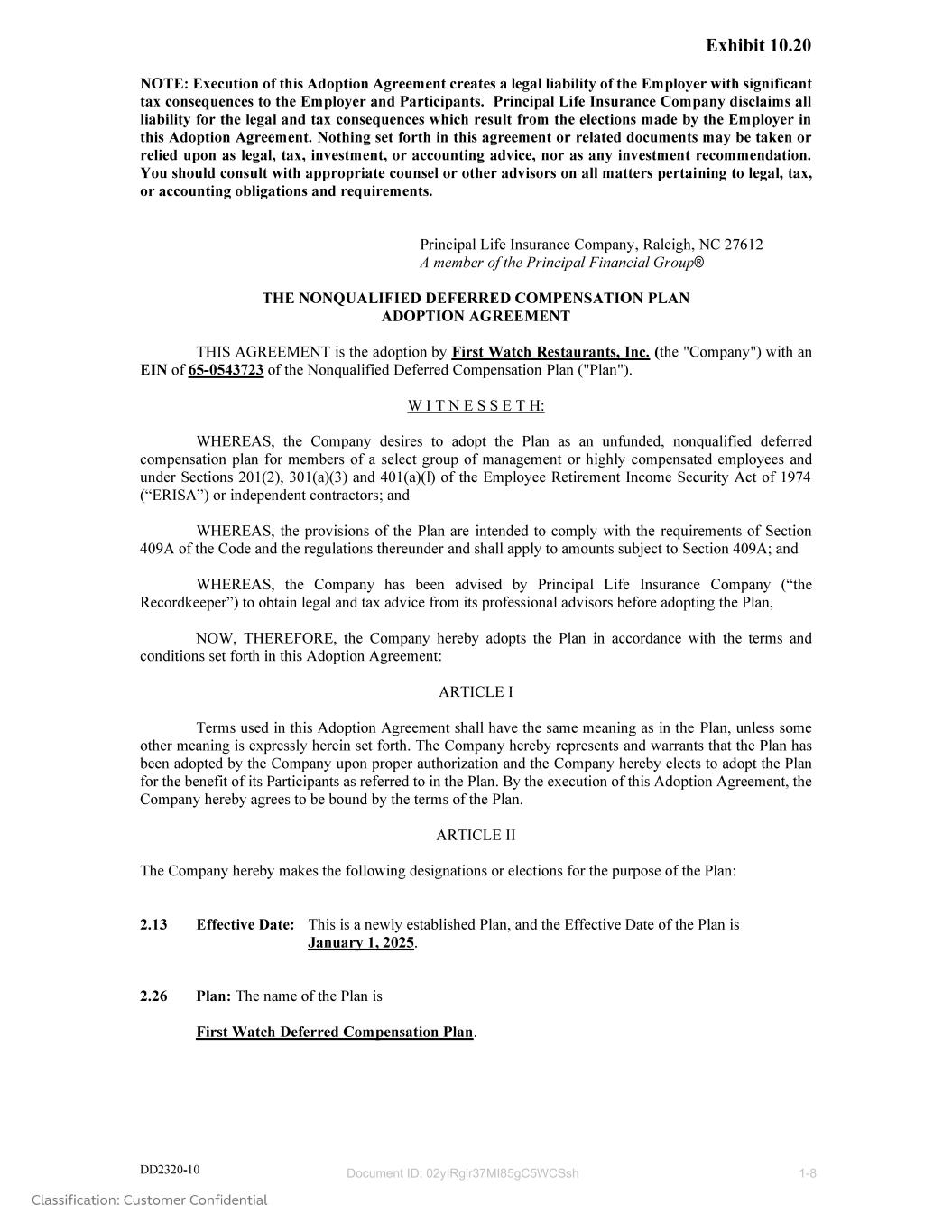
Exhibit 10.20
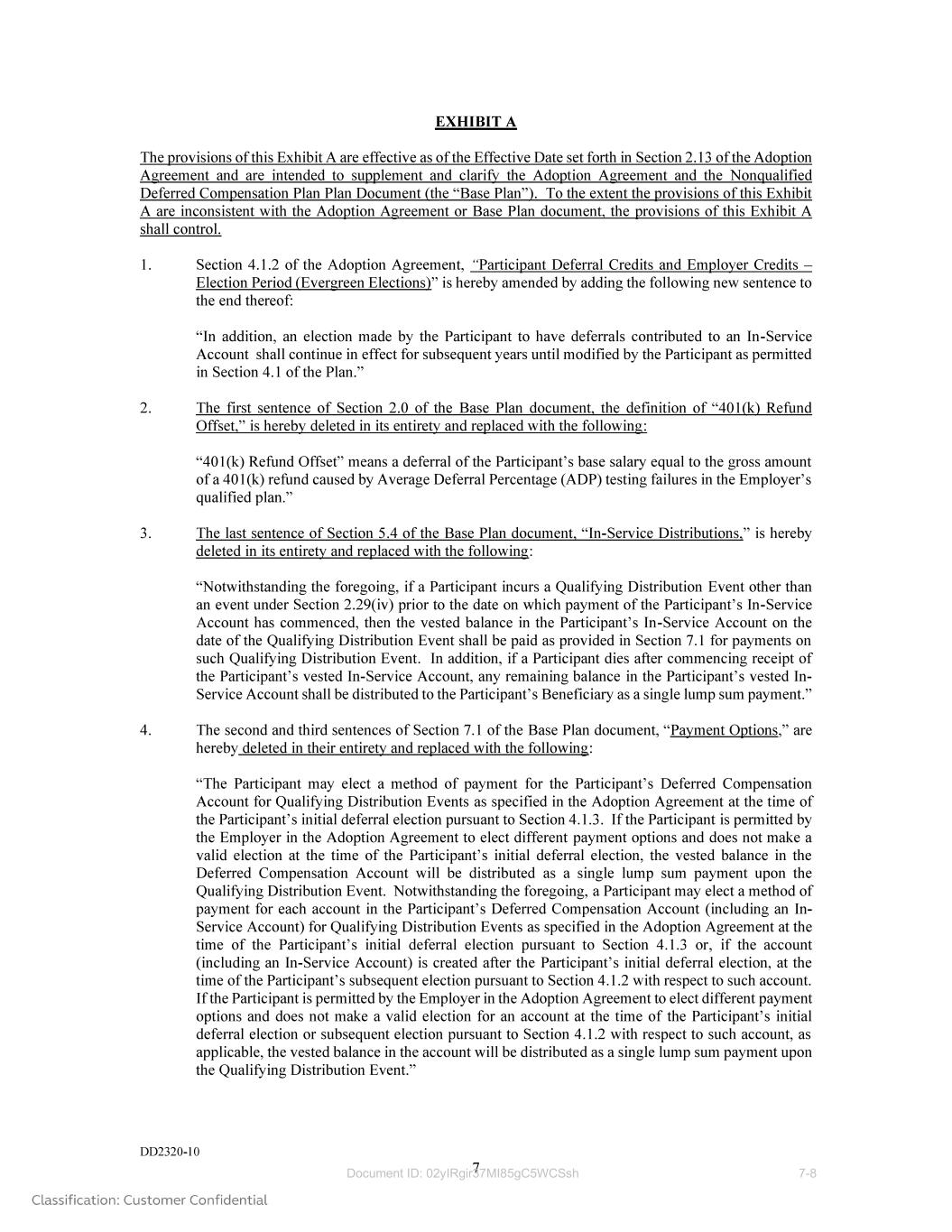
THE NONQUALIFIED DEFERRED COMPENSATION PLAN PLAN DOCUMENT
2 DD2326-10 THE NONQUALIFIED DEFERRED COMPENSATION PLAN Section 1. Purpose By execution of the Adoption Agreement, the Company has adopted the Plan set forth herein, and in the Adoption Agreement, to provide a means by which certain management Employees or Independent Contractors of the Employer may elect to defer receipt of current Compensation from the Employer in order to provide retirement and other benefits on behalf of such Employees or Independent Contractors of the Employer, as selected in the Adoption Agreement. The Plan is intended to be a nonqualified deferred compensation plan that complies with the provisions of Section 409A of the Internal Revenue Code (the "Code"). The Plan is also intended to be an unfunded plan maintained primarily for the purpose of providing deferred compensation benefits for a select group of management or highly compensated employees under Sections 201(2), 301(a)(3) and 401(a)(l) of the Employee Retirement Income Security Act of 1974 (“ERISA”) or independent contractors. Notwithstanding any other provision of this Plan, this Plan shall be interpreted, operated and administered in a manner consistent with these intentions. Section 2. Definitions 2.0 “401(k) Refund Offset” means a deferral of the Participant’s base salary equal to the gross amount of a 401(k)-refund caused by Average Deferral Percentage (ADP) testing failures in the qualified plan. The 401(k) refund itself shall be paid to the Participant from the 401(k) plan and reported on Form 1099-R. This deferral shall not apply to Roth 401(k) refunds or any other refund not generated due to failed testing.
3 DD2326-10 2.1 "Active Participant" means, with respect to any day or date, a Participant who is in Service on such day or date; provided, that a Participant shall cease to be an Active Participant (i) immediately upon a determination by the Committee that the Participant has ceased to be an Employee or Independent Contractor, or (ii) at the end of the Plan Year that the committee determines the Participant no longer meets the eligibility requirements of the Plan. 2.2 "Adoption Agreement" means the written agreement pursuant to which the Company adopts the Plan. The Adoption Agreement is a part of the Plan as applied to the Company. 2.3 "Beneficiary" means the person, persons, entity or entities designated or determined pursuant to the provisions of Section 13 of the Plan. 2.4 "Board" means the Board of Directors of the Company, if the Company is a corporation. If the Company is not a corporation, "Board" shall mean the Company. 2.5 "Change in Control Event" means an event described in Section 409A(a)(2)(A)(v) of the Code (or any successor provision thereto) and the regulations thereunder. 2.6 "Committee" means the Employer, an administrative committee appointed by the Board to serve at the pleasure of the Board, the Board itself, any other person or persons as determined in the Employer’s discretion, or any other person or persons noted in the Adoption Agreement. The Recordkeeper is not the Committee. 2.7 "Company" means the company designated in the Adoption Agreement. 2.8 "Compensation" shall have the meaning designated in the Adoption Agreement. 2.9 "Crediting Date" means the date any corresponding asset payment used to informally finance the Plan, if applicable, is credited to the Employer’s corporate owned
4 DD2326-10 investment account or any other day directed by the Employer. Otherwise, all Credits shall be credited on any business day as specified by the Employer. 2.10 "Deferred Compensation Account" means the account maintained with respect to each Participant under the Plan. The Deferred Compensation Account shall be credited with Participant Deferral Credits and Employer Credits, credited or debited for deemed investment gains or losses, and adjusted for payments in accordance with the rules and elections in effect under Section 8. As permitted in the Adoption Agreement, the Deferred Compensation Account of a Participant may consist of one or more accounts. A Participant may elect payment options for each account as described in Section 7.1 and deemed investments for each account as described in Section 8.2. 2.11 "Disabled or Disability" means Disabled or Disability within the meaning of Section 409A of the Code and the regulations thereunder. Generally, this means that the Participant is unable to engage in any substantial gainful activity by reason of any medically determinable physical or mental impairment which can be expected to result in death or can be expected to last for a continuous period of not less than 12 months, or is, by reason of any medically determinable physical or mental impairment which can be expected to result in death or can be expected to last for a continuous period of not less than 12 months, receiving income replacement benefits for a period of not less than three months under an accident and health plan covering Employees of the Employer. 2.12 “Education Account” is an In-Service Account which will be used by the Participant for educational purposes. 2.13 "Effective Date" shall be the date designated in the Adoption Agreement.
5 DD2326-10 2.14 "Employee" means an individual in the Service of the Employer if the relationship between the individual and the Employer is the legal relationship of employer and employee. An individual shall cease to be an Employee upon the Employee's Separation from Service. 2.15 "Employer" means the Company, as identified in the Adoption Agreement, and any Participating Employer which adopts this Plan. An Employer may be a corporation, a limited liability company, a partnership or sole proprietorship. 2.16 "Employer Credits" means the amounts credited to the Participant's Deferred Compensation Account by the Employer pursuant to the provisions of Section 4.2. 2.17 "Grandfathered Amounts" means, if applicable, the amounts that were deferred under the Plan and were earned and vested within the meaning of Section 409A of the Code and regulations thereunder as of December 31, 2004. Grandfathered Amounts shall be subject to the terms designated in the Plan which were in effect as of October 3, 2004. 2.18 "Independent Contractor" means an individual in the Service of the Employer if the relationship between the individual and the Employer is not the legal relationship of employer and employee. An individual shall cease to be an Independent Contractor upon the termination of the Independent Contractor's Service. An Independent Contractor shall include a director of the Employer who is not an Employee. 2.19 "In-Service Account" means a separate account to be kept for each Participant that has elected to take in-service distributions as described in Section 5.4. The In-Service Account shall be adjusted in the same manner and at the same time as the Deferred Compensation Account under Section 8 and in accordance with the rules and elections in effect under Section 8. 2.20 "Normal Retirement Age", which may also be called “Full Vesting Age”, of a Participant means the age designated in the Adoption Agreement.
6 DD2326-10 2.21 "Participant" means with respect to any Plan Year an Employee or Independent Contractor who has been designated by the Committee as a Participant and who has entered the Plan or who has a Deferred Compensation Account under the Plan; provided that if the Participant is an Employee, the individual must be a member of a select group of management or highly compensated employee of the Employer within the meaning of Sections 201(2), 301(a)(3) and 401(a)(1) of ERISA. 2.22 "Participant Deferral Credits" means the amounts credited to the Participant's Deferred Compensation Account by the Employer pursuant to the provisions of Section 4.1. 2.23 "Participating Employer" means any trade or business (whether or not incorporated) which adopts this Plan with the consent of the Company identified in the Adoption Agreement. 2.24 "Participation Agreement" means a written agreement, including electronic submissions by the Participant or at the Participant’s direction, entered into between a Participant and the Employer pursuant to the provisions of Section 4.1 2.25 "Performance-Based Compensation" means compensation where the amount of, or entitlement to, the compensation is contingent on the satisfaction of preestablished organizational or individual performance criteria relating to a performance period of at least twelve months. Organizational or individual performance criteria are considered preestablished if established in writing within 90 days after the commencement of the period of service to which the criteria relates, provided that the outcome is substantially uncertain at the time the criteria are established. Performance-based compensation may include payments based upon subjective performance criteria as provided in regulations and administrative guidance promulgated under Section 409A of the Code.
7 DD2326-10 2.26 "Plan" means the name of the Plan as designated in the Adoption Agreement. 2.27 "Plan-Approved Domestic Relations Order" shall mean a judgment, decree, or order (including the approval of a settlement agreement) which is: 2.27.1 Issued pursuant to a State's domestic relations law; 2.27.2 Relates to the provision of child support, alimony payments or marital property rights to a Spouse, former Spouse, child or other dependent of the Participant; 2.27.3 Creates or recognizes the right of a Spouse, former Spouse, child or other dependent of the Participant to receive all or a portion of the Participant's benefits under the Plan; 2.27.4 Requires payment to such person of an interest in the Participant's benefits in a lump sum payment or any other form of payment allowed under the Plan at a specific time; and 2.27.5 Meets such other requirements established by the Committee. 2.28 "Plan Year" means the twelve-month period ending on the last day of December, unless otherwise noted in the Adoption Agreement, provided, that the initial Plan Year may have fewer than twelve months. 2.28.1 “Recordkeeper” means the individual or entity responsible for keeping records of Plan activity including the tracking of Participant Deferred Compensation Account balances. As to applicable tax and regulatory rules, the actions of the Recordkeeper are limited to executing the decisions and directions of the Committee. The Recordkeeper does not make plan administration decisions. 2.29 "Qualifying Distribution Event" means (i) the Separation from Service of the Participant, (ii) the date the Participant becomes Disabled, (iii) the death of the Participant, (iv) the time specified by the Participant for an In-Service Distribution, (v) a Change in Control Event, or (vi) an Unforeseeable Emergency, each to the extent provided in Section 5.
8 DD2326-10 2.30 "Seniority Date" which may also be called “Installment Eligibility Date” shall have the meaning designated in the Adoption Agreement and shall apply to both the initial deferral election described in Section 4 and the Subsequent deferral election described in Section 7.5. 2.31 "Separation from Service" or "Separates from Service" means a "separation from service" within the meaning of Section 409A of the Code. 2.32 "Service" as an Employee means employment by the Employer. For purposes of the Plan, the employment relationship is treated as continuing intact while the Employee is on military leave, sick leave, or other bona fide leave of absence if the period of such leave does not exceed six months, or if longer, so long as the Employee's right to reemployment is provided either by statute or contract. If the Participant is an Independent Contractor, "Service" shall mean the period during which the contractual relationship exists between the Employer and the Participant. The contractual relationship is not terminated if the Participant anticipates a renewal of the contract or becomes an Employee. A Participant who has a Deferred Compensation Account which contains amounts deferred or contributed as an Employee and a member of the Board (Dual Status), Services performed in those capacities will be looked at independently when determining if a Separation from Service has occurred. Services as a member of the Board and Independent Contractor (in a capacity not on the Board) will be looked at collectively when determining if a Separation from Service has occurred. 2.33 "Service Bonus" means any bonus that does not meet the definition of Performance-Based Compensation that is paid to a Participant by the Employer as noted in the Adoption Agreement. 2.34 "Specified Employee" means an Employee who meets the requirements for key employee treatment under Section 416(i)(l)(A)(i), (ii) or (iii) of the Code (applied in accordance
9 DD2326-10 with the regulations thereunder and without regard to Section 416(i)(5) of the Code) at any time during the twelve month period ending on December 31 of each year (the "identification date"). If the person is a key employee as of any identification date, the person is treated as a Specified Employee for the twelve-month period beginning on the first day of the fourth month following the identification date. Unless binding corporate action is taken to establish different rules for determining Specified Employees for all plans of the Company and its controlled group members that are subject to Section 409A of the Code, the foregoing rules and the other default rules under the regulations of Section 409A of the Code shall apply. 2.35 "Spouse" or ''Surviving Spouse" means, except as otherwise provided in the Plan, a person who is the legally married spouse or surviving spouse of a Participant. 2.36 "Unforeseeable Emergency" means an "unforeseeable emergency" within the meaning of Section 409A of the Code. 2.37 "Years of Service" means each Plan Year of Service completed by the Participant. For vesting purposes, Years of Service shall be calculated from the date designated in the Adoption Agreement and Service shall be based on service with the Company and all Participating Employers. Section 3. Participation The Committee in its discretion shall designate each Employee or Independent Contractor who is eligible to participate in the Plan. A Participant who Separates from Service with the Employer and who later returns to Service may be eligible consistent with Section 409A of the Code and upon satisfaction of such terms and conditions as the Committee shall establish.
10 DD2326-10 Section 4. Credits to Deferred Compensation Account 4.1 Participant Deferral Credits. To the extent provided in the Adoption Agreement, each Active Participant may elect, by entering into a Participation Agreement with the Employer, to defer the receipt of Compensation from the Employer by a dollar amount or percentage specified in the Participation Agreement. The amount of Compensation the Participant elects to defer, the Participant Deferral Credit, shall be credited by the Employer to the Deferred Compensation Account maintained for the Participant pursuant to Section 8. The following special provisions shall apply with respect to the Participant Deferral Credits of a Participant: 4.1.1 The Employer shall credit to the Participant's Deferred Compensation Account on each Crediting Date an amount equal to the total Participant Deferral Credit for the period ending on such Crediting Date. 4.1.2 An election pursuant to this Section 4.1 shall be made by the Participant by executing and delivering a Participation Agreement to the Committee. Except as otherwise provided in this Section 4.1, the Participation Agreement shall become effective with respect to such Participant as of the first day of January following the date such Participation Agreement is received by the Committee. A Participant's election may be changed at any time prior to the last permissible date for making the election as permitted in this Section 4.1, and shall thereafter be irrevocable. Any election of a Participant shall continue in effect for the time period as set forth in the Adoption Agreement. 4.1.3 A Participant may execute and deliver a Participation Agreement to the Committee within 30 days after the date the Participant first becomes eligible to participate in the Plan. After the 30-day period expires, or after any shorter time period as agreed to by the Participant and the Committee, the latest election made by the Participant during that period becomes irrevocable. Such election shall then be effective as of the first payroll period commencing following the date the Participation Agreement becomes irrevocable. Whether a Participant is treated as newly eligible for participation under this Section shall be determined in accordance with Section 409A of the Code and the regulations thereunder, including (i) rules that treat all elective deferral account balance plans as one plan, and (ii) rules that treat a previously eligible Employee as newly eligible if the Participant’s benefits had been previously distributed or if the Participant has been ineligible for 24 months. For Compensation that is earned based upon a specified
11 DD2326-10 performance period (for example, an annual bonus), where a deferral election is made under this Section but after the beginning of the performance period, the election will only apply to the portion of the Compensation equal to the total amount of the Compensation for the service period multiplied by the ratio of the number of days remaining in the performance period after the date the election becomes irrevocable over the total number of days in the performance period. 4.1.4 A Participant may unilaterally modify a Participation Agreement (either to terminate, increase or decrease future Compensation which is subject to deferral within the percentage limits set forth in Section 4.1 of the Adoption Agreement) by providing a written modification of the Participation Agreement to the Committee. The modification shall become effective as of the first day of January following the date such written modification is received by the Committee, or at such later date as required under Section 409A of the Code. 4.1.5 If the Participant performed services continuously from the later of the beginning of the performance period or the date upon which the performance criteria are established through the date upon which the Participant makes an initial deferral election, a Participation Agreement relating to the deferral of Performance- Based Compensation may be executed and delivered to the Committee no later than the date which is 6 months prior to the end of the performance period, provided that in no event may an election to defer Performance-Based Compensation be made after such Compensation has become readily ascertainable. 4.1.6 If the Employer has a fiscal year other than the calendar year, Compensation relating to Service in the fiscal year of the Employer (such as a bonus based on the fiscal year of the Employer), of which no amount is paid or payable during the fiscal year, may be deferred at the Participant's election if the election to defer is made not later than the close of the Employer's fiscal year next preceding the first fiscal year in which the Participant performs any services for which such Compensation is payable. 4.1.7 Compensation payable after the last day of the Participant's taxable year solely for services provided during the final payroll period containing the last day of the Participant's taxable year (i.e., generally December 31) is treated for purposes of this Section 4.1 as Compensation for services performed in the subsequent taxable year. 4.1.8 The Committee may from time to time establish policies or rules consistent with the requirements of Section 409A of the Code to govern the manner in which Participant Deferral Credits may be made. 4.1.9 If a Participant becomes Disabled, all currently effective deferral elections for such Participant shall be cancelled. At the time the participant is no longer Disabled, subsequent elections to defer future compensation will be permitted under this Section 4.
12 DD2326-10 4.1.10 If a Participant applies for and receives a distribution on account of an Unforeseeable Emergency, all currently effective deferral elections for such Participant shall be cancelled. Subsequent elections to defer future compensation will be permitted under this Section 4. Furthermore, a Participant may apply to the Committee to cancel all deferral elections due to an Unforeseeable Emergency. 4.2 Employer Credits. If designated by the Employer in the Adoption Agreement, the Employer shall cause the Committee to credit to the Deferred Compensation Account of each Active Participant an Employer Credit as determined in accordance with the Adoption Agreement. A Participant must make distribution elections with respect to any Employer Credits credited to the Deferred Compensation Account by the deadline that would apply under Section 4.1 for distribution elections with respect to Participant Deferral Credits credited at the same time, on a Participation Agreement that is timely executed and delivered to the Committee pursuant to Section 4.1. If no distribution election is made, vested amounts in the Deferred Compensation Account will be distributed in a lump sum upon the earliest of any Qualifying Distribution Event limited to Separation from Service, Disability, Death or Change in Control. 4.3. Deferred Compensation Account. All Participant Deferral Credits and Employer Credits shall be credited to the Deferred Compensation Account of the Participant as provided in Section 8. Section 5. Qualifying Distribution Events 5.1 Separation from Service. If the Participant Separates from Service with the Employer, the vested balance in the Deferred Compensation Account shall be paid to the Participant by the Employer as provided in Section 7. Notwithstanding the foregoing, no distribution shall be made earlier than six months after the date of Separation from Service
13 DD2326-10 (or, if earlier, the date of death) with respect to a Participant who as of the date of Separation from Service is a Specified Employee of a corporation (or a member of such corporation's controlled group) the stock in which is traded on an established securities market (either foreign or domestic) or otherwise. Any payments to which such Specified Employee would be entitled during the first six months following the date of Separation from Service shall be accumulated and paid on the first day of the seventh month following the date of Separation from Service, and shall be adjusted for deemed investment gain and loss incurred during the six month period. 5.2 Disability. If the Employer designates in the Adoption Agreement that distributions are permitted under the Plan when a Participant becomes Disabled, and the Participant becomes Disabled while in Service, the vested balance in the Deferred Compensation Account shall be paid to the Participant by the Employer as provided in Section 7. 5.3 Death. If the Participant dies while in Service, the Employer shall pay a benefit to the Participant's Beneficiary in the amount of the vested balance in the Deferred Compensation Account and any additional amount designated in the Adoption Agreement. Payment of such benefit shall be made by the Employer as provided in Section 7. 5.4 In-Service Distributions. If the Employer designates in the Adoption Agreement that in-service distributions are permitted under the Plan, a Participant may designate in the Participation Agreement to have a specified amount credited to the Participant's In-Service Account for in-service distributions at the date specified by the Participant. In no event may an in- service distribution of an amount be made before the date that is two years after the first day of the year in which any deferral election to such In-Service Account became effective. Notwithstanding the foregoing, if a Participant incurs a Qualifying Distribution Event prior to the date on which the entire balance in the In-Service Account has been distributed, then the vested
14 DD2326-10 balance in the In-Service Account on the date of the Qualifying Distribution Event shall be paid as provided under Section 7.1 for payments on such Qualifying Distribution Event. 5.5 Change in Control Event. If the Employer designates in the Adoption Agreement that distributions are permitted under the Plan upon the occurrence of a Change in Control Event, the Participant may designate in the Participation Agreement to have the vested balance in the Deferred Compensation Account paid to the Participant upon a Change in Control Event by the Employer as provided in Section 7. 5.6 Unforeseeable Emergency. If the Employer designates in the Adoption Agreement that distributions are permitted under the Plan upon the occurrence of an Unforeseeable Emergency event, a distribution from the Deferred Compensation Account may be made to a Participant in the event of an Unforeseeable Emergency, subject to the following provisions: 5.6.1 A Participant may, make an application to the Committee to cancel all active deferral elections or to cancel deferral elections and receive a distribution in a lump sum of all or a portion of the vested balance in the Deferred Compensation Account (determined as of the date the distribution, if any, is made under this Section 5.6) because of an Unforeseeable Emergency. A distribution because of an Unforeseeable Emergency shall not exceed the amount required to satisfy the Unforeseeable Emergency plus amounts necessary to pay taxes reasonably anticipated as a result of such distribution, after taking into account the extent to which the Unforeseeable Emergency may be relieved through reimbursement or compensation by insurance or otherwise or by liquidation of the Participant's assets (to the extent the liquidation of such assets would not itself cause severe financial hardship) or by stopping current deferrals under the Plan pursuant to Section 4.1.10. 5.6.2 The Participant's request for a distribution on account of Unforeseeable Emergency must be made in writing to the Committee. The request must specify the nature of the financial hardship, the total amount requested to be distributed from the Deferred Compensation Account, and the total amount of the actual expense incurred or to be incurred on account of the Unforeseeable Emergency. 5.6.3 If a cancellation of deferral elections is approved, such cancellation will be effective as soon as practicable. If a distribution under this Section 5.6 is approved by the Committee, such distribution will be made as soon as practicable following
15 DD2326-10 the date it is approved. The processing of the request shall be completed as soon as practicable from the date on which the Committee receives the properly completed written request for a distribution on account of an Unforeseeable Emergency. If a Participant's Separation from Service occurs after a request is approved in accordance with this Section 5.6.3, but prior to distribution of the full amount approved, the approval of the request shall be automatically null and void and the benefits which the Participant is entitled to receive under the Plan shall be distributed in accordance with the applicable distribution provisions of the Plan. 5.6.4 The Committee may from time to time adopt additional policies or rules consistent with the requirements of Section 409A of the Code to govern the manner in which such distributions may be made so that the Plan may be conveniently administered. Section 6. Vesting A Participant shall be fully vested in the portion of the Deferred Compensation Account attributable to Participant Deferral Credits, and all income, gains and losses attributable thereto. A Participant shall become fully vested in the portion of the Deferred Compensation Account attributable to Employer Credits, and income, gains and losses attributable thereto, in accordance with the vesting schedule and provisions designated by the Employer in the Adoption Agreement. Once a Participant achieves vesting on an Employer Credit, it cannot be reduced or eliminated. If Change in Control was elected as a vesting event in the Adoption Agreement, participants accounts shall be fully vested upon a Change in Control, however new vesting schedules may be applied to future Employer Credits. If a Participant's Deferred Compensation Account is not fully vested upon Separation from Service, the portion of the Deferred Compensation Account that is not fully vested shall be forfeited.
16 DD2326-10 Section 7. Distribution Rules 7.1 Payment Options. The Employer shall designate in the Adoption Agreement the payment options which may be elected by the Participant. The Participant may at such time elect a method of payment for Qualifying Distribution Events as specified in the Adoption Agreement. If the Participant is permitted by the Employer in the Adoption Agreement to elect different payment options and does not make a valid election, the vested balance in the Deferred Compensation Account will be distributed as a lump sum upon the Qualifying Distribution Event. Notwithstanding the foregoing, if certain Qualifying Distribution Events occur prior to the date on which the vested balance of a Participant's Deferred Compensation Account is completely paid pursuant to this Section 7.1 following the occurrence of certain Qualifying Distribution Events, the following rules apply: 7.1.1 If the currently effective Qualifying Distribution Event is a Separation from Service or Disability, and the Participant subsequently dies, the remaining unpaid vested balance of a Participant's Deferred Compensation Account shall be paid as a lump sum. 7.1.2 If the currently effective Qualifying Distribution Event is a Change in Control Event, and any subsequent Qualifying Distribution Event occurs (except an In-Service Distribution described in Section 2.29(iv)), the remaining unpaid vested balance of a Participant's Deferred Compensation Account shall be paid as provided under Section 7.1 for payments on such subsequent Qualifying Distribution Event. 7.2 Timing of Payments. Payment shall be made in the manner elected by the Participant and shall commence as soon as practicable after the distribution date specified for the Qualifying Distribution Event. Distribution shall be no later than within 60 days following the day after the Qualifying Distribution Event. Such payment shall not be deemed late if the payment is made on or before the later of (i) December 31 of the calendar year in which the Qualifying Distribution Event occurs, or (ii) the date that is 2-1/2 months after the Qualifying Distribution
17 DD2326-10 Event occurs. Participants shall not have any influence as to the tax year or timing of the distribution. For each payment, the Committee must specify a date for the Deferred Compensation Account(s) to be valued. In the event the Participant fails to make a valid election of the payment method, the distribution will be made in a single lump sum payment as soon as practicable after the Qualifying Distribution Event. A payment may be further delayed to the extent permitted in accordance with regulations and guidance under Section 409A of the Code. 7.3 Installment Payments. If the Participant elects to receive installment payments upon a Qualifying Distribution Event, the payment of each installment shall be made on the anniversary of the date of the first installment payment, and the amount of the installment shall be adjusted on such anniversary for credits or debits to the Participant's account pursuant to Section 8 of the Plan. Such adjustment shall be made by dividing the balance in the Deferred Compensation Account on such date by the number of installments remaining to be paid hereunder; provided that the last installment due under the Plan shall be the entire amount credited to the Participant's account on the date of payment. 7.4 De Minimis Amounts. Notwithstanding any payment election made by the Participant, if the Employer designates a pre-determined de minimis amount in the Adoption Agreement, the vested balance in all Deferred Compensation Accounts of the Participant will be distributed in a single lump sum payment if at the time of a permitted Qualifying Distribution Event the vested balance does not exceed such pre-determined de minimis amount; provided, however, that such distribution will be made only where the Qualifying Distribution Event is a Separation from Service, death, Disability, or Change in Control Event. In addition, the Employer may distribute a Participant's vested balance in all of the Participant’s Deferred Compensation Accounts at any time if the balance does not exceed the limit in Section 402(g)(1)(B) of the Code
18 DD2326-10 and results in the termination of the Participant's entire interest in the Plan as provided under Section 409A of the Code. 7.5 Subsequent Elections. With the consent of the Committee, a Participant may delay or change the method of payment of the Deferred Compensation Account subject to the following requirements: 7.5.1 The new election may not take effect until at least 12 months after the date on which the new election is made. 7.5.2 If the new election relates to a payment for a Qualifying Distribution Event other than the death of the Participant, the Participant becoming Disabled, or an Unforeseeable Emergency, the new election must provide for the deferral of the payment for a period of at least five years from the date such payment would otherwise have been made. 7.5.3 If the new election relates to a payment from the In-Service Account, the new election must be made at least 12 months prior to the date of the first scheduled payment from such account. For purposes of this Section 7.5 and Section 7.6, a payment is each separately identified amount to which the Participant is entitled under the Plan; provided, that entitlement to a series of installment payments is treated as the entitlement to a single payment. 7.6 Acceleration Prohibited. The acceleration of the time or schedule of any payment due under the Plan is prohibited except as expressly provided in regulations and administrative guidance promulgated under Section 409A of the Code (such as accelerations for domestic relations orders and employment taxes). It is not an acceleration of the time or schedule of payment if the Employer waives or accelerates the vesting requirements applicable to a benefit under the Plan. 7.7 Residual Distributions. If calculation of the amount of any credit to a Participant’s Deferred Compensation Account is not administratively practicable due to events beyond the
19 DD2326-10 control of the Employer, payments may be made to the Participant for residual amounts contributed to or remaining in a Deferred Compensation Account after payments under the provisions of this Section 7 have commenced or been completed. The residual amount shall be credited to the Deferred Compensation Account when the calculation of the amount becomes administratively practicable. Examples of residual amounts include, but are not limited to, additional investment returns credited after payment (due to dividends or pricing changes) or additional contributions made after payment (such as an annual bonus deferral or an Employer Credit). Payments that would have been made had the residual amount been calculable at the benefit commencement date shall be made up as soon as practicable after crediting to the Deferred Compensation Account, in no case later than the end of the year in which calculation of the amount becomes administratively practicable. 7.8 Ineffective Deferrals. If a Participant deferral election under Section 4 to contribute to an In-Service Account carries over to a subsequent year (an evergreen election) and the deferral election is ineffective (i.e., the distribution election would cause payment in the current or prior years), the amount deferred will be credited to a Deferred Compensation Account that is not an In-Service Account. If the Participant only has one account of this type, the amount deferred will be credited to that account. If the Participant has multiple accounts of this type, and one of the accounts has a lump sum at Separation from Service distribution election, the amount deferred will be credited to that account. If the Participant has multiple accounts of this type and does not have an account with a lump sum at Separation from Service distribution election, one will be established with a lump sum at Separation from Service distribution election and the amount deferred will be credited to this account.
20 DD2326-10 Section 8. Accounts; Deemed Investment; Adjustments to Account 8.1 Accounts. The Committee shall establish a book reserve account, entitled the "Deferred Compensation Account," on behalf of each Participant. The Committee shall also establish an In-Service Account as a part of the Deferred Compensation Account of each Participant, if applicable. The amount credited to the Deferred Compensation Account shall be adjusted pursuant to the provisions of Section 8.3. 8.2 Deemed Investments. The Deferred Compensation Account of a Participant shall be credited with an investment return determined as if the account were invested in one or more investment funds made available by the Committee. The Participant shall elect the investment funds in which the Participant’s Deferred Compensation Account shall be deemed to be invested. Such election shall be made in the manner prescribed by the Committee and shall take effect upon the entry of the Participant into the Plan. The investment election of the Participant shall remain in effect until a new election is made by the Participant. In the event the Participant fails for any reason to make an effective election of the investment return to be credited to the account, the investment return shall be determined by the Committee. 8.3 Adjustments to Deferred Compensation Account. With respect to each Participant who has a Deferred Compensation Account under the Plan, the amount credited to such account shall be adjusted by the following debits and credits, at the times and in the order stated: 8.3.1 The Deferred Compensation Account shall be debited each business day with the total amount of any payments made from such account since the last preceding business day. Unless otherwise specified by the Employer, each deemed investment fund will be debited pro-rata based on the value of the investment funds as of the end of the preceding business day. 8.3.2 The Deferred Compensation Account shall be credited on each Crediting Date with the total amount of any Participant Deferral Credits and Employer Credits to such account since the last preceding Crediting Date.
21 DD2326-10 8.3.3 The Deferred Compensation Account shall be credited or debited on each day securities are traded on a national stock exchange with the amount of deemed investment gain or loss resulting from the performance of the deemed investment funds elected by the Participant in accordance with Section 8.2. The amount of such deemed investment gain or loss shall be determined by the Committee and such determination shall be final and conclusive upon all concerned. Section 9. Administration by Committee 9.1 Membership of Committee. If the Committee consists of individuals appointed by the Board, they will serve at the pleasure of the Board. Any member of the Committee may resign, and any successor shall be appointed by the Board. 9.2 General Administration. The Committee shall be responsible for the operation and administration of the Plan and for carrying out its provisions. The Committee shall have the full authority and discretion to make, amend, interpret, and enforce all appropriate rules and regulations for the administration of this Plan and decide or resolve any and all questions, including interpretations of this Plan, as may arise in connection with this Plan. Any such action taken by the Committee shall be final and conclusive on any party. To the extent the Committee has been granted discretionary authority under the Plan, the Committee’s prior exercise of such authority shall not obligate it to exercise its authority in a like fashion thereafter. The Committee shall be entitled to rely conclusively upon all tables, valuations, certificates, opinions and reports furnished by any actuary, accountant, controller, counsel or other person employed or engaged by the Employer with respect to the Plan. The Committee may, from time to time, employ agents and delegate to such agents, including Employees of the Employer, such administrative or other duties as it sees fit. 9.3 Indemnification. To the extent not covered by insurance, the Employer shall
22 DD2326-10 indemnify the Committee, each Employee, officer, director, and agent of the Employer, and all persons formerly serving in such capacities, against any and all liabilities or expenses, including all legal fees relating thereto, arising in connection with the exercise of duties and responsibilities with respect to the Plan, provided however that the Employer shall not indemnify any person for liabilities or expenses due to that person’s own gross negligence or willful misconduct. Section 10. Contractual Liability, Trust 10.1 Contractual Liability. Unless otherwise elected in the Adoption Agreement, the Company shall be obligated to make all payments hereunder. This obligation shall constitute a contractual liability of the Company to the Participants, and such payments shall be made from the general funds of the Company. The Company shall not be required to establish or maintain any special or separate fund, or otherwise to segregate assets to assure that such payments shall be made, and the Participants shall not have any interest in any particular assets of the Company by reason of its obligations hereunder. To the extent that any person acquires a right to receive payment from the Company under the Plan, such right shall be no greater than the right of an unsecured creditor of the Company. 10.2 Trust. The Employer may establish a trust to assist it in meeting its obligations under the Plan. Any such trust shall conform to the requirements of a grantor trust under Revenue Procedures 92-64 and 92-65 and at all times during the continuance of the trust the principal and income of the trust shall be subject to claims of general creditors of the Employer under federal and state law. The establishment of such a trust would not be intended to cause Participants to realize current income on amounts contributed thereto, and the trust would be so interpreted and administered.
23 DD2326-10 Section 11. Allocation of Responsibilities The persons responsible for the Plan and the duties and responsibilities allocated to each are as follows: 11.1 Board. (i) To amend the Plan; (ii) To appoint and remove members of the Committee; and (iii) To terminate the Plan as permitted in Section 14. 11.2 Committee. (i) To designate Participants; (ii) To interpret the provisions of the Plan and to determine the rights of the Participants under the Plan, except to the extent otherwise provided in Section 16 relating to claims procedure; (iii) To administer the Plan in accordance with its terms, except to the extent powers to administer the Plan are specifically delegated to another person or persons as provided in the Plan; (iv) To account for the amount credited to the Deferred Compensation Account of a Participant; (v) To direct the Employer in the payment of benefits; (vi) To file such reports as may be required with the United States Department of Labor, the Internal Revenue Service and any other government agency to which reports may be required to be submitted from time to time; and (vii) To administer the claims procedure to the extent provided in Section 16. Section 12. Benefits Not Assignable; Facility of Payments 12.1 Benefits Not Assignable. No portion of any benefit credited or paid under the Plan with respect to any Participant shall be subject in any manner to anticipation, alienation, sale, transfer, assignment, pledge, encumbrance or charge, and any attempt so to anticipate, alienate, sell, transfer, assign, pledge, encumber or charge the same shall be void, nor shall any portion of
24 DD2326-10 such benefit be in any manner payable to any assignee, receiver or any one trustee. 12.2 Plan-Approved Domestic Relations Orders. The Committee shall establish procedures for determining whether an order directed to the Plan is a Plan- Approved Domestic Relations Order. If the Committee determines that an order is a Plan- Approved Domestic Relations Order, the Committee shall cause the payment of amounts pursuant to or segregate a separate account as provided by (and to prevent any payment or act which might be inconsistent with) the Plan-Approved Domestic Relations Order notwithstanding Section 12.1. 12.3 Payments to Minors and Others. If any individual entitled to receive a payment under the Plan shall be physically, mentally or legally incapable of receiving or acknowledging receipt of such payment, the Committee, upon the receipt of satisfactory evidence of incapacity and satisfactory evidence that another person or institution is maintaining custody of that person and that no guardian or committee has been appointed, may cause any payment otherwise payable to that person to be made to such person or institution so maintaining custody. Payment to such person or institution shall be in full satisfaction of all claims by or through the Participant to the extent of the amount thereof. Section 13. Beneficiary The Participant's Beneficiary shall be the person, persons, entity or entities designated by the Participant on the Beneficiary designation form provided by and filed with the Committee or its designee. If the Participant does not designate a Beneficiary, the Beneficiary shall be the Surviving Spouse. If the Participant does not designate a Beneficiary and has no Surviving Spouse, the Beneficiary shall be the Participant's estate. The designation of a Beneficiary may be changed or revoked only by filing a new Beneficiary designation form with the Committee or its designee. If a Beneficiary (the "primary Beneficiary") is receiving or is entitled to receive
25 DD2326-10 payments under the Plan and dies before receiving all of the payments due, the balance to which the Beneficiary is entitled shall be paid to the contingent Beneficiary, if any, named in the Participant's current Beneficiary designation form. If there is no contingent Beneficiary, the balance shall be paid to the estate of the primary Beneficiary. Any Beneficiary may disclaim all or any part of any benefit to which such Beneficiary shall be entitled hereunder by filing a written disclaimer with the Committee before payment of such benefit is to be made. Such a disclaimer shall be made in a form satisfactory to the Committee and shall be irrevocable when filed. Any benefit disclaimed shall be payable from the Plan in the same manner as if the Beneficiary who filed the disclaimer had predeceased the Participant. Section 14. Amendment and Termination of Plan The Employer may amend any provision of the Plan or terminate the Plan at any time; provided, that in no event shall such amendment or termination reduce the balance in any Participant's Deferred Compensation Account, including reduction in vesting percentage, as of the date of such amendment or termination, nor shall any such amendment materially adversely affect the Participant relating to the payment of such Deferred Compensation Account. Notwithstanding the foregoing, the following special provisions shall apply: 14.1 Termination and liquidation of the Plan in the Discretion of the Employer. The Employer in its discretion may terminate the Plan and distribute vested benefits in a single lump sum to Participants subject to the following requirements and any others specified under Section 409A of the Code: 14.1.1 All arrangements sponsored by the Employer that would be aggregated with the Plan under Section 1.409A-l(c) of the Treasury Regulations are terminated. 14.1.2 No payments other than payments that would be payable under the terms
26 DD2326-10 of the Plan if the termination had not occurred are made within 12 months of the termination date. 14.1.3 All benefits under the Plan are paid within 24 months of the termination date. 14.1.4 The Employer does not adopt a new arrangement that would be aggregated with the Plan under Section 1.409A-1(c) of the Treasury Regulations providing for the deferral of compensation at any time within 3 years following the date of termination of the Plan. 14.1.5 The termination does not occur proximate to a downturn in the financial health of the Employer. Distribution of benefits shall occur in the same tax year for all Participants. 14.2 Termination and liquidation of the Plan Upon Change in Control Event. If the Employer terminates the Plan within thirty days preceding or twelve months following a Change in Control Event, the vested Deferred Compensation Account of each Participant shall become payable to the Participant in a lump sum within twelve months following the date of termination, subject to the requirements of Section 409A of the Code. Distribution of benefits shall occur in the same tax year for all Participants. 14.3 Termination and liquidation of the Plan upon Corporate Dissolution. The Plan may be terminated within 12 months of a corporate dissolution taxed under Section 331, or with the approval of a bankruptcy court provided the amounts deferred under the plan are included in the Participant’s gross income as required under Section 409A of the Code. Section 15. Communication to Participants The Employer shall make a copy of the Plan available for inspection by Participants and Beneficiaries during reasonable hours at the principal office of the Employer.
27 DD2326-10 Section 16. Claims Procedure The following claims procedure shall apply with respect to the Plan: 16.1 Filing of a Claim for Benefits. If a Participant or Beneficiary (the "claimant") believes there is an entitlement to benefits by the claimant under the Plan which is not being paid or which is not being accrued for the claimant’s benefit, the claimant shall file a written claim therefore with the Committee. 16.2 Notification to Claimant of Decision. Within 90 days after receipt of a claim by the Committee (or within 180 days if special circumstances require an extension of time), the Committee shall notify the claimant of the decision with regard to the claim. In the event of such special circumstances requiring an extension of time, there shall be furnished to the claimant prior to expiration of the initial 90-day period written notice of the extension, which notice shall set forth the special circumstances and the date by which the decision shall be furnished. If such claim shall be wholly or partially denied, notice thereof shall be in writing and worded in a manner calculated to be understood by the claimant, and shall set forth: (i) the specific reason or reasons for the denial; (ii) specific reference to pertinent provisions of the Plan on which the denial is based; (iii) a description of any additional material or information necessary for the claimant to perfect the claim and an explanation of why such material or information is necessary; and (iv) an explanation of the procedure for review of the denial and the time limits applicable to such procedures, including a statement of the claimant's right to bring a civil action under ERISA following an adverse benefit determination on review. 16.3 Procedure for Review. Within 60 days following receipt by the claimant of notice of denying a claim, in whole or in part, or, if such notice shall not be given, within 60 days following the latest date on which such notice could have been timely given, the claimant may
28 DD2326-10 appeal denial of the claim by filing a written application for review with the Committee. Following such request for review, the Committee shall fully and fairly review the decision denying the claim. Prior to the decision of the Committee, the claimant shall be given an opportunity to review pertinent documents and to submit issues and comments in writing. 16.4 Decision on Review. The decision on review of a claim denied in whole or in part by the Committee shall be made in the following manner: 16.4.1 Within 60 days following receipt by the Committee of the request for review (or within 120 days if special circumstances require an extension of time), the Committee shall notify the claimant in writing of its decision with regard to the claim. In the event of such special circumstances requiring an extension of time, written notice of the extension shall be furnished to the claimant prior to the commencement of the extension. 16.4.2 With respect to a claim that is denied in whole or in part, the decision on review shall set forth specific reasons for the decision, shall be written in a manner calculated to be understood by the claimant, and shall set forth: (i) the specific reason or reasons for the adverse determination; (ii) specific reference to pertinent Plan provisions on which the adverse determination is based; (iii) a statement that the claimant is entitled to receive, upon request and free of charge, reasonable access to, and copies of, all documents, records, and other information relevant to the claimant’s claim for benefits; and (iv) a statement describing any voluntary appeal procedures offered by the Plan and the claimant’s right to obtain the information about such procedures, as well as a statement of the claimant’s right to bring an action under ERISA section 502(a). 16.4.3 The decision of the Committee shall be final and conclusive. 16.5 Action by Authorized Representative of Claimant. All actions set forth in this Section 16 to be taken by the claimant may likewise be taken by a representative of the claimant duly authorized by the claimant to act on the claimant’s behalf on such matters. The Committee may require such evidence of the authority to act of any such representative as it may reasonably
29 DD2326-10 deem necessary or advisable. 16.6 Disability Claims. Notwithstanding any provision of the Plan to the contrary, if a claim for benefits is based on Disability, the following claims procedures shall apply: The Committee shall maintain a procedure under which any Participant or Beneficiary can file a claim for benefits under this Plan based on Disability. 16.6.1 After receiving a claim for benefits, the Committee will notify the Participant or Beneficiary of its claim determination within 45 days of the receipt of the claim. This period may be extended by 30 days if an extension is necessary to process the claim due to matters beyond the control of the Committee. A written notice of the extension, the reason for the extension and when the Committee expects to decide the claim, will be furnished to the Participant or Beneficiary within the initial 45-day period. This period may be extended for an additional 30 days beyond the original extension. A written notice of the additional extension, the reason for the additional extension and when the Committee expects to decide the claim, will be furnished to the Participant or Beneficiary within the first 30-day extension period if an additional extension of time is needed. However, if a period of time is extended due to a Participant or Beneficiary’s failure to submit information necessary to decide a claim, the period for making the benefit determination by the Committee will be tolled from the date on which the notification of the extension is sent to the Participant or Beneficiary until the date on which the Participant or Beneficiary responds to the request for additional information. 16.6.2 If a claim for benefits is denied, in whole or in part, a Participant or Beneficiary or an authorized representative, will receive a written notice of the denial. The notice will follow the rules of 29 C.F.R. § 2560.503-1(o) for culturally and linguistically appropriate notices and will be written in a manner calculated to be understood by the Participant or Beneficiary. The notice will include: (i) the specific reason(s) for the denial, (ii) references to the specific Plan provisions on which the benefit determination was based, (iii) a description of any additional material or information necessary to perfect a claim and an explanation of why such information is necessary, (iv) a description of the Committee’s appeals procedures and applicable time limits, including, to the extent applicable, a statement of the right to bring a civil action under section 502(a) of ERISA following an adverse benefit determination on review,
30 DD2326-10 (v) a discussion of the decision, including an explanation of the basis for disagreeing with or not following: (i) the views presented by the claimant to the Committee of health care professionals treating the claimant and vocational professionals who evaluated the claimant; (ii) the views of medical or vocational experts whose advice was obtained on behalf of the Committee in connection with a claimant’s adverse benefit determination, without regard to whether the advice was relied upon in making the benefit determination; and (iii) a disability determination regarding the claimant presented by the claimant to the Committee made by the Social Security Administration, (vi) if the determination is based on medical necessity or experimental treatment or similar exclusion or limit, either an explanation of the scientific or clinical judgment for the determination, applying the terms of the Plan to the relevant medical circumstances, or a statement that such explanation will be provided free of charge upon request, (vii) either the specific internal rules, guidelines, protocols, standards or other similar criteria of the Plan relied upon in making the adverse benefit determination, or a statement that such rules, guidelines, protocols, standards, or other similar criteria of the Plan do not exist, and (viii) a statement that the Participant or Beneficiary is entitled to receive, upon request and free of charge, reasonable access to, and copies of, all documents, records, and other information relevant to the claim for benefits. 16.6.3 If a claim for benefits is denied, a Participant, Beneficiary, or representative, may appeal the denied claim in writing within 180 days of receipt of the written notice of denial. The Participant or Beneficiary may submit any written comments, documents, records and any other information relating to the claim. Upon request, the Participant or Beneficiary will also have access to, and the right to obtain copies of, all documents, records and information relevant to the claim free of charge. 16.6.4 A full review of the information in the claim file and any new information submitted to support the appeal will be conducted. The claim decision will be made by a first review appeals committee appointed by the Employer. This committee will consist of individuals who were not involved in the initial benefit determination, nor will such individuals be subordinate to any person involved in the initial benefit determination. This review will not afford any deference to the initial benefit determination. 16.6.5 If the initial adverse decision was based in whole or in part on a medical judgment, the first review appeals committee will consult with a healthcare professional who has appropriate training and experience in the field of medicine involved in the medical judgment, was not consulted in the initial adverse benefit determination and is not a subordinate of the healthcare professional who was consulted in the initial adverse benefit determination.
31 DD2326-10 16.6.6 Before an adverse benefit determination on review is issued, the first review appeals committee will provide the Participant or Beneficiary, free of charge, with any new or additional evidence considered, relied upon, or generated by the committee or other person making the benefit determination (or at the direction of the committee or such other person) in connection with the claim. Such evidence will be provided as soon as possible and sufficiently in advance of the date on which the notice of adverse benefit determination on review is required to be provided to give the Participant or Beneficiary a reasonable opportunity to respond prior to that date. 16.6.7 Before the first review appeals committee issues an adverse benefit determination on review based on a new or additional rationale, the committee will provide the Participant or Beneficiary, free of charge, with the rationale. The rationale will be provided as soon as possible and sufficiently in advance of the date on which the notice of adverse benefit determination on review is required to be provided to give the Participant or Beneficiary a reasonable opportunity to respond prior to that date. 16.6.8 The first review appeals committee will make a determination on an appealed claim within 45 days of the receipt of an appeal request. This period may be extended for an additional 45 days if the committee determines that special circumstances require an extension of time. A written notice of the extension, the reason for the extension and the date that the committee expects to render a decision will be furnished to the Participant or Beneficiary within the initial 45-day period. However, if the period of time is extended due to a Participant’s or Beneficiary’s failure to submit information necessary to decide the appeal, the period for making the benefit determination will be tolled from the date on which the notification of the extension is sent until the date on which the Participant or Beneficiary responds to the request for additional information. 16.6.9 If the claim on appeal is denied in whole or in part, a Participant or Beneficiary will receive a written notification of the denial. The notice will follow the rules of 29 C.F.R. § 2560.503-1(o) for culturally and linguistically appropriate notices and will be written in a manner calculated to be understood by the claimant. The notice will include: (i) the specific reason(s) for the adverse determination, (ii) references to the specific Plan provisions on which the determination was based, (iii) a statement regarding the right to receive upon request and free of charge reasonable access to, and copies of, all records, documents and other information relevant to the benefit claim, (iv) a description of the first review appeals committee’s review procedures and
32 DD2326-10 applicable time limits, including a statement of the right to bring a civil action under section 502(a) of ERISA following an adverse benefit determination on review, (v) a discussion of the decision, including an explanation of the basis for disagreeing with or not following: (i) the views presented by the claimant to the committee of health care professionals treating the claimant and vocational professionals who evaluated the claimant; (ii) the views of medical or vocational experts whose advice was obtained by or on behalf of the committee in connection with a claimant’s adverse benefit determination, without regard to whether the advice was relied upon in making the benefit determination; and (iii) a disability determination regarding the claimant presented by the claimant to the committee made by the Social Security Administration, (vi) if the determination is based on medical necessity or experimental treatment or similar exclusion or limit, either an explanation of the scientific or clinical judgment for the determination, applying the terms of the Plan to the relevant medical circumstances, or a statement that such explanation will be provided free of charge upon request, and (vii) either the specific internal rules, guidelines, protocols, standards or other similar criteria of the Plan relied upon in making the adverse benefit determination, or a statement that such rules, guidelines, protocols, standards, or other similar criteria of the Plan do not exist. 16.6.10 If the appeal of the benefit claim denial is denied, a Participant, Beneficiary, or representative, may make a second appeal of the denial in writing to the Committee within 180 days of the receipt of the written notice of denial. The Participant or Beneficiary may submit with the second appeal any written comments, documents, records and any other information relating to the claim. Upon request, the Participant or Beneficiary will also have access to, and the right to obtain copies of, all documents, records and information relevant to the claim free of charge. 16.6.11 Upon receipt of the second appeal, a full review of the information in the claim file and any new information submitted to support the appeal will be conducted. The claim decision will be made by a second review appeals committee appointed by the Employer. This committee will consist of individuals who were not involved in the initial benefit determination or the first review appeals committee, nor will such individuals be subordinate to any person involved in the initial benefit or first appeal determination. 16.6.12 If the first appeal was based in whole or in part on a medical judgment, the second appeals review committee will consult with a healthcare professional who has appropriate training and experience in the field of medicine involved in the medical judgment, was not consulted in the initial adverse benefit determination nor in the first appeal and is not a subordinate of the healthcare
33 DD2326-10 professional(s) consulted in the initial adverse benefit determination and first appeal. 16.6.13 Before the second appeals review committee issues a denial of the second claim appeal, the committee will provide the Participant or Beneficiary, free of charge, with any new or additional evidence considered, relied upon, or generated by the committee or other person making the benefit determination (or at the direction of the committee or such other person) in connection with the claim. Such evidence will be provided as soon as possible and sufficiently in advance of the date on which the notice of adverse benefit determination on review is required to be provided to give the Participant or Beneficiary a reasonable opportunity to respond prior to that date. 16.6.14 Before the second review appeals committee issues a denial of the second claim appeal based on a new or additional rationale, the committee will provide the Participant or Beneficiary, free of charge, with the rationale. The rationale will be provided as soon as possible and sufficiently in advance of the date on which the notice of adverse benefit determination on review is required to be provided to give the Participant or Beneficiary a reasonable opportunity to respond prior to that date. 16.6.15 The second appeals review committee will make a determination on the second claim appeal within 45 days of the receipt of the appeal request. This period may be extended for an additional 45 days if the committee determines that special circumstances require an extension of time. A written notice of the extension, the reason for the extension and the date that the committee expects to render a decision will be furnished to the Participant or Beneficiary within the initial 45-day period. However, if the period of time is extended due to the Participant’s or Beneficiary’s failure to submit information necessary to decide the appeal, the period for making the benefit determination will be tolled from the date on which the notification of the extension is sent until the date on which the Participant or Beneficiary responds to the request for additional information. 16.6.16 If the claim on appeal is denied in whole or in part for a second time, the Participant or Beneficiary will receive a written notification of the denial. The notice will follow the rules of 29 C.F.R. § 2560.503-1(o) for culturally and linguistically appropriate notices and will be written in a manner calculated to be understood by the applicant. The notice will include the same information that was included in the first adverse determination letter and will identify the contractual limitations period that applies to the Participant’s or Beneficiary’s right to bring an action under section 502(a) of ERISA including the calendar date on which the contractual limitations period expires for the claim. 16.6.17 A claimant may not commence a judicial proceeding against any person, including the Committee, the Employer, the Board, the first or second appeals review committee(s), or any other person or committee, with respect to a claim for benefits without first exhausting the claims procedures set forth in the preceding paragraphs. No suit or legal action contesting in whole or in part any denial of
34 DD2326-10 benefits under the Plan shall be commenced later than the earlier of (i) the first anniversary of (A) the date of the notice of the Committee’s final decision on appeal, or (B) if the claimant fails to request any level of administrative review within the timeframe permitted under this Section 16.6, the deadline for requesting the next level of administrative review, and (ii) the last date on which such legal action could be commenced under the applicable statute of limitations under ERISA (including, for this purpose, any applicable state statute of limitations that applies under ERISA to such legal action). 16.6.18 A claimant has the right to request a written explanation of any violation of these claims procedures. The Committee will provide an explanation within 10 days of the request. Section 17. Miscellaneous Provisions 17.1 Set off. The Employer may at any time offset a Participant's Deferred Compensation Account by an amount up to $5,000 to collect the amount of any loan, cash advance, extension of other credit or other obligation of the Participant to the Employer that is then due and payable in accordance with the requirements of Section 409A of the Code. 17.2 Notices. Each Participant who is not in Service and each Beneficiary shall be responsible for furnishing the Committee or its designee with the current address, and direct deposit information if desired, for the mailing of notices and benefit payments. Any notice required or permitted to be given to such Participant or Beneficiary shall be deemed given if directed to such address and mailed by regular United States mail, first class, postage prepaid. If any benefit distribution is rejected or returned to the Employer, benefit payments will be suspended until the Participant or Beneficiary furnishes the proper information. This provision shall not be construed as requiring the mailing of any notice or notification otherwise permitted to be given by posting or by other publication. 17.3 Lost Distributees. A benefit shall be deemed forfeited if the Committee is unable to locate the Participant or Beneficiary to whom payment is due by the fifth anniversary of the
35 DD2326-10 date payment is to be made or commence; provided, that the deemed investment rate of return pursuant to Section 8.2 shall cease to be applied to the Participant's account following the first anniversary of such date; provided further, however, that such benefit shall be reinstated if a valid claim is made by or on behalf of the Participant or Beneficiary for all or part of the forfeited benefit. The Employer and Committee will be responsible for determining whether unclaimed property laws are applicable to forfeited benefits. 17.4 Reliance on Data. The Employer and the Committee shall have the right to rely on any data provided by the Participant or by any Beneficiary. Representations of such data shall be binding upon any party seeking to claim a benefit through a Participant, and the Employer and the Committee shall have no obligation to inquire into the accuracy of any representation made at any time by a Participant or Beneficiary. 17.5 Headings. The headings and subheadings of the Plan have been inserted for convenience of reference and are to be ignored in any construction of the provisions hereof. 17.6 Continuation of Employment. The establishment of the Plan shall not be construed as conferring any legal or other rights upon any Employee or any persons for continuation of employment, nor shall it interfere with the right of the Employer to discharge any Employee without regard to the effect thereof under the Plan. 17.7 Merger or Consolidation; Assumption of Plan. No Employer shall consolidate or merge into or with another corporation or entity, or transfer all or substantially all of its assets to another corporation, partnership, trust or other entity (a "Successor Entity") unless such Successor Entity shall assume the rights, obligations and liabilities of the Employer under the Plan and upon such assumption, the Successor Entity shall become obligated to perform the terms and conditions of the Plan. Nothing herein shall prohibit the assumption of the obligations and
36 DD2326-10 liabilities of the Employer under the Plan by any Successor Entity. 17.8 Construction. The Employer shall designate in the Adoption Agreement the state or commonwealth according to whose laws the provisions of the Plan shall be construed and enforced, except to the extent that such laws are superseded by ERISA and the applicable requirements of the Code. 17.9 Taxes. The Employer or other payor may withhold a benefit payment under the Plan or a Participant's wages, or the Employer may reduce a Participant's Deferred Compensation Account balance, in order to meet any federal, state, or local or employment tax withholding obligations with respect to Plan benefits, as permitted under Section 409A of the Code. The Employer or other payor shall report Plan payments and other Plan-related information to the appropriate governmental agencies as required under applicable laws. 17.10 Administration Fees. Any Plan or Plan related fees related to the administration of the Plan shall be paid by the Employer. 17.11 Savings Clause. To the extent that any of the provisions of the Plan are found by a court of competent jurisdiction to be illegal, invalid, or unenforceable for any reason, such provision shall be deleted, and the balance of the Plan shall not be affected.
Exhibit 19.1
First Watch Restaurant Group, Inc.
Insider Trading and Regulation FD Policy
I.INTRODUCTION
A.Purpose
The purpose of this Insider Trading and Regulation FD Policy (this “Policy”) is to help First Watch Restaurant Group, Inc. and its subsidiaries (the “Company”) comply with U.S. federal and state securities laws, as well as similar laws in other countries where the Company does business, and to preserve the reputation and integrity of the Company.
B.What Is Insider Trading?
Insider trading occurs when a person who is aware of material non-public information about a company buys or sells that company’s securities or provides material non-public information to another person who may trade on the basis of that information. Insider trading is illegal and strictly prohibited.
C.What Securities are Subject to this Policy?
This Policy applies to purchases or sales of the Company’s securities (e.g., common stock, as well as options, puts, calls or other derivatives, whether or not issued by the Company) or any other type of securities that the Company may issue, such as preferred stock, debt, convertible debentures and warrants (collectively, “Company Securities”). This Policy also prohibits trading in the securities of another company if you become aware of material non-public information about that company in the course of your position with the Company.
D.Who is subject to this Policy?
(1) Company Personnel
This Policy applies to all directors, officers, employees and team members of the Company and its subsidiaries and consultants (collectively, “Company Personnel”). The use of “you” throughout this Policy speaks directly to Company Personnel.
(2) Family Members and Others Living in Your Household
This Policy also applies to (i) anyone who lives in the household of Company Personnel (whether or not family members) and (ii) any child, stepchild, grandchild, parent, stepparent, grandparent, spouse, sibling, mother-in-law, father-in-law, son-in-law, daughter-in-law, brother-in-law, or sister-in-law, and includes adoptive relationships, whose transactions are subject to your influence or control (collectively referred to as “Family Members”). You are responsible for the transactions of Family Members and therefore should inform your Family Members of the need to confer with you before they trade in Company Securities.
1
(3) Controlled Entities
This Policy also applies to any entities or accounts that are under the influence or control or are a beneficiary of, including corporations, partnerships or trusts, of Company Personnel or their Family Members (collectively, “Controlled Entities”), and transactions by such Controlled Entities should be treated for the purposes of this Policy and applicable securities laws as if they were for the account of the Company Personnel or Family Member.
(4) Designated Persons
In addition, as specified in Section III of this Policy, Designated Persons (as defined below) are subject to additional restrictions relating to the prohibition of purchases and sales of Company Securities.
E.Questions
Questions about this Policy or any proposed transaction or communication should be directed to the Legal Department.
F.Individual Responsibility
You are responsible for complying with this Policy, including for determining whether you are aware of material non-public information. Any action on the part of the Company, the Legal Department or Company Personnel pursuant to this Policy (or otherwise) does not in any way constitute legal advice or insulate an individual from liability under applicable securities laws. You could be subject to severe legal penalties and disciplinary action by the Company for any conduct prohibited by this Policy or applicable securities laws, as described below in more detail under the heading “Consequences of Violation.”
II.INSIDER TRADING
A.Policy Prohibiting Insider Trading
•No Trading on Material Non-Public Information. If you are aware of material non-public information about the Company, you may not, directly or indirectly, buy or sell Company Securities.
•No Tipping. If you are aware of material non-public information about the Company, you may not communicate or pass (“tip”) that information on to others outside the Company, including Family Members and friends. The federal securities laws impose liability on any person who “tips” or communicates material non-public information (the “tipper”) to another person or entity (the “tippee”), who then trades on the basis of the information. Penalties may apply regardless of whether the tipper derives any benefits from the tippee’s trading activities.
Moreover, if you, in the course of working for the Company, learn of material non-public information about a company with which the Company does business, including a customer or supplier of the Company, you may not trade in, take advantage of, or share information about that company’s securities until the information becomes public or is no longer material.
2
B.What is Material, Non-Public Information?
(1) Identifying Material Information
As a general rule, you should consider material any information that a reasonable investor would consider important in making a decision to buy, hold, or sell securities. Any information that could be expected to affect a company’s stock price, whether it is positive or negative, should be considered material. There is no bright-line standard for assessing materiality; rather, materiality is based on an assessment of all of the facts and circumstances, and you should carefully consider how a transaction may be construed by enforcement authorities who will have the benefit of hindsight. While it is not possible to define all categories of material information, some examples of information that ordinarily would be regarded as material are:
•A proposed acquisition, sale, joint venture, merger or tender offer;
•Large contracts, renewals and terminations;
•Projected future earnings or losses or other earnings guidance;
•Changes to earnings guidance or projections, if any;
•A significant expansion or cutback of operations, including related to restaurants opening or closing;
•Significant changes to vendor or supplier pricing;
•Extraordinary management or business developments;
•Changes in executive management;
•Actual or threatened major lawsuits or legal settlements;
•Material cybersecurity incidents or privacy breaches;
•Extraordinary customer quality claims;
•The commencement or results of regulatory proceedings;
•The gain or loss of a major supplier or key vendor;
•Company restructuring;
•Borrowing activities, including contemplated financings and refinancings (other than in the ordinary course);
•A change in dividend policy, the declaration of a stock split, or an offering of additional securities;
•The establishment, actual purchases, or the anticipated timing of purchases of a repurchase program for Company Securities;
•A change in pricing or cost structure;
•Major marketing changes;
•A change in auditors or notification that the auditor’s reports may no longer be relied upon;
•Commercialization of a significant new product, process, or service;
•Removal of product from the market, including any recall;
•The imposition of a ban on trading in Company Securities or the securities of another company;
•Significant transactions in Company Securities;
•Material weakness in internal controls of financial reporting; or
•Impending bankruptcy or the existence of severe liquidity problems.
(2) When Is Information Considered “Public”?
Information that has not been disclosed to the public is generally considered to be non-public information. In order to establish that the information has been disclosed to the public, it may be
3
necessary to demonstrate that the information has been widely disseminated. The following are considered methods of public dissemination:
•a Form 8-K or other document filed with, or submitted to, the U.S. Securities and Exchange Commission (“SEC”);
•a press release; or
•a conference call or webcast of such a call that is open to the public at large, and has been the subject of adequate advance notice within the meaning of Regulation FD, as promulgated under the Securities Exchange Act of 1934, as amended (the “Exchange Act”).
By contrast, material non-public information is generally not considered to be publicly disseminated if it is:
•only provided to the Company’s employees, or if it is only available to a select group of analysts, brokers, and institutional investors; or
•only communicated through internet forums, blogs or social media (e.g., Twitter, Facebook or LinkedIn) or the Company’s website.
Once information is widely disseminated, it is still necessary to afford the investing public with sufficient time to absorb the information. As a general rule, information should not be considered fully absorbed by the marketplace until after one full trading day has elapsed since the day on which the information is released. Depending on the particular circumstances, the Company may determine that a longer or shorter period should apply to the release of specific material non-public information.
(3) Confidentiality of Material, Non-Public Information
Company Personnel who have access to material, non-public information must take special precautions to keep it confidential, including by storing and communicating all files and documents containing the material, non-public information using the Company’s information systems, and may only disclose material, non-public information to authorized parties for business purposes. Any disclosure of material, non-public information may only be made by Authorized Spokespersons (as defined below) and must be made at the time and in the manner required to meet legal requirements, which may impact the timing or format of planned internal or external communications. Teams working on confidential projects may be required to take additional confidentiality precautions, such as properly labelling material, non-public information to indicate how it should be handled, distributed and destroyed or maintaining a list of individuals to whom sensitive information has been disclosed.
Even though Company Personnel must generally keep material, non-public information confidential, this does not limit or interfere with their ability, without notice to or authorization of the Company, to communicate in good faith with any government agency for the purpose of reporting a possible violation of law, or to participate in any investigation or proceeding that may be conducted by any government agency, including by providing documents or other information.
If you have any question as to whether information is material or is publicly available, please err on the side of caution and direct an inquiry to the Legal Department. | ||
4
III.CERTAIN ADDITIONAL RESTRICTIONS
A.Designated Persons
All Designated Persons are subject to the Blackout Periods restrictions described in this Section III. Designated Persons may not give trading advice of any kind about the Company, whether or not such Designated Person is aware of material non-public information.
The following are “Designated Persons”:
•all directors and officers (as defined in Rule 16a-1(f) of the Exchange Act) of the Company;
•Family Members and Controlled Entities of directors and officers of the Company; and
•employees in key financial reporting or communication roles and such other persons, in each case, as may be designated from time to time by the General Counsel, or his or her designee in the Legal Department (designated individuals will be identified and contacted through a separate memorandum).
B.Blackout Periods
Subject to Section III.F below, Designated Persons may not conduct transactions (for their own or related accounts) involving Company Securities during the following periods (the “Blackout Periods”):
•The period in any fiscal quarter commencing 15 calendar days prior to the end of that quarter, and in each case ending after the first full trading day after the public disclosure of the financial results for such fiscal quarter or year. If public disclosure of the financial results occurs on a trading day after the markets open, then such date of disclosure shall not be considered the first trading day with respect to such public disclosure. For example, trading would be permissible on a Tuesday following a Monday release before trading hours and on a Wednesday following a Monday release during or after trading hours.
•Any other period designated in writing by the General Counsel, or his or her designee in the Legal Department.
The Chief Financial Officer, the General Counsel, or the General Counsel’s designee in the Legal Department will send out a notice at least annually setting forth the specific dates for the quarterly Blackout Periods. If you are made aware of the existence of an event-specific Blackout Period, you should not disclose the existence of such Blackout Period to any other person.
C.Pre-Clearance
All directors and officers (as defined in Rule 16a-1(f) of the Exchange Act) of the Company must clear purchases or sales in Company Securities with the General Counsel, or his or her designee in the Legal Department, before the trade may occur. The General Counsel, or his or her designee in the Legal Department, must clear purchases or sales in Company Securities with the Chief Financial Officer, before the trade may occur. The General Counsel, or his or her designee in the Legal
5
Department, may designate and provide notice to other key employees who may, from time to time, be subject to the pre-clearance procedures under this Policy.
Directors and officers seeking to pre-clear a trade in Company Securities must notify the General Counsel, or his or her designee in the Legal Department, in writing of the desire to conduct a trade at least three (3) business days before the date of the proposed transaction. Directors and officers should be prepared to provide the dates on which the proposed transactions are expected to occur and to identify the broker-dealer or any other investment professional responsible for executing the trade. The General Counsel, or his or her designee in the Legal Department, will inform the requesting individual of a decision with respect to the request as soon as possible after considering all the circumstances relevant to his/her determination. The General Counsel, or his or her designee in the Legal Department, is under no obligation to approve a transaction submitted for pre-clearance, and may determine not to permit the transaction. If the General Counsel, or his or her designee in the Legal Department, has not responded to a request for pre-clearance, do not trade in the Company Securities. If approved, the transaction must occur within three (3) business days after receipt of approval (so long as the transaction is not during a Blackout Period). If permission is denied, refrain from initiating any transaction in Company Securities, and do not inform any other person of the restriction. Pre-clearance requests will not be granted during a Blackout Period.
Designated Persons must also clear gifts and other transfers of Company Securities with the General Counsel, or his or her designee in the Legal Department, before the gift or other transfer is made.
Even if approval to trade pursuant to the pre-clearance process is obtained in writing, or pre-clearance is not required for a particular transaction, Designated Persons may not trade in the Company Securities if he or she is aware of material, non-public information about the Company. This Policy does not require pre-clearance of transactions in any other company’s securities unless otherwise indicated in writing by the General Counsel, or his or her designee in the Legal Department. | ||
D.Prohibited and Special Transactions
In addition to the other restrictions and prohibitions contained in this Policy, Designated Persons may not:
•Short-Term Trading: Sell any Company Securities of the same class during the six months following a purchase of any Company Securities of that class (or vice versa). Shares purchased through the Company’s equity plans and transactions with the Company are not subject to this restriction.
•Short Sales: Engage in short sales (selling securities that you do not own, with the intention of buying the securities at a lower price in the future) of Company Securities. In addition, Section 16(c) of the Exchange Act prohibits directors and officers from engaging in short sales.
•Publicly Traded Options: Engage in Company Securities in the form of puts, calls, or other derivative securities, on an exchange or in any other organized market.
6
•Pledging: Pledge, hypothecate, or otherwise encumber shares of Company Securities as collateral for indebtedness. This includes but is not limited to holding such shares in a margin account or any other account that could cause Company Securities to be subject to a margin call or otherwise be available as collateral for a margin loan.
•Hedging: Purchase a financial instrument or entering into any transaction that is designed to hedge, establish downside price protection or otherwise offset declines in the market value of Company Securities, including puts, calls, prepaid variable forward contracts, equity swaps, collars, exchange funds (excluding broad-based index funds) and other financial instruments that are designed to or have the effect of hedging or offsetting any decrease in the market value of Company Securities.
•Standing and Limit Orders: Place standing or limit orders on Company Securities outside of a properly established Rule 10b5-1 Plan or outside of the three business day period following pre-clearance approval.
E.Transactions under Company Plans
The limitations of this Policy do not apply to the following, except as specifically noted:
•Stock Option Exercises: Exercise of an employee stock option acquired pursuant to the Company’s plans, or to the exercise of a tax withholding right pursuant to which a person has elected to have the Company withhold shares subject to an option to satisfy tax withholding requirements. This Policy does apply, however, to any sale of the underlying stock or to a cashless exercise of the option through a broker, as this entails selling a portion of the underlying stock to cover the cost of exercise.
•Restricted Stock Awards: Vesting of restricted stock, or the exercise of a tax withholding right pursuant to which a person elected to have the Company withhold shares of stock to satisfy tax withholding requirements upon the vesting of any restricted stock. The Policy does apply, however, to any market sale of restricted stock.
•401(k) Plan: Purchases of Company Securities in the Company’s 401(k) plan resulting from periodic contribution of money to the plan pursuant to standard payroll deduction elections.
•Employee Stock Purchase Plan: Purchases of Company Securities in any employee stock purchase plan resulting from periodic contribution of money to the plan pursuant to the election made at the time of enrollment in the plan. This Policy also does not apply to purchases of Company Securities resulting from lump sum contributions to the plan, provided that elections to participate by lump sum payment were made at the beginning of the applicable enrollment period. This Policy does apply, however, to elections to participate in the plan for any enrollment period, and to sales of Company Securities purchased pursuant to the plan.
•Other Similar Transactions: Any other similar purchase of Company Securities from the Company or sales of Company Securities to the Company are not subject to this Policy.
7
F.Planned Trading Programs
Rule 10b5-1 under the Exchange Act provides an affirmative defense, under certain conditions, against allegations that an insider traded in the Company Securities while aware of material non-public information. In order to be eligible to rely on this defense, a person subject to this Policy must enter into a trading plan for transactions in Company Securities that meets certain conditions specified in Rule 10b5-1 (a “Rule 10b5-1 Plan”). If the plan meets the requirements of Rule 10b5-1, Company Securities may be purchased or sold without regard to certain insider trading restrictions, including blackout and pre-clearance requirements.
To comply with this Policy, Rule 10b5-1 Plans must be approved by the General Counsel, or his or her designee in the Legal Department, and meet the requirements of Rule 10b5-1. In general, a Rule 10b5-1 Plan must be entered into at a time when the person entering into the plan is not aware of material non-public information and not during a Blackout Period. Once the plan is adopted, the person must not exercise any influence over the amount of securities to be traded, the price at which they are to be traded, or the date of the trade. The plan must either specify the amount, pricing, and timing of transactions in advance or delegate discretion on these matters to an independent third party. Any Rule 10b5-1 Plan must be submitted for approval at least two weeks prior to the entry into the Rule 10b5-1 Plan.
G.Post-Termination Transactions
The Policy continues to apply to transactions in Company Securities even after your service with the Company has ended (other than the pre-clearance and trading prohibitions during a Blackout Period, which will cease to apply upon the expiration of any Blackout Period pending at the time of the termination of service). If you are aware of material non-public information when your employment terminates, you may not purchase or sell Company Securities until that information has become public or is no longer material.
IV.REGULATION FD AND COMMUNICATION WITH THE PUBLIC
The Company engages in communications from time to time with investors, securities analysts, and the financial press. It is against the law – specifically Regulation FD (Fair Disclosure) promulgated by the SEC – as well as this Policy, for any person acting on behalf of the Company to selectively disclose material non-public information to Market Participants (as defined herein) where it is reasonably foreseeable that the recipient may be likely to trade on the basis of such information, unless the information has first or simultaneously been disclosed to the public.
For purposes of this Policy, “Market Participants” include: (a) research analysts, brokers, dealers, investment advisers and certain institutional investment managers (and their associated persons, including analysts) and investment companies and hedge funds (and their affiliated persons); and (b) retail (non-institutional) holders or potential holders of Company Securities.
In addition, this Policy prohibits Company Personnel from disclosing any Company material, non-public information to anyone outside the Company, including analysts, stockholders, journalists or any media outlet, Family Members and friends, other than in accordance with this Policy. Company Personnel also may not discuss non-public information regarding the Company or its business on any online or internet-based forum, including social media.
8
Any disclosure by the Company of material non-public information must be made first or simultaneously to the public in a manner that is designed to achieve broad public dissemination and must be made in accordance with the Company’s policies and procedures for releasing material information.
The Company has established procedures for releasing material information in a manner that is designed to achieve broad public dissemination of the information immediately upon its release.
(1) Authorized Spokespersons
The Company limits the number of spokespersons authorized to communicate with Market Participants on behalf of the Company with any person or entity outside the Company – both to ensure compliance with Regulation FD and otherwise to protect the confidentiality of sensitive business or financial information regarding the Company. Accordingly, the Company has designated the Chief Executive Officer, Chief Financial Officer, and any other specifically designated person as the sole Authorized Spokespersons for the Company. Unless you have been designated in writing as an Authorized Spokesperson, you may not publicly respond to any inquiries.
All inquiries regarding the Company or its securities made by any person or entity outside the Company, including but not limited to securities analysts, members of the media, existing stockholders and/or debtholders and potential investors (except in the context of planned and authorized presentations) with regard to the Company’s business operations or prospects as well as the Company’s financial condition, results of operations, share price or any development or plan affecting the Company, should be referred immediately and exclusively to an Authorized Spokesperson.
(2) Procedures for Communicating with Market Participants
Company Personnel should not review analyst reports prior to their being published, send analyst reports to investors or prospective investors, comment on an analyst’s model, provide analyst phone numbers for people to call them directly, endorse or ratify revenue or earnings projections made by an analyst, or express comfort or disagreement about analyst estimates. In addition, Company Personnel should not discuss financial or operational information about the Company’s competitors. An Authorized Spokesperson may review an analyst report solely for the purpose of confirming or correcting publicly disclosed information that may be contained in such analyst report.
(3) Timing of Public Disclosure
Company Personnel could be deemed to be “acting on behalf of” the Company and subject the Company to possible SEC enforcement action for violation of Regulation FD if Company Personnel orally, or in writing (including all written electronic communications), communicate material non-public information to market professionals and investors in situations where the Company has not either previously or simultaneously released that information to the public pursuant to one or more of the following methods:
•Form 8-K or other document filed with, or submitted to, the SEC;
•a press release; or
9
•a conference call or webcast of such a call that is open to the public at large, and has been the subject of adequate advance notice within the meaning of Regulation FD.
The Company will issue a press release announcing a quarterly earnings call no less than 48 hours prior to such call. The press release shall include:
•date and time of the call;
•instructions as to how to access the call;
•a brief description of the subject matter to be covered during such call; and
•location on the Company’s website where the webcast and audio file of the call (and any slides or other materials presented including reconciliations for any non-GAAP financial measures to be presented on the call) will be available.
(4) Quiet Period
At the end of each fiscal quarter, the Company will observe a “quiet period” with respect to communication with the investment community, commencing at the close of the quarter. During this quiet period, the Company, including Authorized Spokespersons, should not provide information or guidance on expected financial results, previously published financial or other performance estimates or other guidance (including any reference to previously published estimates or guidance which might implicitly reaffirm the previously published estimate or guidance), analyst models, Company outlook, market trends or any other matters which might be directly or indirectly indicative of the Company’s prospective financial results for the period. On-site meetings will not be conducted. Immediately prior to any earnings release, the Company should cease all communication with the investing public. The quiet period ends when the Company’s earnings information for that quarter is publicly released. If management believes it is necessary or in the best interest of the Company to engage in communications during the quiet period, the Authorized Spokesperson, with the approval of the General Counsel, may do so in a manner consistent with Regulation FD. In no event shall such communication include any comment on the Company’s financial results or outlook for the current or future periods.
(5) Inadvertent Disclosure
Company Personnel should notify the Legal Department immediately if they become aware of facts suggesting that material non-public information may have been communicated in violation of this Policy. In certain circumstances, steps can be taken promptly upon discovery of the selective disclosure to protect both the Company and the person responsible for that communication. Regulation FD, for example, gives a brief period, generally 24 hours, after discovery of a careless or inadvertent selective disclosure to avoid potential SEC enforcement action by fully disclosing the information to the public.
(6) Responding to Rumors and News Media
Rumors and media reports concerning the business and affairs of the Company may circulate from time to time. It is the Company’s general policy not to comment upon such rumors and/or to publish corrections about inaccurate or incomplete media statements. Company Personnel should not
10
comment upon or respond to such rumors and/or media reports. Requests for comments or responses should be referred to an Authorized Spokesperson.
(7) Communicating Responsibly on Social Media and other Electronic Communications
Use of personal social media channels by directors, officers, employees, agents or other persons, including the Authorized Spokespersons, to communicate material non-public Company information is prohibited.
When using social media, Company Personnel have a responsibility to communicate in a manner that is consistent with our Company’s values. Company Personnel may not use social media or any other platform to post any non-public information about the Company, unless authorized by the Legal Department. Be polite and respectful in your professional and personal use of social media and remember that your conduct may impact how others view our Company and our values. In your business communications, the form and content of your email messages, texts, direct messages or other communications, should be professional and to-the-point, whether sent to co-workers or third parties. Care should be taken to ensure that a message has been addressed only to the intended recipients, that confidential and personal information is not being inappropriately shared, and that you would not be embarrassed by its contents.
V.CONSEQUENCES OF VIOLATION
Selective disclosure of material, nonpublic information in any forum other than the approved methods listed above, and by any individual other than an Authorized Spokesperson, is considered a violation of this Policy and may be considered a violation of U.S. federal securities laws. A violation of this Policy may result an SEC civil enforcement action against the individual offender, the Company, and the Company’s officers and directors.
Insider trading is a serious crime. There are no thresholds or limits on the size of a transaction that will trigger insider trading liability. Insider trading violations are pursued vigorously by the SEC and can be detected using advanced technologies. In the past, relatively small trades have resulted in investigations by the SEC or the Department of Justice and lawsuits.
Individuals found liable for insider trading (and tipping) face penalties of up three (3) times the profit gained or loss avoided, a criminal fine of up to $5 million and up to twenty (20) years in jail. In addition to the potential criminal and civil liabilities, in certain circumstances the Company may be able to recover all profits made by an insider who traded illegally plus collect other damages. Furthermore, the Company (and its executive officers and directors) could face penalties the greater of $1 million or three (3) times the profit gained or loss avoided as a result of an employee’s violation and/or criminal penalty of up to $25 million.
Any violation of this Policy should be brought to the attention of the General Counsel or Legal Department. Without regard to civil or criminal penalties that may be imposed by others, violation of this Policy and its procedures may constitute grounds for dismissal from the Company.
Adopted as modified by the Board on February 17, 2022.
11
Exhibit 21.1
Subsidiaries of First Watch Restaurant Group, Inc.
As of December 28, 2025
| Entity Name | Jurisdiction of Formation | ||||
| AI Fresh Parent, Inc. | Delaware | ||||
| First Watch E&I Restaurant Group, LLC | Delaware | ||||
| First Watch Franchise Development Co. | Delaware | ||||
| First Watch Restaurants Texas, LLC | Delaware | ||||
| First Watch Restaurants, Inc. (d/b/a First Watch) | Florida | ||||
| First Watch Texas Holding, LLC | Delaware | ||||
| FWR Holding Corporation | Delaware | ||||
| Good Egg Restaurants, LLC | Arizona | ||||
| TFW-NC, LLC | North Carolina | ||||
Exhibit 23.1
CONSENT OF INDEPENDENT REGISTERED PUBLIC ACCOUNTING FIRM
We hereby consent to the incorporation by reference in the Registration Statements on Form S-3 (No. 333-291287) and Form S-8 (No. 333-259937 and 333-289248) of First Watch Restaurant Group, Inc. of our report dated February 24, 2026 relating to the financial statements and the effectiveness of internal control over financial reporting, which appears in this Form 10-K.
/s/ PricewaterhouseCoopers LLP
Tampa, Florida
February 24, 2026
Exhibit 31.1
Certification of Principal Executive Officer Pursuant to Exchange Act Rule 13a-14(a)/15d-14(a) as Adopted Pursuant to Section 302 of the Sarbanes-Oxley Act of 2002
I, Christopher A. Tomasso, certify that:
1.I have reviewed this Annual Report on Form 10-K of First Watch Restaurant Group, Inc.;
2.Based on my knowledge, this report does not contain any untrue statement of a material fact or omit to state a material fact necessary to make the statements made, in light of the circumstances under which such statements were made, not misleading with respect to the period covered by this report;
3.Based on my knowledge, the financial statements, and other financial information included in this report, fairly present in all material respects the financial condition, results of operations and cash flows of the registrant as of, and for, the periods presented in this report;
4.The registrant's other certifying officer(s) and I are responsible for establishing and maintaining disclosure controls and procedures (as defined in Exchange Act Rules 13a-15(e) and 15d-15(e)) and internal control over financial reporting (as defined in Exchange Act Rules 13a-15(f) and 15d-15(f)) for the registrant and have:
(a)Designed such disclosure controls and procedures, or caused such disclosure controls and procedures to be designed under our supervision, to ensure that material information relating to the registrant, including its consolidated subsidiaries, is made known to us by others within those entities, particularly during the period in which this report is being prepared;
(b)Designed such internal control over financial reporting, or caused such internal control over financial reporting to be designed under our supervision, to provide reasonable assurance regarding the reliability of financial reporting and the preparation of financial statements for external purposes in accordance with generally accepted accounting principles;
(c)Evaluated the effectiveness of the registrant’s disclosure controls and procedures and presented in this report our conclusions about the effectiveness of the disclosure controls and procedures, as of the end of the period covered by this report based on such evaluation; and
(d)Disclosed in this report any change in the registrant’s internal control over financial reporting that occurred during the registrant’s most recent fiscal quarter (the registrant’s fourth fiscal quarter in the case of an annual report) that has materially affected, or is reasonably likely to materially affect, the registrant’s internal control over financial reporting; and
5.The registrant's other certifying officer(s) and I have disclosed, based on our most recent evaluation of internal control over financial reporting, to the registrant’s auditors and the audit committee of the registrant’s board of directors (or persons performing the equivalent functions):
(a)All significant deficiencies and material weaknesses in the design or operation of internal control over financial reporting which are reasonably likely to adversely affect the registrant’s ability to record, process, summarize and report financial information; and
(b)Any fraud, whether or not material, that involves management or other employees who have a significant role in the registrant’s internal control over financial reporting.
Date: March 11, 2025 /s/ Christopher A. Tomasso
Christopher A. Tomasso
Chief Executive Officer
(Principal Executive Officer)
Exhibit 31.2
Certification of Principal Financial Officer Pursuant to Exchange Act Rule 13a-14(a)/15d-14(a) as Adopted
Pursuant to Section 302 of the Sarbanes-Oxley Act of 2002
I, Mel Hope, certify that:
1.I have reviewed this Annual Report on Form 10-K of First Watch Restaurant Group, Inc.;
2.Based on my knowledge, this report does not contain any untrue statement of a material fact or omit to state a material fact necessary to make the statements made, in light of the circumstances under which such statements were made, not misleading with respect to the period covered by this report;
3.Based on my knowledge, the financial statements, and other financial information included in this report, fairly present in all material respects the financial condition, results of operations and cash flows of the registrant as of, and for, the periods presented in this report;
4.The registrant's other certifying officer(s) and I are responsible for establishing and maintaining disclosure controls and procedures (as defined in Exchange Act Rules 13a-15(e) and 15d-15(e)) and internal control over financial reporting (as defined in Exchange Act Rules 13a-15(f) and 15d-15(f)) for the registrant and have:
(a)Designed such disclosure controls and procedures, or caused such disclosure controls and procedures to be designed under our supervision, to ensure that material information relating to the registrant, including its consolidated subsidiaries, is made known to us by others within those entities, particularly during the period in which this report is being prepared;
(b)Designed such internal control over financial reporting, or caused such internal control over financial reporting to be designed under our supervision, to provide reasonable assurance regarding the reliability of financial reporting and the preparation of financial statements for external purposes in accordance with generally accepted accounting principles;
(c)Evaluated the effectiveness of the registrant’s disclosure controls and procedures and presented in this report our conclusions about the effectiveness of the disclosure controls and procedures, as of the end of the period covered by this report based on such evaluation; and
(d)Disclosed in this report any change in the registrant’s internal control over financial reporting that occurred during the registrant’s most recent fiscal quarter (the registrant’s fourth fiscal quarter in the case of an annual report) that has materially affected, or is reasonably likely to materially affect, the registrant’s internal control over financial reporting; and
5.The registrant's other certifying officer(s) and I have disclosed, based on our most recent evaluation of internal control over financial reporting, to the registrant’s auditors and the audit committee of the registrant’s board of directors (or persons performing the equivalent functions):
(a)All significant deficiencies and material weaknesses in the design or operation of internal control over financial reporting which are reasonably likely to adversely affect the registrant’s ability to record, process, summarize and report financial information; and
(b)Any fraud, whether or not material, that involves management or other employees who have a significant role in the registrant’s internal control over financial reporting.
Date: March 11, 2025 /s/ Mel Hope
Mel Hope
Chief Financial Officer
(Principal Financial Officer)
Exhibit 32.1
CERTIFICATION OF PRINCIPAL EXECUTIVE OFFICER AND PRINCIPAL FINANCIAL OFFICER PURSUANT TO 18 U.S.C. SECTION 1350,
AS ADOPTED PURSUANT TO SECTION 906 OF THE SARBANES-OXLEY ACT OF 2002
In connection with the Annual Report on Form 10-K of First Watch Restaurant Group, Inc. (the “Company”) for the fiscal year ended December 28, 2025, as filed with the Securities and Exchange Commission on the date hereof (the “Report”), Christopher A. Tomasso, Chief Executive Officer of the Company, and Mel Hope, Chief Financial Officer of the Company, hereby certify, pursuant to 18 U.S.C. Section 1350, as adopted pursuant to Section 906 of the Sarbanes-Oxley Act of 2002, that, to their knowledge:
1.The Report fully complies with the requirements of Section 13(a) or 15(d), as applicable, of the Securities Exchange Act of 1934; and
2.The information contained in the Report fairly presents, in all material respects, the financial condition and results of operations of the Company.
Date: February 24, 2026
/s/ Christopher A. Tomasso
Christopher A. Tomasso
Chief Executive Officer
(Principal Executive Officer)
/s/ Mel Hope
Mel Hope
Chief Financial Officer
(Principal Financial Officer)